
J. M. W. Turner: life, art, and influence of an English landscape master
Comprehensive overview of Joseph Mallord William Turner, his life, artistic development, major works, techniques, travels and lasting influence on landscape and atmospheric painting.
Overview
Joseph Mallord William Turner (23 April 1775 – 19 December 1851) was an English painter whose work expanded the possibilities of landscape and marine painting through a radical focus on light, colour and atmosphere. Trained at the Royal Academy, Turner produced both watercolours and oil paintings that range from detailed topographical views to luminous, highly expressive studies of weather, sea and sky. His career bridged academic traditions and forward-looking experiments that anticipated later movements in European art.
Image gallery
10 Images




Early life and training
Turner was born in Covent Garden, London, to parents of modest means. His father worked as a wigmaker, and family difficulties in Turner’s childhood—his mother suffered from mental illness—shaped his early years. He showed artistic promise at a young age and began formal study at the Royal Academy of Arts in London as a teenager. Turner exhibited a watercolour in the Academy’s annual show within a year of enrollment, and by 1802, aged 28, he was elected a member of the Royal Academy and later served as its Professor of Perspective. From early on he worked in both watercolour and oil, mastering the different demands of each medium.
Travels and influences
Travel was essential to Turner’s development. He toured widely across Europe, including trips to France and Switzerland, where alpine light and dramatic scenery shaped his palette and compositional choices. Visits to the Louvre in Paris and multiple voyages to Venice in Italy exposed him to a long tradition of landscape painting. Early in his career he absorbed lessons from classical landscapists such as Claude Lorrain and Nicolas Poussin, but he progressively moved away from idealised, historical settings toward a more direct engagement with natural phenomena and fleeting visual effects.
Style, technique and themes
Turner’s mature work is characterised by an increasing emphasis on light, atmosphere and motion rather than on detailed draughtsmanship. Where earlier landscapes were often carefully rendered, his later paintings became more generalised or suggestive in form and colour, using broad strokes, luminous glazes and layered washes. He pursued the visual drama of sunlight, storm, rain and fog, and repeatedly explored the sea’s power and volatility. To study conditions firsthand he sometimes took extreme measures—famously tying himself to a ship’s mast to observe a storm—so that observations of wind, spray and shifting light could inform his brushwork. These preoccupations helped create works that modern viewers see as precursors to the Impressionists, who admired his attention to transient effects and chromatic vibrancy.
Major subjects and notable works
Turner painted a wide variety of subjects, but certain themes recur: seascapes, maritime disasters, industrial change, volcanic eruptions and tranquil river valleys. Some of his best-known paintings illustrate these interests:
- The Fighting Temeraire — an elegiac depiction of a great warship being towed to dismantling after Trafalgar, linking maritime history and the passage of time (Battle of Trafalgar).
- Rain, Steam and Speed — a dramatic, atmospheric view of a steam train crossing a bridge that juxtaposes nature and industrial modernity (steam train and bridge).
- The Slave Ship (also titled Slavers Throwing overboard the Dead and Dying) — a morally charged, colour-driven seascape that combines human atrocity and a gathering typhoon.
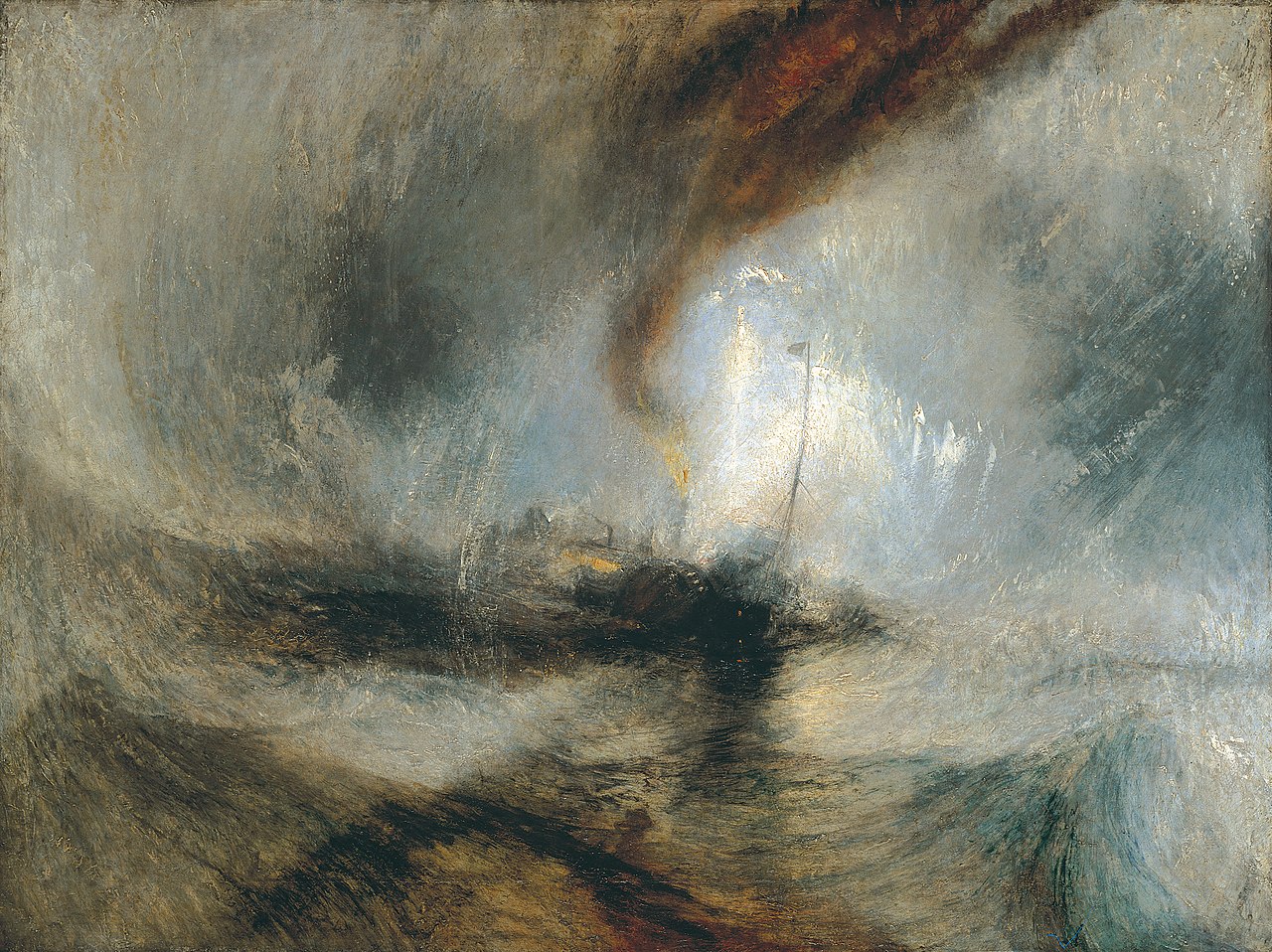
- Snow Storm and several shipwreck scenes — works that confront the viewer with wind, spray and the precariousness of vessels at sea.
Images from different moments of his career illustrate this range: 


Personal life, controversies and legacy
Turner never married but fathered children by a long-term companion, and he maintained a close and at times dependent relationship with his father, who assisted in the studio until his death. As he aged Turner’s manner and appearance became eccentric and his later pictures divided critics: some praised his genius while others derided the looseness of his late technique—satirical remarks suggested his effects could be created with a mop. Despite contemporaneous debate, his last paintings are now widely respected for their daring abstraction of light and color. On his death in Chelsea he left a large bequest of more than 300 oil paintings and thousands of watercolours to the nation, ensuring public access to his work.
Enduring significance
Turner is remembered for transforming British landscape painting into a vehicle for exploring perception, emotion and the sublime forces of nature. His technical experiments in oil and watercolour broadened the language of painting and influenced later artists at home and abroad. He was buried near the distinguished portraitist Sir Joshua Reynolds in St Paul’s Cathedral, a mark of official recognition. Today his paintings are central in major museum collections and continue to be studied for their innovative handling of colour, atmosphere, and the meeting of natural phenomena with human history.
Further reading and resources are available in galleries and archives for those who wish to examine Turner's sketches, travel drawings and written notes. For studies of his technique, exhibitions and conservation history consult institutional catalogues and specialist monographs that trace the development of one of Britain’s most influential painters.
Covent Garden London Chelsea English artist landscape wigmaker watercolour Europe France Switzerland Louvre Paris Venice Italy generalised Claude Lorrain and Poussin fog Impressionists Battle of Trafalgar steam train and bridge Joshua Reynolds St Paul's CathedralQuestions and answers
Q: Who was Joseph Mallord William Turner?
A: Joseph Mallord William Turner was an English painter and artist who is considered one of the greatest landscape painters of all time. He had a great mastery of light and colour, and his works often show ideas that were ahead of their time.
Q: Where did he grow up?
A: Turner grew up in Covent Garden, London with his father who was a maker of wigs and his mother who suffered from mental illness. When he was young, he was sent to live with his uncle in Brentford, West London where he first started to paint.
Q: How old was Turner when he became a student at the Royal Academy of Art school?
A: Turner became a student at the Royal Academy of Art school in London when he was 14 years old. He was accepted into the academy a year later.
Q: What kind of paintings did Turner produce as his personal style developed?
A: As his personal style developed, Turner began to produce paintings that were generalised or exaggerated in form and colour rather than realistic or detailed. These caused much argument as to their artistic value but are now some of his best loved works.
Q: What places did Turner visit during his life?
A: During his life, Turner often travelled across Europe visiting France, Switzerland, Italy (Venice), and Paris (the Louvre).
Q: Who were some artists that influenced him early on in his career? A: In his early career, Turner was influenced by the painters Claude Lorrain and Nicolas Poussin who painted "historical" landscapes.
Q: What are some famous paintings by him? A: Some famous paintings by him include The Fighting Temeraire tugged to her last berth to be broken up; Rain Steam and Speed which shows a steam train crossing a bridge; Snowstorm which shows a steamship in a snowstorm trying to get into harbour; The Shipwreck of the HMS Minotaur; The Eruption of Vesuvius; The Slave Ship or Slavers Throwing overboard the Dead and Dying—Typhoon coming on; Crossing the Brook which is a stunning scenic view of Tamar Valley & River from New Bridge near Gunnislake in Cornwall painted 1815
Author
AlegsaOnline.com J. M. W. Turner: life, art, and influence of an English landscape master Leandro Alegsa
URL: https://en.alegsaonline.com/art/140165