
Bridge: Design, Types, History, and Importance
Overview of bridges: what they are, major types and components, historical development, common uses, and maintenance considerations for civil and military crossings.
Overview
A bridge is a built structure whose purpose is to span an open space or gap to provide a passageway. Bridges commonly cross rivers, valleys, and other roads, and they may serve pedestrians, cyclists, trains and vehicles. Urban highway connections such as highway overpasses are a familiar type that carries a road over another road to separate traffic flows.
Image gallery
10 Images



Basic components and materials
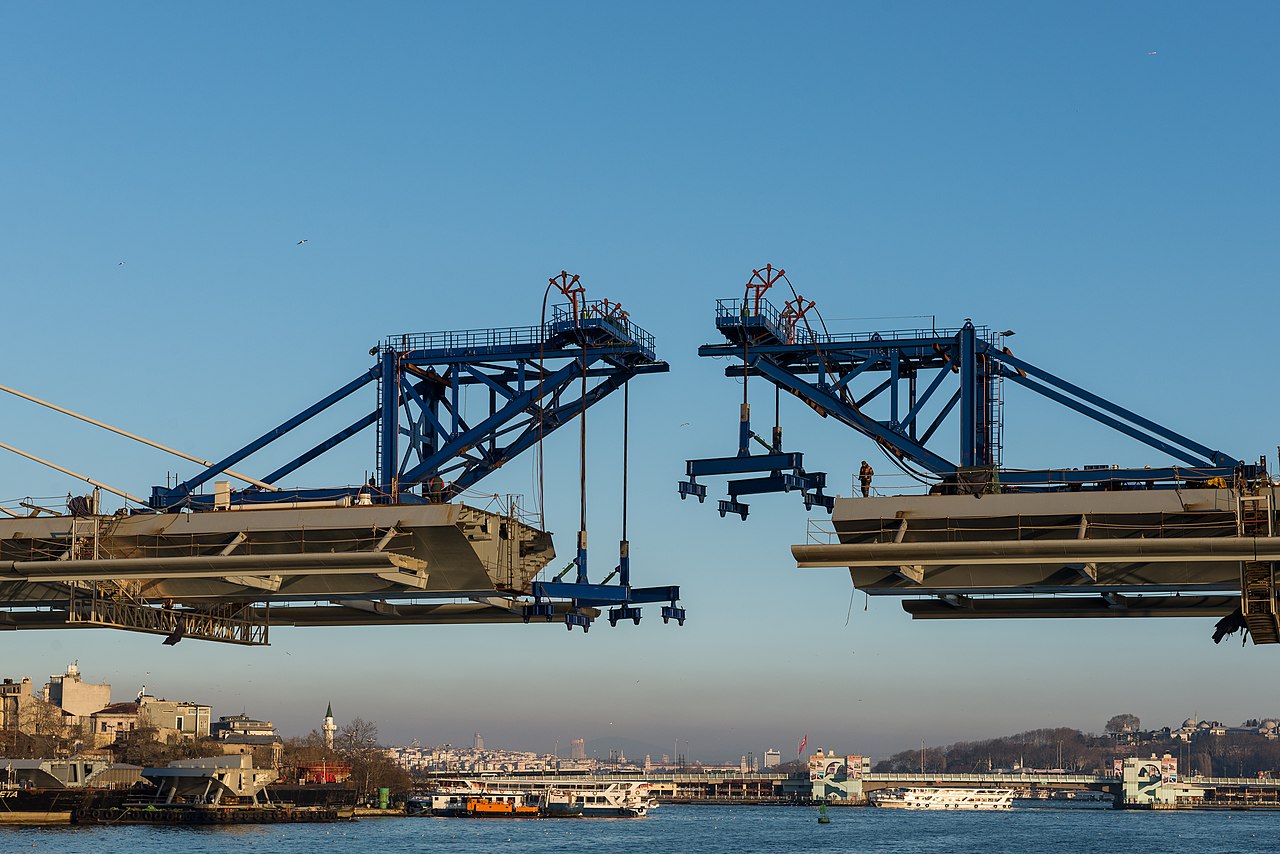
Most bridges share a set of basic parts: the deck (the surface travelled on), spans (the distance between supports), piers or columns, abutments at the ends, foundations below ground, and mechanical elements such as bearings and expansion joints. Materials have evolved from timber, stone and brick to iron, steel and modern reinforced or prestressed concrete. Composite materials and corrosion-resistant alloys are increasingly used for durability and lighter weight.
Principal types
Bridge form depends on span length, load, site conditions and economy. Common structural types include:
- Beam (or girder) bridges: simple spans supported at each end.
- Arch bridges: use compression in a curved form to carry loads to the supports.
- Truss bridges: use a triangulated framework of members for stiffness and efficiency.
- Suspension bridges: carry the deck from cables hung between towers for long spans.
- Cable-stayed bridges: support the deck with cables connected directly to towers.
- Cantilever bridges: built using projecting spans balanced by counterweights or other spans.
- Movable bridges
- Pontoon or floating bridges: rest on buoyant supports for temporary or shallow-water crossings.
Bridges can also be classified by function, from simple pedestrian footbridges to long railway viaducts. Some are designed for military use and are portable so they can be deployed quickly, while others are permanent civilian structures serving cities or highways.
History and development
Early bridges were likely made from felled trees or simple stone crossings. Stone and masonry arch bridges built in antiquity and the medieval period have survived for many centuries, demonstrating the longevity of older techniques. The industrial era brought iron and then steel construction, allowing much longer spans and new forms such as suspension and truss bridges. In the 20th and 21st centuries, advances in materials, computer-aided design and construction methods have produced very long spans and slender, efficient structures; some modern examples are celebrated as engineering landmarks.
Uses, importance and notable considerations
Bridges are vital for transport networks, economic activity and regional integration. They allow the movement of people, goods and services, and sometimes carry utilities such as water mains, gas lines or telecommunication cables. Temporary or emergency bridges are used in disaster relief and military logistics. Because bridges concentrate loads and provide critical connections, their design must consider live loads, environmental effects, wind and seismic forces, and long-term durability.
Maintenance, safety and lifespan
Although some historic stone bridges can last many centuries, modern metal and concrete bridges require ongoing inspection and maintenance to prevent deterioration from corrosion, fatigue and freeze–thaw cycles. Regular inspection, load rating, timely repairs and upgrades—such as seismic retrofitting—are essential to public safety. Budget constraints and aging infrastructure make maintenance a major challenge in many regions, and managing the lifecycle of a bridge is a key part of civil engineering practice.
For further technical details and standards, consult engineering references and authoritative sources: general introduction, material guides such as those covering steel and concrete, and case studies of historic and modern bridges (river crossings, valley viaducts, road overpasses). Additional practical topics include temporary portable bridges used by the military and the differences between civilian and specialized structures.
Questions and answers
Q: What is a bridge?
A: A bridge is a structure designed to cross an open space or gap.
Q: What are bridges mostly made for?
A: Bridges are mostly made for crossing rivers, valleys, or roads.
Q: What are most big bridges made to carry?
A: Most big bridges are made to carry vehicles.
Q: What are highway overpasses?
A: Highway overpasses are bridges that carry a road over another road.
Q: What are military bridges?
A: Military bridges are portable bridges that can be easily moved to where they are needed.
Q: What were the first man-made bridges probably made of?
A: The first man-made bridges were probably made from cut wood or stones.
Q: What are most large bridges made of in recent centuries?
A: In recent centuries, most large bridges are made mostly of steel.
Tags
Related articles
Author
AlegsaOnline.com Bridge: Design, Types, History, and Importance Leandro Alegsa
URL: https://en.alegsaonline.com/art/14069
Sources
- commons.wikimedia.org : Bridges
- usatoday30.usatoday.com : usatoday30.usatoday.com/news/nation/2010-11-22-bridges22_ST_N.htm
- design-technology.org : "Beam bridges"
- arabianbusiness.com : "Dubai to build world's longest arch bridge"
- newton.dep.anl.gov : "Cable Stay vs Suspension Bridges"