
Boric acid (H3BO3): properties, uses, and safety
Boric acid (H3BO3) is a boron-containing weak acid used in antiseptics, preservatives, insecticides, flame retardants and as a neutron absorber; it is toxic and regulated for reproductive effects.
Overview
Boric acid is a simple inorganic compound of boron with the nominal formula H3BO3. It commonly occurs as a white crystalline solid or powder and is slightly soluble in water. Chemically it behaves as a weak acid and forms salts known as borates. The substance is widely used in industry and household products because of its antiseptic, preservative and flame-retardant properties; it is also employed in nuclear reactors as a neutron absorber when dissolved in reactor coolant.
Image gallery
7 Images



Chemistry and physical characteristics
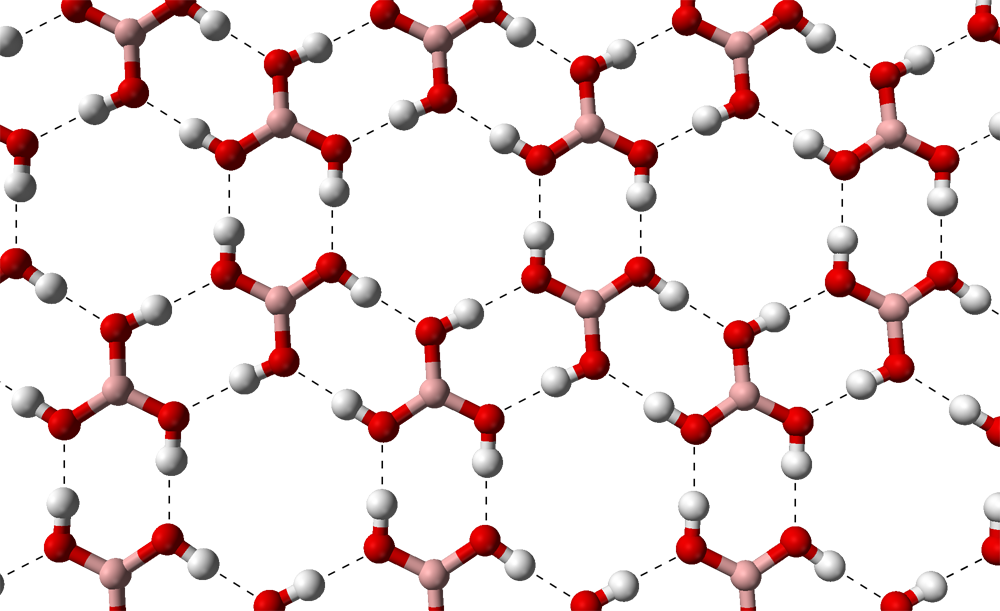
Structurally, boric acid is a boron atom bound to three hydroxyl groups; it can act as a Lewis acid by accepting electron pairs. It typically crystallizes in a layered structure and dehydrates on heating to yield various boron oxides. In aqueous solution, boric acid does not donate a proton in the classical Brønsted sense as readily as mineral acids; instead it accepts hydroxide to form tetrahydroxyborate species. For basic chemical background see boron-centered chemistry summaries.
Production and historical notes
Boric acid is obtained from natural minerals (such as colemanite and kernite), from geothermal brines, and as a by-product of certain glass, enamel and ceramic manufacturing processes. Historically, its antiseptic and preservative uses date back many decades; industrial demand increased with developments in glass, borosilicate materials and flame-retardant formulations. Modern regulatory reviews and industrial applications can be found via chemical authorities and agencies referenced in safety summaries and databases (by-product context, glass, porcelain and enamel links).
Uses and applications
Boric acid has a diverse set of practical applications across consumer, industrial and scientific fields. Common uses include:
- As an antiseptic and mild disinfectant in topical products and first-aid formulations (disinfectant).
- As a preservative and buffering agent in some formulations; it has been assigned the food additive code E284 in contexts where it was historically used.
- As a component of borate glasses, glazes and enamels and as a by-product of their manufacture.
- As a flame retardant additive in some materials and polymers (flame retardant).
- In nuclear power plants, dissolved boric acid serves as a soluble neutron absorber to help control reactivity in pressurized water reactors (neutron absorber).
- As an insecticide and fungicide in agriculture and for household pest control, and in some industrial catalysts.
Safety, toxicity and regulation
Boric acid is toxic if absorbed or ingested in sufficient amounts. Toxicological data indicate that damage and adverse effects can occur at doses on the order of tens of milligrams per kilogram of body weight; for this reason it must be handled cautiously and kept away from infants and pets. Regulatory authorities have evaluated its reproductive effects: under European chemical regulation frameworks (REACH), the compound has been assessed by the European Chemicals Agency and identified as a substance of concern for reproductive toxicity (EU regulatory context; birth defects and teratogen discussions). Some jurisdictions restrict or label products that contain boric acid above defined concentration thresholds; for example, mixtures exceeding a certain percentage are subject to specific hazard classifications and communication requirements.
Practical guidance and notable facts
When used deliberately—whether as a laboratory reagent, in industrial processes, or in household treatments—appropriate personal protective equipment and safe handling procedures should be observed. Manufacturers and users commonly consult material safety data sheets and regulatory listings for up-to-date guidance. Although boric acid has useful applications, its combination of functionality and toxicity has prompted re-evaluation of uses in consumer products and tighter workplace controls in many regions.
For additional technical or regulatory details consult specialized databases and authoritative sources: boron resources, industrial chemical handbooks and regulatory portals listed with official agency links such as REACH and relevant safety notices (EU information). Further summaries and product safety pages are available through product suppliers and occupational health sites (health & disinfectant, borates, E-number, manufacturing, glass, porcelain, flame retardant, nuclear, reproductive, teratogenicity).
Related articles
Author
AlegsaOnline.com Boric acid (H3BO3): properties, uses, and safety Leandro Alegsa
URL: https://en.alegsaonline.com/art/13105