
Year Without a Summer (1816): climatic and social impacts after Tambora
The Year Without a Summer (1816) followed the 1815 Mount Tambora eruption. Volcanic aerosols reduced sunlight, producing widespread cold, crop failures and social upheaval across Europe, North America and Asia.
Overview
The phrase "Year Without a Summer" refers to the unusually cold, wet and sunless conditions experienced across much of the Northern Hemisphere in 1816. The anomaly followed a massive volcanic event: a powerful volcanic eruption on the island then administered as part of the Dutch East Indies. That eruption, at Mount Tambora, injected large quantities of particulate matter and gases into the upper atmosphere and altered weather patterns for months to years afterward.
Image gallery
6 Images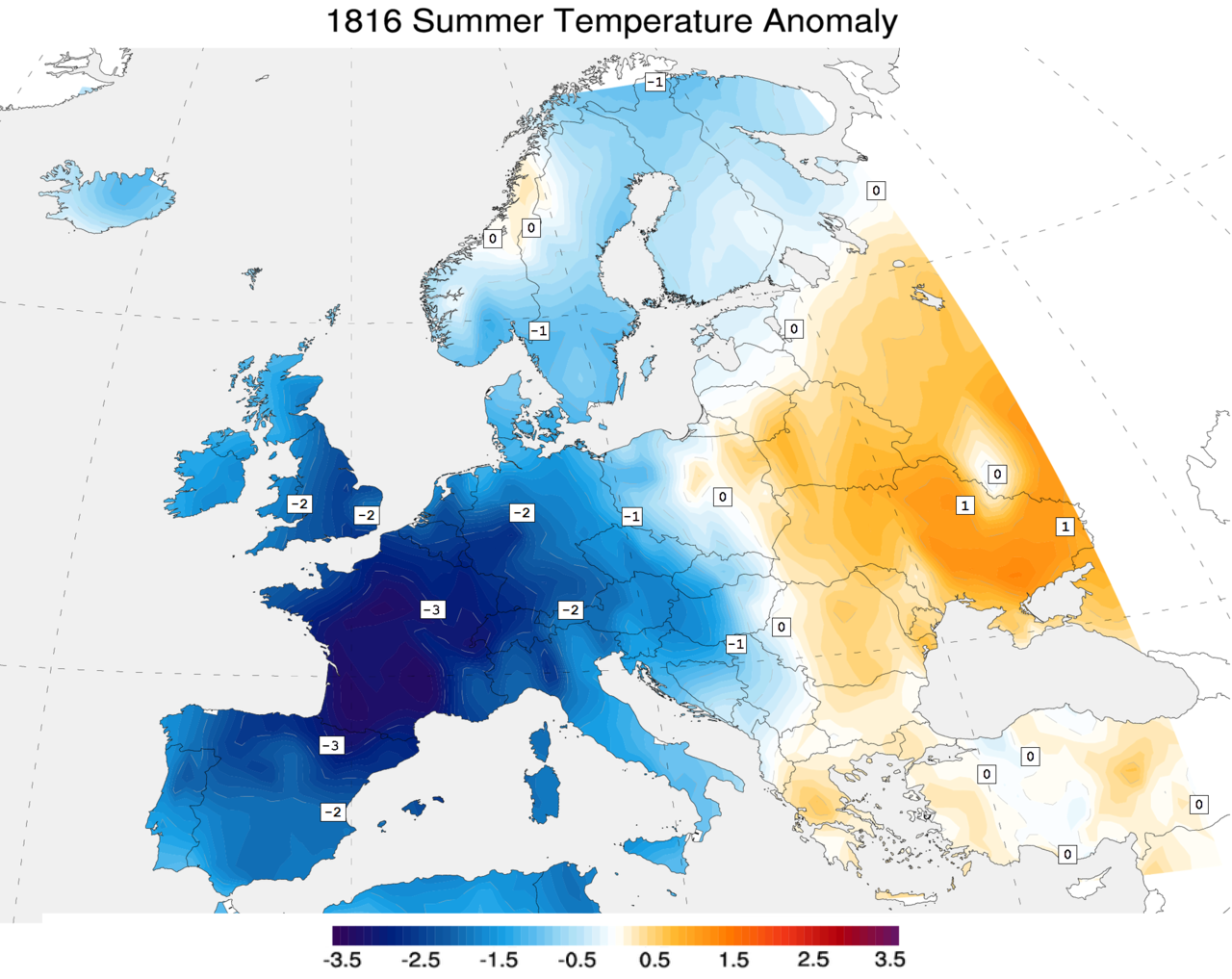



How the eruption changed climate
Fine ash and sulfur-rich gases emitted by the eruption were converted to reflective aerosols in the stratosphere. These particles scattered and absorbed incoming sunlight, reducing surface temperatures and shifting atmospheric circulation. The cooling effect was not uniform: some regions experienced frost and snow in normally warm months, while others endured altered monsoons, droughts or heavy rains.
Regional effects and human consequences
Large parts of Europe and northern North America reported delayed or failed summers. In places such as New England and Germany, contemporaneous accounts recorded frosts, snow and frozen lakes during late spring and early summer. Widespread crop failures, food shortages and higher prices followed; similar agricultural crises also struck regions of China. These conditions contributed to hardship, local famines and movement of populations in search of livelihood.
Notable cultural and historical impacts
The bleak weather of 1816 left marks beyond agriculture. Refugees, poor harvests and economic strain influenced politics and local communities. In Europe, prolonged gloomy conditions coincided with creative gatherings where writers and artists responded to the strange climate — an oft-cited example being the rainy summer in which Mary Shelley conceived her novel "Frankenstein."
Significance for science and society
Mount Tambora is remembered as one of the largest eruptions in recorded history. Its aftermath helped scholars recognize how volcanic aerosols can force short-term global cooling and disrupt weather systems. The episode has since been studied as an early demonstration of climate sensitivity to atmospheric particulates and as a historical case of how environmental shocks affect food security and migration.
Summary and lasting lessons
The Year Without a Summer illustrates the wide-ranging reach of a single major volcanic eruption: atmospheric chemistry, regional climate, agriculture, economy and culture were all affected. Modern monitoring of volcanic emissions and research into climate responses draw on events like 1815–1816 to better prepare for and mitigate comparable disruptions in the future.
- Cause: 1815 eruption of Mount Tambora and global aerosol loading.
- Physical effect: reduced sunlight and cooler average temperatures across the Northern Hemisphere.
- Human impacts: crop failures, food shortages, migration and cultural responses.
- Legacy: important case study for volcanology and climate science.
Related articles
Author
AlegsaOnline.com Year Without a Summer (1816): climatic and social impacts after Tambora Leandro Alegsa
URL: https://en.alegsaonline.com/art/109732