
Wayland the Smith (Weland, Völundr): legendary Germanic smith
Wayland, known in Old Norse as Völundr, is a legendary smith of Germanic tradition. Associated with metalwork, revenge myths, Anglo‑Saxon literature and English place‑names like Wayland's Smithy.
Overview
Wayland (Old English Weland, Old Norse Völundr) is a figure from Germanic legend traditionally described as a master smith and craftsman. Celebrated in medieval poetry and later folklore, he occupies a space between mortal artisan and culture‑hero, associated with skill at forging weapons, jewellery and, in English tradition, even horseshoes. Accounts vary by region and period, but he is consistently portrayed as an unrivalled maker whose story explores themes of captivity, ingenuity and retribution.
Image gallery
6 Images


Legend and themes
In surviving Norse and Anglo‑Saxon sources Wayland appears as a captive artisan who is hamstrung or otherwise restrained by a hostile ruler and forced to work. Several versions recount his escape and his violent revenge against those who wronged him, including striking uses of his smithing skill. These motifs—mastery of craft, bodily mutilation, calculated vengeance and flight—are central to the Wayland tradition and recur in related Germanic tales. The figure sometimes blends with local folklore about skilled metalworkers and mysterious makers of fine objects.
Literary and material sources
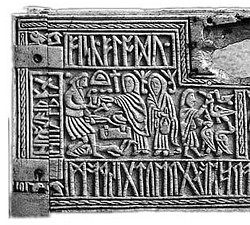
Wayland is attested in a handful of early medieval texts and artifacts. He is named or alluded to in Old English poems such as Deor and appears indirectly in heroic fragments like Waldere; scholars also see echoes of his story in Beowulf and in Old Norse poetry. A celebrated visual representation appears on the Anglo‑Saxon Franks Casket, whose carved panels are widely interpreted as depicting scenes from his legend alongside other stories. Archaeological and toponymic evidence has kept his memory alive in the English landscape and place‑names.
Sites, folk beliefs and place‑names
Wayland's Smithy, a Neolithic long barrow in Oxfordshire, received its name from the Anglo‑Saxons and became linked to late folk beliefs: a traditional tale holds that leaving a horse there overnight with a small silver coin would result in new shoes by morning. Numerous English place‑names and local legends—Wayland Hundred in Norfolk and Wayland Wood, for example—preserve his association with craftsmanship and the land, blending prehistoric monuments with medieval imagination.
Legacy and significance
Wayland endures as a symbol of expert craft and the ambivalent power of technology in early European culture. He appears in later literature, art, and modern adaptations that draw on his image as both creator and avenger. His story offers insight into how medieval societies thought about skilled labour, magic, and justice, and why certain names and sites retained cultural potency long after the poems were first composed.
Further reading and resources
- Overview of Germanic mythology and mythic smiths
- Comparative studies of Wayland/Weland/Völundr
- The role of smiths in early medieval societies
- References to Wayland in Anglo‑Saxon poetry
- Interpretation of the Franks Casket panels
- Archaeology and history of Wayland's Smithy
- Folk traditions connected to burial mounds
- Horse‑shoeing customs in English folklore
- Coins and offerings in folk ritual
- Studies of Anglo‑Saxon place‑names
- Modern retellings and cultural adaptations
Related articles
Author
AlegsaOnline.com Wayland the Smith (Weland, Völundr): legendary Germanic smith Leandro Alegsa
URL: https://en.alegsaonline.com/art/106954
Sources
- homeros.godsong.org : Austin Simmons, The Cipherment of the Franks Casket (PDF)