
Shallow-water waves: behavior, coastal effects, and key characteristics
Waves entering shallow water change shape and speed as the sea floor interferes with particle motion, producing shoaling, breaking surf, coastal erosion and predictable hazards like tsunamis.
Overview
Shallow-water waves occur when ocean waves moving toward the shore enter a zone where the water depth is small compared with the wavelength. As long as the wavelength remains much larger than the local depth the dynamics change from deep-water behavior to depth‑controlled motion. These changes begin when the incoming ocean surface waves interact with the seafloor in the nearshore coastal area.
Image gallery
2 Images
Physical mechanisms and characteristics
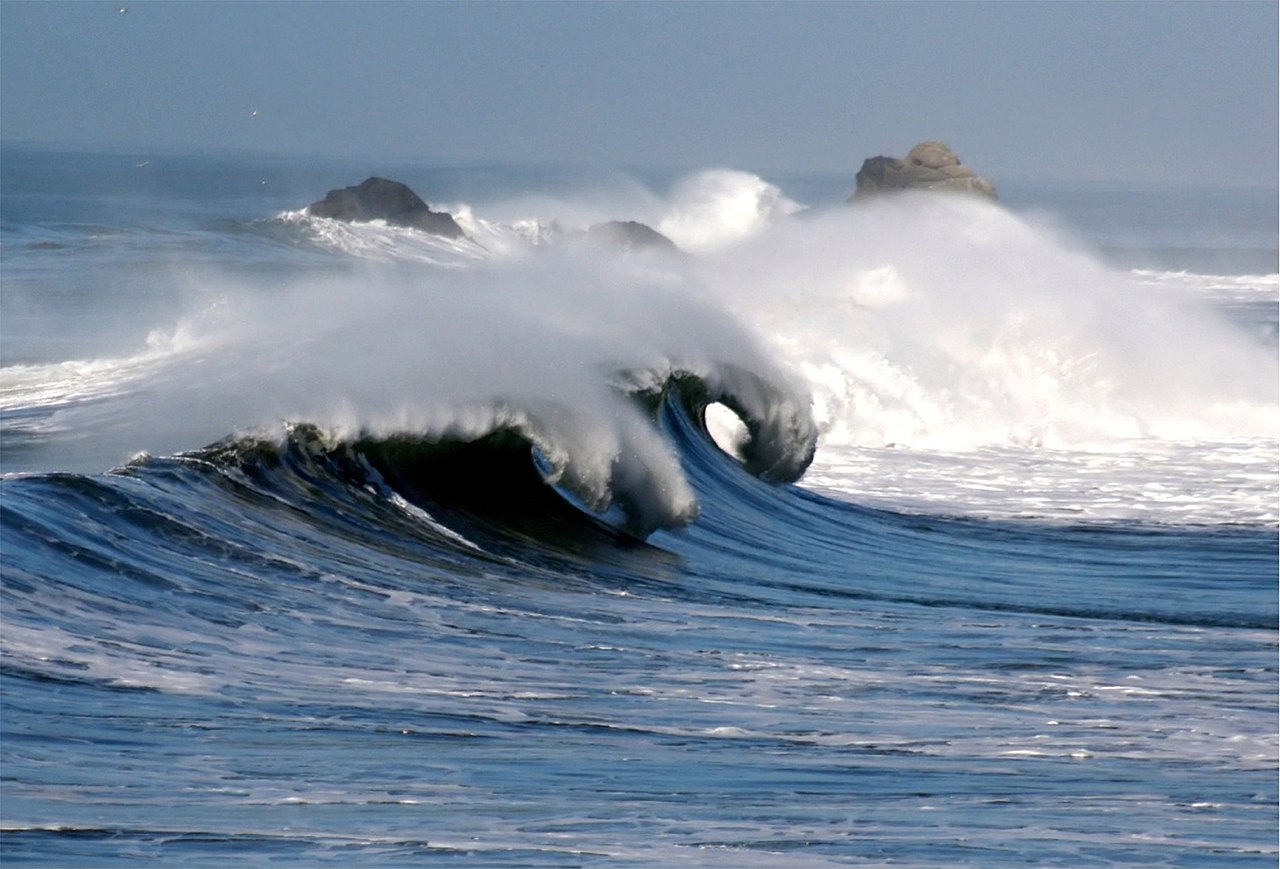
In deep water, water particles move in nearly circular orbits, but when the depth decreases those orbits are flattened and distorted by the bottom. When the wavelength becomes large relative to the water depth, the wave speed, shape and energy distribution are controlled by depth rather than wavelength. This produces shoaling (an increase in wave height), steepening of the wave face, and ultimately breaking. The role of the ocean bottom is central: friction and pressure effects near the seabed modify the flow and transfer momentum to the bed.
Breaking, turbulence and coastal change
Once a wave becomes too steep it breaks, releasing energy in the form of turbulence and strong nearshore currents. The turbulent flow in the surf zone entrains sediments and generates powerful alongshore and offshore motions. These processes accelerate erosion of both seabed and shoreline, reshape beaches, and redistribute sand in ways that can alter coastal morphology over seasons to decades.
Examples, hazards and importance
Shallow-water behavior affects everyday coastal phenomena: the conditions surfers use to ride waves, sediment patterns that determine beach width, and the performance of coastal structures such as breakwaters and jetties. In extreme cases, long-wavelength events such as a tsunami can shoal dramatically as they approach shore, causing a rapid rise in wave height and destructive runup. Understanding shallow-water processes is thus essential for hazard assessment, coastal planning and marine engineering.
Key characteristics and distinctions
- Depth-limited speed: wave celerity depends primarily on water depth in the shallow regime.
- Shoaling: energy concentration raises wave height as depth decreases.
- Refraction and focusing: wave crests bend toward shallower regions, altering energy distribution.
- Breaking types: spilling, plunging, surging—each affects sediment transport differently.
Practical notes
Coastal engineers and scientists use simplified models, observational data and numerical simulation to predict how waves will transform over the nearshore shelf and to design defenses and restoration projects. Effective management balances natural dynamics with human use, recognizing that small changes in seabed slope or coastal structures can have large effects on shallow-water wave behavior and the living shorelines they influence.
For further reading on fundamental wave theory and coastal processes, consult introductory texts and applied references that cover the transition from deep- to shallow-water regimes and the implications for shorelines and infrastructure. Links to authoritative resources may assist in deeper study of specific mechanisms and local case studies: ocean surface waves, coastal area, wavelength, water depth, ocean bottom, erosion and tsunami.
Questions and answers
Q: When do waves at shallow water develop?
A: Waves at shallow water develop when ocean surface waves travel into the coastal area where the wavelength is much larger than the water depth.
Q: How is the circular motion of water particles disrupted in shallow water?
A: The circular motion of water particles in shallow water is disrupted by the ocean bottom.
Q: What happens to the swell on the water surface as the water becomes shallower?
A: As the water becomes shallower, the swell on the water surface becomes higher and steeper.
Q: What happens after a wave breaks in shallow water?
A: After a wave breaks in shallow water, the water flows violently and turbulently, leading to erosion of the ocean bottom and shoreline intensifying dramatically.
Q: What is the most devastating effect that can occur in shallow water?
A: Tsunamis can have the most devastating effect in shallow water.
Q: How does erosion of the ocean bottom and shoreline intensify in shallow water?
A: Erosion of the ocean bottom and shoreline intensifies as a result of violent and turbulent water flow after a wave breaks in shallow water.
Q: What disrupts the normal circular motion of the water particles in shallow water?
A: The ocean bottom disrupts the normal circular motion of the water particles in shallow water.
Related articles
Author
AlegsaOnline.com Shallow-water waves: behavior, coastal effects, and key characteristics Leandro Alegsa
URL: https://en.alegsaonline.com/art/106934
Sources
- commons.wikimedia.org : Ocean surface waves
- highered.mcgraw-hill.com : Exploring the World Ocean. Online LearningCenter