
Warthog (Phacochoerus africanus): an adaptable African pig
Overview of the warthog, a hardy wild pig of sub‑Saharan Africa: appearance, behaviour, range, adaptations to heat and drought, reproduction, ecology and relationship with people.
Warthog (Phacochoerus africanus) is a distinctive wild pig native to much of sub‑Saharan Africa. Recognizable for its facial warts, curved tusks and sparse coat, the warthog is adapted to life on open grasslands and dry savannas. It combines grazing habits with opportunistic foraging and several behavioural and physiological traits that help it survive prolonged dry seasons.
Image gallery
10 Images


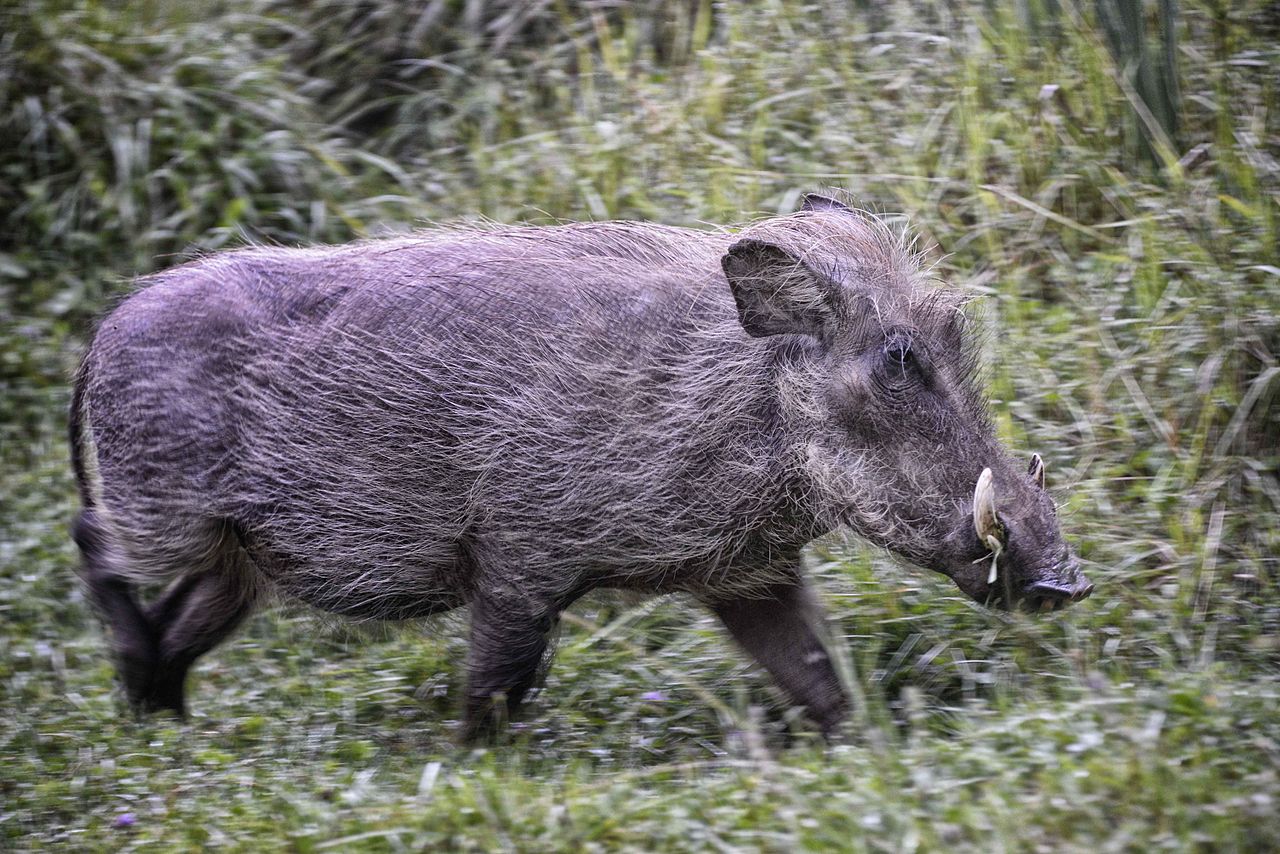
Taxonomy and appearance
Belonging to the pig family, Suidae, warthogs show sexual dimorphism: males are generally larger and have more pronounced tusks and facial swellings than females. The so‑called "warts" are thickened skin pads and bony protuberances that protect the head during fights. Tusks are elongated canine teeth used for digging, display and defence. The body is sparsely haired with a mane along the back; piglets are typically marked with faint stripes when young.
Range and habitat
Warthogs occur across much of Africa south of the Sahara, and are common in regions of East Africa. They occupy grassland, open woodland and savanna and often depend on abandoned burrows made by other species for shelter. Although they prefer areas with seasonal water and grasses, some populations endure lengthy dry periods by using stored body water and behavioural avoidance of midday heat.
Behavior, diet and adaptations
Primarily grazers, warthogs feed on short grasses, roots, bulbs and fallen fruit, and they will take carrion or small animals when available. They use their snouts and lower tusks to excavate roots and bulbs. To reduce water loss in hot conditions they tolerate a higher-than-normal body temperature and rely on behavioural measures such as wallowing when water is available and retreating to shaded burrows during the hottest hours. This kind of heat tolerance is functionally similar to strategies seen in other arid‑adapted mammals such as camels and some desert gazelles.
Social life and reproduction
Social groups, often called sounders, typically include females and their offspring; adult males may be solitary or form small bachelor groups. Courtship and mating occur around resources or inside territories, and females give birth in sheltered burrows to litters of several piglets after a pregnancy that lasts several months. Young are nursed for a period before joining adults in grazing; their early stripes help camouflage them among vegetation.
Predators, defence and survival
Warthogs are preyed upon by large carnivores such as lions, leopards, hyenas and crocodiles. Their primary defences are speed, use of burrows (often entered rear first so the tusks face outward) and aggressive use of tusks when cornered. Their thick facial pads also reduce injury during combat with rivals or predators.
Ecological role and conservation
Warthogs influence grassland dynamics by grazing and digging for tubers, which can aid soil turnover and create microhabitats for other species. They are widely present in protected areas and in many regions are of relatively low conservation concern, although local populations may be affected by habitat change, hunting and competition with livestock. Their presence is important to predators and scavengers, and they are frequently encountered by wildlife tourists and researchers.
Human interactions and notable facts
- Local communities may hunt warthogs for meat, and animals are sometimes kept or tolerated near settlements where compatible with livelihoods.
- Warthogs commonly use burrows excavated by other animals and will plug the entrance with vegetation when resting.
- Facial "warts" are protective structures, not disease symptoms.
- They often adopt a kneeling posture to graze, supported by callused pads on their wrists.
For further general information see regional field guides and conservation summaries; online resources can provide more detailed accounts of behaviour, subspecies and local status in specific countries. References and species assessments are periodically updated as new research becomes available.
Related articles
Author
AlegsaOnline.com Warthog (Phacochoerus africanus): an adaptable African pig Leandro Alegsa
URL: https://en.alegsaonline.com/art/106644