
Weasel (genus Mustela): small carnivores of the Mustelid family
A concise encyclopedic overview of weasels (genus Mustela): traits, species and distribution, behavior, reproduction, relationship with humans, and conservation notes.
Overview
Weasels belong to the genus Mustela, a group of small, active carnivores within the family Mustelidae. The genus includes a range of closely related forms often called weasels, as well as animals commonly known as polecats, stoats, domestic ferrets and some species labeled minks. Their compact, elongated bodies and sharp teeth reflect a hunting lifestyle specialized for catching small vertebrates and invertebrates.
Image gallery
10 Images


Physical characteristics
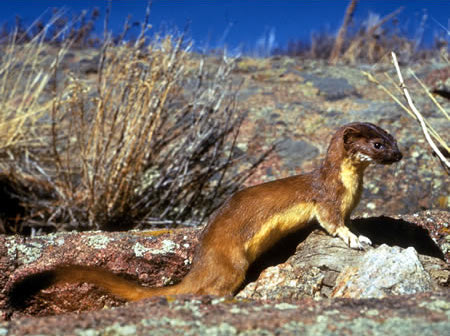
Weasels are typically long and slender with short legs, a flexible spine, and a narrow skull that help them pursue prey into tight spaces such as tunnels and dens. Their fur is usually brown or reddish on the back with a lighter underside; several species undergo seasonal molts, most famously the stoat which turns white in winter (ermine) in colder regions. Smaller species measure roughly 17–22 cm (body length) with tails that add several centimetres; exact sizes vary by species.
Species, range and habitat
Taxonomic treatments differ, but the genus comprises roughly a dozen to around two dozen species depending on classification, with many authorities citing about seventeen distinct species. Members of Mustela inhabit much of the temperate and boreal Northern Hemisphere and parts of the Southern Hemisphere; they are absent from places such as Antarctica and much of Australasia. Typical habitats include woodlands, grasslands, farmland and wetlands where they can access small mammals, birds, eggs and insects and make use of burrows and rock crevices for shelter.
Behaviour and diet
Weasels are primarily solitary and highly active hunters. Their diet focuses on small mammals such as rodents and rabbits, but many species also take birds, amphibians, reptiles, eggs and invertebrates. The slim body shape is adapted to enter burrows and nests (burrows) to reach prey. They rely on acute hearing and smell more than vision, and their metabolism is high, requiring frequent feeding. Some species can take prey larger than themselves by using stealth and tenacity.
Reproduction and lifecycle
Breeding systems vary: many weasels have a single annual litter, while others display delayed implantation—an adaptation that times birth to favourable seasons. Litters range from a few to a dozen or more young, born blind and dependent; juveniles mature quickly and disperse within months. Survival rates depend on food availability, predation and habitat stability.
Relationship with humans and conservation
Humans have long interacted with weasels in several ways. The domestic ferret derives from wild polecat-like ancestors and has been used for hunting, pest control and as a companion animal. Some mustelids have been hunted for fur, prompting trade and regulation. Weasels are sometimes persecuted as poultry predators, yet they also help control rodent pests. Conservation status varies by species: while many are common and adaptable, others face habitat loss, pollution and direct persecution. Despite a superficial resemblance to small cats, they are not felids (cats) but members of a distinct mustelid lineage more closely tied to otters, badgers and similar carnivores.
Notable distinctions and facts
- Appearance: elongated torso and short limbs distinguish weasels from many other small predators.
- Seasonal change: some species develop white winter coats (ermine), useful for camouflage in snow.
- Ecological role: effective predators of rodents, they can influence local small-mammal populations.
- Taxonomy and common names: common names (weasel, stoat, mink, polecat) overlap and vary by region; scientific names clarify relationships (Mustela within Mustelidae).
Questions and answers
Q: What is a weasel?
A: Weasels are small, active predators, part of the Mustela genus, which includes polecats, stoats, ferrets, and minks.
Q: What is the body shape of a weasel adapted for?
A: The body shape of a weasel is adapted to going down burrows after prey such as rabbits.
Q: How many species of weasels are there?
A: There are 17 species of weasels in the world, except for Antarctica and Australasia.
Q: What is the size of a weasel?
A: Weasels vary in length from 173 to 217 mm (6.8 to 8.5 in).
Q: What is the color of a weasel's coat?
A: Weasels have red or brown upper coats and white underneath.
Q: How long is a weasel's tail?
A: A weasel's tail can be from 34 to 52 mm (1.3 to 2.0 in) long.
Q: What is the biological relationship between weasels and cats?
A: Biologically, despite looking a bit like cats, weasels are actually more related to dogs.
Related articles
Author
AlegsaOnline.com Weasel (genus Mustela): small carnivores of the Mustelid family Leandro Alegsa
URL: https://en.alegsaonline.com/art/107034
Sources
- mammal.org.uk : "The Weasel"