
Water beetle
A general overview of water beetles: their appearance, adaptations for aquatic life, main families, life cycle, ecological roles, and conservation concerns.
Overview
Water beetles are a varied group of beetles adapted to live at least part of their life in freshwater habitats. Many species are streamlined swimmers, while others crawl among submerged plants or skim the water surface. They are usually dark in color—black, brown, or greenish—and range considerably in size, from a few millimetres to several centimetres long (roughly 0.08 to 1.57 inches in common descriptions). Aquatic beetles occur in ponds, lakes, marshes, streams and slow rivers worldwide and show a wide range of behaviours and forms.
Image gallery
2 Images
Characteristics and adaptations
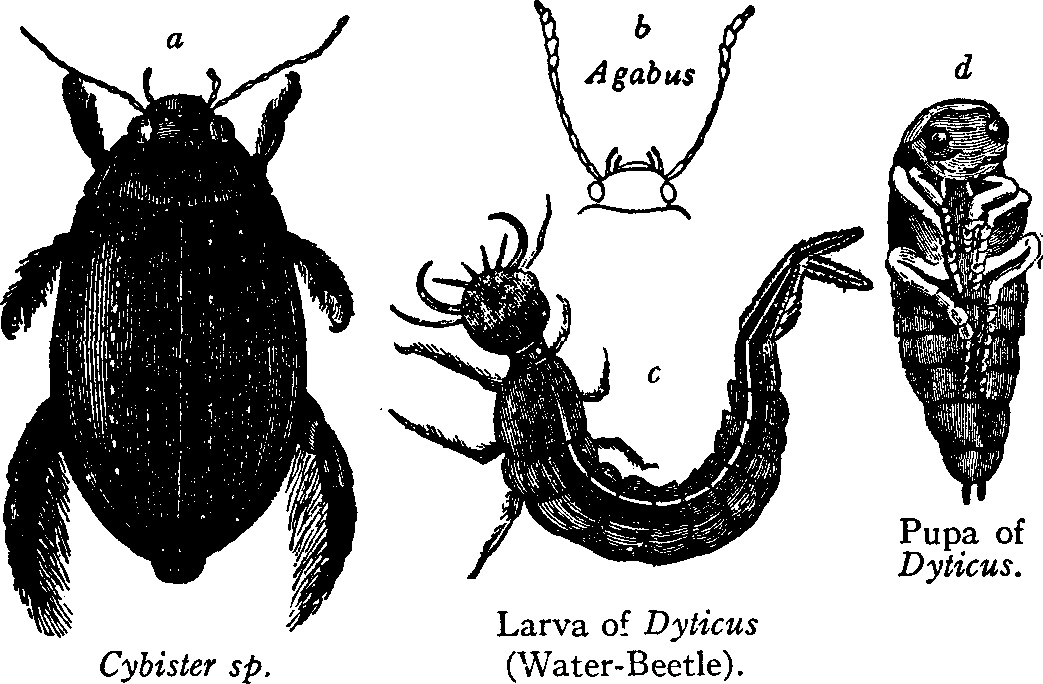
Typical adaptations for life in water include a smooth, hydrodynamic body; hairs that trap air; and modified legs for swimming. Many use a thin film of trapped air beneath the wing cases (elytra) or against their bodies to breathe while submerged. The hind legs of many species are flattened and fringed with hairs to act as paddles. Some species have highly reflective or hydrophobic surfaces that aid movement on the surface film.
Diversity and classification
“Water beetle” is an informal name covering members of several beetle families rather than a single taxonomic group. Well-known families include:
- Gyrinidae — the whirligig beetles, which often swim rapidly in groups and have split eyes for vision above and below the surface: whirligig beetles.
- Dytiscidae — commonly called diving beetles, generally predatory and able swimmers: Dytiscidae.
- Haliplidae — small beetles that often graze algae on submerged vegetation.
- Noteridae and Amphizoidae — groups with more specialized habits, including species associated with cold streams.
- Hydroscaphidae — tiny skiff beetles found in certain wet microhabitats.
Estimates of how many species are known vary; readers can consult classification resources for current counts and regional lists: species and taxonomy.
Life cycle and behaviour
Most water beetles undergo complete metamorphosis: egg, larva, pupa and adult. Larvae are typically aquatic and many are active predators, equipped with strong mandibles for capturing prey. Adults may continue to hunt aquatic invertebrates, scavenge, or feed on plant material depending on the family. Many species can fly and disperse between water bodies, allowing colonisation of temporary pools and recovery after local disturbances.
Ecological role and conservation
Water beetles play important roles in freshwater food webs as predators, prey for fish and birds, and consumers of algae and detritus. Because some species are sensitive to pollution and habitat change, they are used as indicators of water quality. Threats to water beetles include habitat loss, pollution, changes in water management, and the drying of temporary wetlands. Conservation depends on preserving diverse and connected aquatic habitats and maintaining good water quality.
For general information on beetles and related groups see broader references on aquatic insects: beetle overview. More detailed family-level treatments and identification resources are available through regional guides and specialist keys: further reading.
Related articles
Author
AlegsaOnline.com Water beetle Leandro Alegsa
URL: https://en.alegsaonline.com/art/106779
Sources
- publicfiles.dep.state.fl.us : Epler, J. H. 1996. Identification manual for the water beetles of Florida (Coleoptera: Dryopidae, Dytiscidae, Elmidae, Gyrinidae, Haliplidae, Hydraenidae, Hydrophilidae, Noteridae, Psephenidae, Ptilodactylidae, Scirtidae). (PDF, 9.0 MB)