
Warsaw Pact — the Treaty of Friendship, Cooperation and Mutual Assistance
Cold War military alliance of the Soviet Union and Central/Eastern European states (1955–1991), established as a counterweight to NATO and notable for Soviet dominance and the 1968 invasion of Czechoslovakia.
Overview
The Warsaw Pact was the common name for the Treaty of Friendship, Cooperation and Mutual Assistance, a military and political alliance created in 1955 among the Soviet Union and several Central and Eastern European states. Formed after the rearmament and integration of West Germany into NATO, the Pact established collective defense obligations and a unified command intended to coordinate the allied militaries. It served as the principal security framework for the Communist bloc during the Cold War and is often contrasted with non-related agreements such as the Warsaw Convention or the later Treaty of Warsaw (1970).
Image gallery
10 Images




Members and organization
Founding and subsequent members included the Soviet Union and the governments of several Central and Eastern European states that identified with socialist or people’s democratic systems. In practice the Soviet Union (USSR) dominated the alliance politically and militarily, hosting much of the Pact’s command structure and stationing forces across member territories. The more visible member states were the German Democratic Republic (East Germany), Poland, Czechoslovakia, Hungary, Romania, Bulgaria and Albania.
Founding and legal form
The Warsaw Pact was signed in Warsaw in May 1955 as a direct response to developments in Western Europe, particularly the integration of West Germany into NATO. The original treaty texts were produced in several languages, including Russian, Polish, Czech and German, reflecting its multinational nature. The treaty established collective defense provisions and a standing military staff intended to coordinate operations under a unified command led by the Soviet military.
History and key events
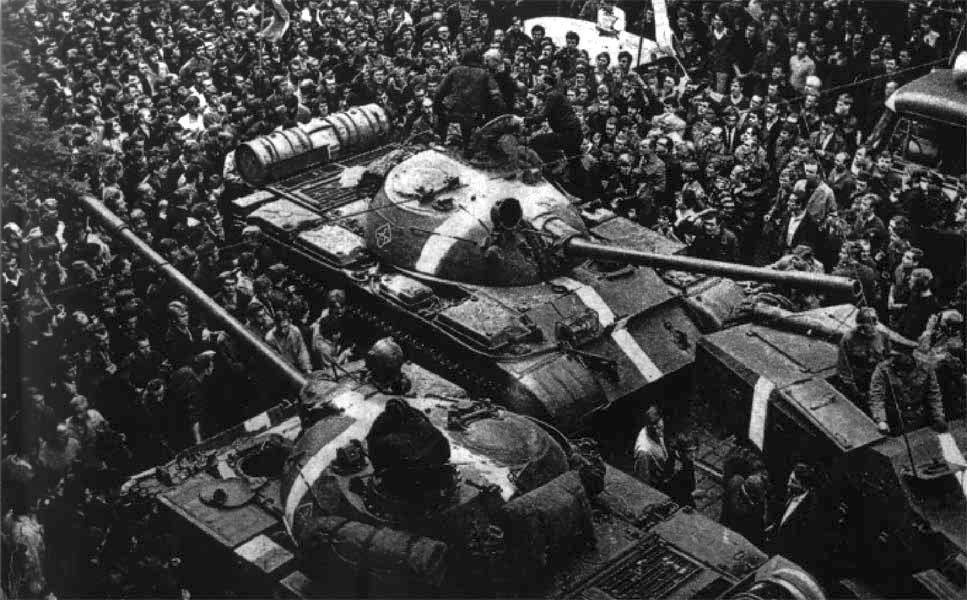
Throughout the Cold War (Cold War) the Pact functioned as the counterpart to NATO and as a mechanism for Moscow to project influence within the Eastern Bloc. It was invoked most controversially in 1968, when Pact forces intervened in Czechoslovakia to suppress political liberalization there. That intervention helped prompt Albania’s formal withdrawal and long-standing distancing in the late 1960s, while Romania remained a member but pursued a more independent foreign policy within the alliance.
Structure, operations and tensions
Although the treaty presented a framework of equal, mutual assistance, decision-making was heavily influenced by Soviet priorities. The Pact maintained joint military staffs, regular exercises, and plans for cross-border operations; Soviet forces were frequently stationed on allied territory. Internal tensions existed over national sovereignty, bilateral relations with Moscow, and responses to domestic uprisings—factors that revealed the limits of the alliance’s stated equality.
Dissolution and legacy
As communist governments in Eastern Europe fell or reformed between 1989 and 1991, the Warsaw Pact rapidly lost its political and military purpose. Member governments began withdrawing or suspending cooperation and the organization ceased effective function; it was formally dissolved in 1991. Historians and political analysts view the Pact as both a stabilizing military alliance for the Soviet bloc and an instrument of Soviet hegemony that helped shape Cold War geopolitics, military doctrine and the postwar order in Europe.
Notable distinctions and references
- The pact is legally distinct from the Warsaw Convention and from bilateral treaties such as the 1970 Treaty of Warsaw.
- It was established in Warsaw as a reaction to NATO expansion involving West Germany.
- Language versions and signatories reflected the multiethnic membership; copies were made in Russian, Polish, Czech and German.
- Its existence spanned much of the Cold War and the rise and fall of the Eastern Bloc.
For more focused studies of national roles, military operations, or the Pact’s legal text see dedicated resources and archival collections that examine the treaty, member state practice, and the events that led to its end.
Central Europe | Eastern Europe | Socialist states | Soviet Union | East Germany | Poland | Czechoslovakia | Hungary | Romania
Poland (host) | Treaty text | West Germany | Russian | Polish | Czech | German | Cold War | Eastern Bloc
Related articles
Author
AlegsaOnline.com Warsaw Pact — the Treaty of Friendship, Cooperation and Mutual Assistance Leandro Alegsa
URL: https://en.alegsaonline.com/art/106629