
Czech language
West Slavic language of about ten million speakers, official in the Czech Republic. Known for a rich case system, three genders, distinctive phonemes and high mutual intelligibility with Slovak.
The Czech language is a West Slavic language spoken primarily in the Czech Republic. It is the official language there and is used in government, education and media. Around ten million people speak Czech natively, and additional learners and diaspora communities maintain the language abroad. Czech is closely related to Slovak and shares many features with other Slavic languages.
Image gallery
10 Images


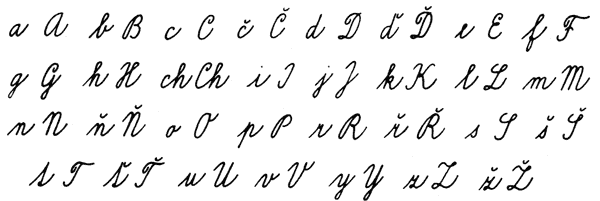

Characteristics and writing system
Czech uses a Latin-based alphabet with diacritical marks (háček and acute accents) to indicate specific sounds and vowel length. Its phonology includes a number of consonant clusters and a characteristic consonant pronounced as ř, which has no direct equivalent in many other languages. The writing system is largely phonemic: spelling closely reflects pronunciation for most words.
Grammar and structure
Grammatically, Czech is a highly inflected language. Nouns decline for seven cases and three grammatical genders (masculine, feminine, neuter), and adjectives, pronouns and numerals agree with nouns in gender, number and case. Verbs conjugate for person, number, tense and aspect; aspect (perfective vs. imperfective) plays a central role in expressing completed versus ongoing actions. Because of this inflectional complexity, sentence meaning is carried by word endings as well as word order.
- Key grammatical features: seven cases, three genders, verbal aspect.
- Notable phonetic features: ř sound, vowel length contrasts, clusters.
- Orthography: Latin script with diacritics and largely phonetic spelling.
History and classification
Czech developed from the common Slavic ancestor and is part of the West Slavic subgroup along with Slovak and Polish. Its written tradition dates back to medieval times; Old Czech and later standardizing movements in the 19th century helped shape the modern literary language. Czech standardization was influenced by efforts to codify grammar, dictionaries and orthography in response to cultural and national revival movements.
Mutual intelligibility and relations
Czech and Slovak are mutually intelligible to a high degree: speakers of each can usually understand the other without studying it, though differences in vocabulary, pronunciation and idiom exist. Czech also shares similarities with other Slavic languages, but grammatical and lexical differences make mutual comprehension less immediate with languages outside the West Slavic group.
Uses, learning and notable facts
Czech is used in everyday communication, literature, broadcast media and administration. It is taught in schools across the Czech Republic and offered at many universities worldwide. For learners, common challenges are the case system and verb aspects, while advantages include relatively regular spelling. The language is sometimes described as more morphologically complex than English; it can also be compared with classical inflected languages in how grammatical roles are marked by endings rather than fixed word order. See references to the Czech Republic for geographic context and to comparative languages for grammar comparisons: country profile, Slovak relation, inflected language examples, English comparison.
Czech is both a living national language and an important part of the Slavic linguistic family, with a rich literary tradition and continuing role in education, culture and public life.
Related articles
Author
AlegsaOnline.com Czech language Leandro Alegsa
URL: https://en.alegsaonline.com/art/24972
Sources
- locallingo.com : "Czech nouns - gender: masculine, feminine, neuter"