
Bengal Presidency: administration, territory and legacy in British India
Major administrative division of British India centered on Calcutta, the Bengal Presidency governed undivided Bengal and at various times included territories now in Bangladesh, India, Pakistan, Myanmar and SE Asia.
Overview
The Bengal Presidency was one of the principal administrative units of British India. Originating in the 18th century with the expansion of the East India Company's power in undivided Bengal, the presidency became a political and economic hub centered on Calcutta (Kolkata). Over the 19th century it evolved from company control to direct Crown administration after the events of the 1850s, and for much of the colonial period it administered a vast and diverse territory.
Image gallery
10 Images





Extent and modern successors
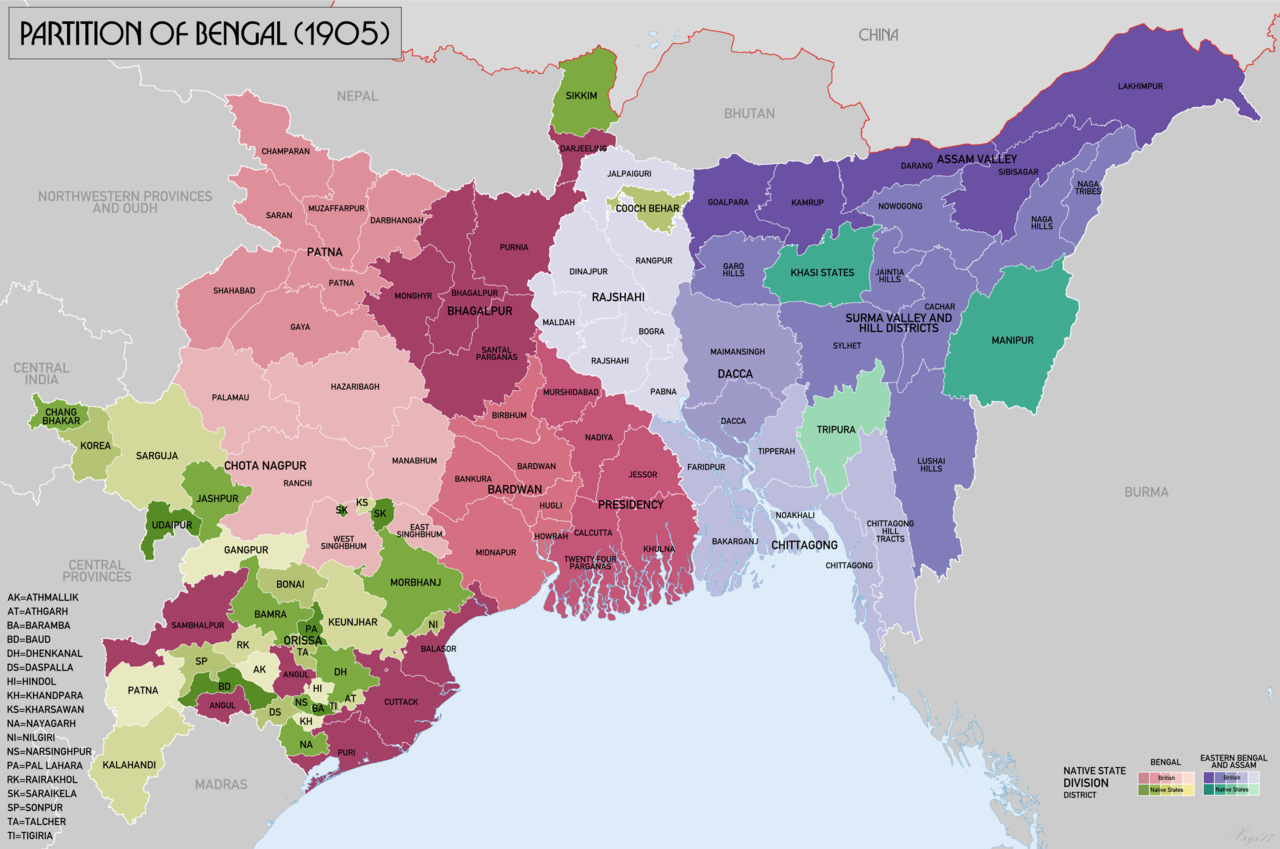
The Presidency's boundaries changed repeatedly. At its core was historic Bengal, but at different times its jurisdiction reached far beyond, covering provinces that later formed parts of modern countries and states. Principal modern equivalents include:
- Bangladesh and the Indian Republic (India) as primary successors of the old Bengal heartland.
- Regions that correspond to today's Indian states such as West Bengal, Assam, Bihar, Meghalaya, the coastal province historically called Orissa (now Odisha), and Tripura.
- Territories later administered from or transferred into other presidencies but once associated with Bengal include parts of Uttar Pradesh, Uttarakhand, Haryana, Himachal Pradesh, and portions of Chhattisgarh, Madhya Pradesh and Maharashtra.
- Some frontier and northwestern districts extended into areas now in Pakistan, including the North-West Frontier and regions of the colonial British Punjab.
- For a time the presidency also administered or oversaw wider imperial outposts, such as Penang (Penang) and Singapore (Singapore), until those settlements were reorganized under separate colonial arrangements in the mid-19th century.
Administration and features
As a presidency, Bengal combined fiscal, judicial and military responsibilities. The Governor (and later Governor-General when the post carried all-India authority) resided in Calcutta and oversaw a layered bureaucracy of district collectors, judges and revenue officers. The region contained major port cities, fertile river deltas, and important trade routes — factors that made it central to colonial revenue extraction and global commerce. The presidency encompassed diverse languages, religions and agrarian systems, from deltaic rice cultivation to upland forested regions.
Historical development
The presidency's institutional origins are tied to the East India Company's consolidation after clashes with local rulers and European rivals. Following military victories and political treaties in the late 18th century, the Company acquired diwani rights (revenue collection) over Bengal and adjacent provinces, establishing a pattern of indirect rule supported by a growing civil service and military presence. The 19th century brought administrative reforms, railroad expansion, and integration into imperial trade networks; after 1858, the British Crown assumed formal control and reorganized many governance structures.
Legacy and significance
The Bengal Presidency left a deep imprint on South Asian political geography, infrastructure, and institutions. Its administrative boundaries helped shape later provincial divisions and influenced patterns of transport, education and law. Urban centers founded or expanded under the presidency became major cities in independent states. The presidency is also central to studies of colonial economy, social change, and the political movements that eventually produced independence and partition. For further reading on specific provinces, administrative reforms and the cultural transformations within the presidency, consult specialized historical sources and archives referenced by modern scholarship.
Notable distinctions
Unlike a modern nation-state, the Bengal Presidency was an administrative construct whose borders shifted according to military, commercial and bureaucratic priorities. It combined both core territories where British presence was continuous and frontier zones with varying degrees of direct control. Its history therefore provides a useful case study of how imperial governance adapted to regional diversity and strategic demands across South and Southeast Asia.
Tags
Related articles
Author
AlegsaOnline.com Bengal Presidency: administration, territory and legacy in British India Leandro Alegsa
URL: https://en.alegsaonline.com/art/10497