
Vertical-lift bridge: design, function, history and examples
Overview of vertical-lift bridges: how they work, principal components, variants, advantages, limits, operation and notable examples with engineering considerations.
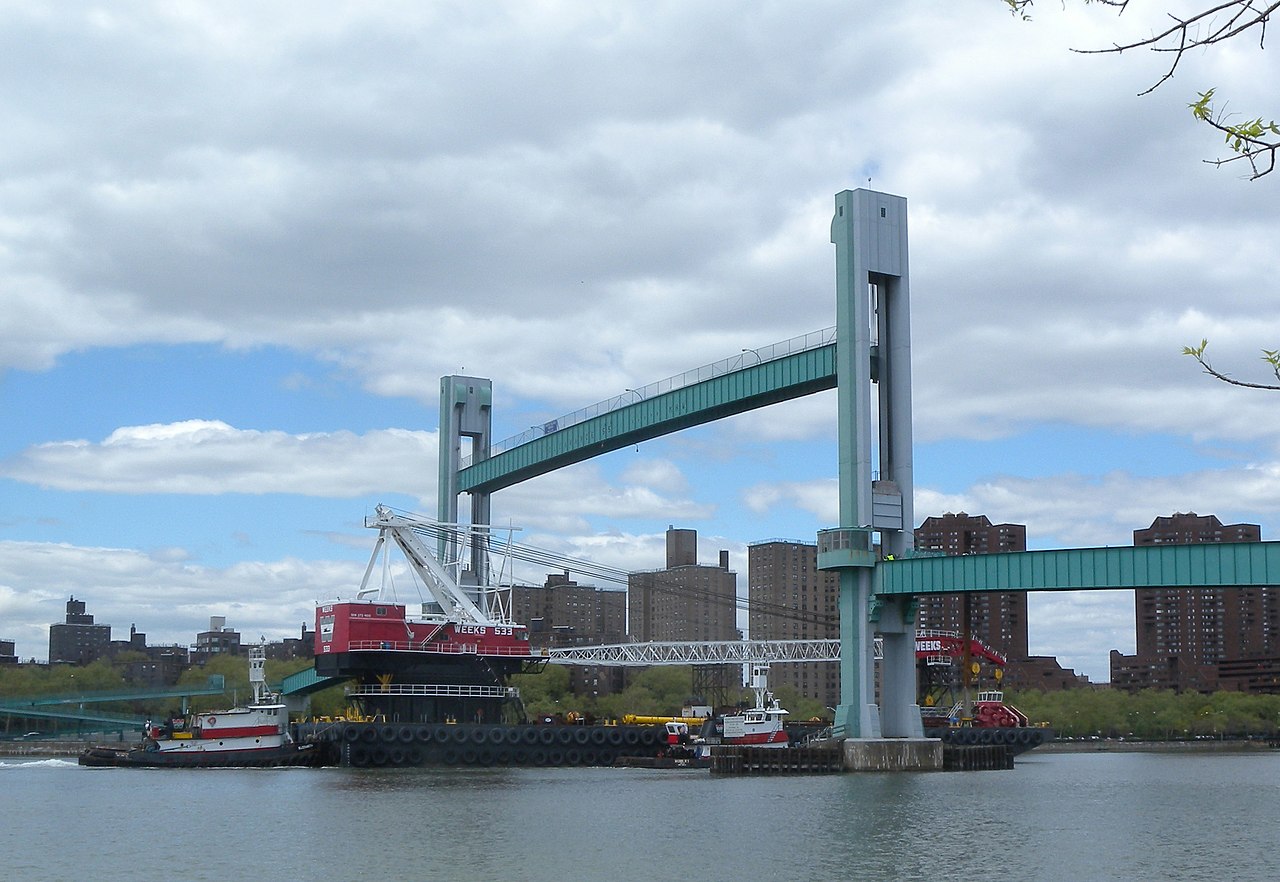
A vertical-lift bridge, often called a lift bridge, is a type of movable bridge in which a central span is raised straight up while remaining parallel to the roadway or track. Unlike bascule bridges that rotate or swing-span bridges that pivot horizontally, a vertical-lift span moves in a vertical path to provide clearance for river, harbor or canal traffic while maintaining a fixed horizontal alignment for vehicles or trains.
Image gallery
10 Images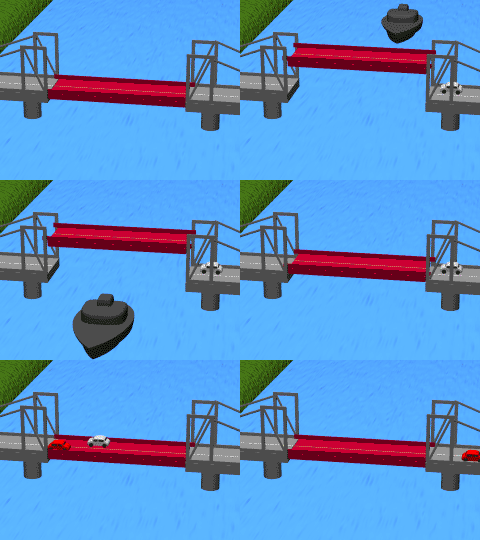




Design and principal components
Typical towered vertical-lift bridges include two towers at the ends of the lift span, wire ropes or chains, sheaves, guide rails and counterweights that balance the deck. The machinery that moves the span — electric motors, gearboxes or hydraulic units — is sized primarily to overcome friction, inertia and wind loads because counterweights offset the static weight of the span. Principal components commonly include:
- Lift towers and tower framing to support travel of counterweights and provide guide rails.
- The lift span or deck, which remains parallel to the road or rail surface in all positions.
- Counterweights sized to balance the deck mass so drive effort is minimized.
- Sheaves, wire ropes or chains that route lifting forces between the deck and counterweights.
- Drive machinery and control systems, including brakes, locks and interlocks that secure the span in place.
Variants and notable mechanisms
While the tower-and-counterweight arrangement is the most common, engineers have developed variants to suit site constraints or span lengths. Alternatives include direct hydraulic lifts beneath a short span, balance-beam hybrids that use pivoting members atop towers, and electrically driven lifts with different cable layouts. For a general overview of movable structures see resources on movable bridge types and on the vertical motion used in movable spans at vertical motion. The parallel movement of the span is a distinguishing feature; see further discussion at parallel-span operation.
Short hydraulic installations have been used where overhead towers are impractical; an example of a short-span hydraulic lift can be found on St Paul Avenue in Milwaukee, cited in studies of municipal movable bridges — see local notes at St Paul Avenue and the regional context at Wisconsin. Balance-beam hybrids that combine bascule-like pivoting beams with vertical lift towers are illustrated by the historic La Salle Street Bridge in Chicago, Illinois and by technical descriptions of balance-beam mechanisms.
Operation, safety and control
Operation of a vertical-lift bridge requires coordinated traffic management for both water and land users. Typical procedures include closing roadway or rail traffic with gates, engaging locks that secure the span at road level, starting the lift sequence, monitoring position sensors, and re-securing the span when lowering. Interlock systems prevent motors from running unless gates are down and locks are released. Navigation aids and markings indicate clearance limits; maritime operators must allow for the reduced maximum height beneath a raised span, so harbor authorities and nautical charts often reference bridge clearance data — see guidance on ship clearance.
Advantages
Vertical-lift bridges offer several practical benefits. Because counterweights only need to match the deck weight, the deck can be made of heavier, more robust materials, which suits railroad use and heavy vehicle loads. The vertical motion is mechanically straightforward and predictable, simplifying control logic and safety interlocks. For longer movable spans they can be more economical and simpler to design than bascule bridges, reducing construction complexity and enabling heavier live loads.
Limitations and operational considerations
The principal drawback is limited vertical clearance under a raised span: the deck hangs above the water and occupies space beneath it, so very tall vessels may still be blocked even when the span is fully lifted. Tower height and surrounding airspace can also constrain operations in urban settings. Wind can impose significant loads on the raised span, and ice, debris or marine growth can interfere with moving parts. For planning and design trade-offs consult technical literature on bridge design and roadway interaction studies at roadway integration.
Maintenance, durability and preservation
Maintenance is essential to reliable operation. Regular inspection and upkeep focus on cables or chains, counterweights and guides, bearings, motors and gearboxes, electrical controls and structural corrosion protection. Historic vertical-lift bridges on active networks are commonly rehabilitated rather than replaced when they are of cultural or operational value. Preservation efforts often involve updating mechanical and electrical systems while retaining original towers and appearance.
History, typical uses and examples
Vertical-lift bridges became prevalent during the late 19th and early 20th centuries as railways and heavy road traffic required movable crossings that could carry substantial loads. They remain common where heavy trains must cross navigable waterways or where a high fixed bridge is impractical for economic, navigational or urban reasons. For comparative discussions of movable-span types and historical development, consult the general references to movable bridges and to the specific mechanical concepts above.
Because these bridges balance robust load capacity with a straightforward lifting principle, they continue to be selected when a durable deck and reliable vertical clearance are required. Technical reports, transportation agency pages and historical registries provide case studies of individual bridges, maintenance programs and adaptive reuse; see municipal and engineering resources referenced above for further detail.
Related articles
Author
AlegsaOnline.com Vertical-lift bridge: design, function, history and examples Leandro Alegsa
URL: https://en.alegsaonline.com/art/104759