
Victoria line
Deep-level London Underground line running between Brixton and Walthamstow Central, opened 1968; noted for automatic operation, hump-backed station profiles and high passenger throughput.
Overview
The Victoria line is a deep‑level tube route on the London Underground system and provides a high‑frequency north‑east to south service between Brixton in south London and Walthamstow Central. Shown on the schematic map with a distinctive light blue band, the line was opened in stages and began full passenger service in 1968. It was planned and built to relieve congestion on central sections of the network and to give fast cross‑city links through major interchanges.
Image gallery
10 Images
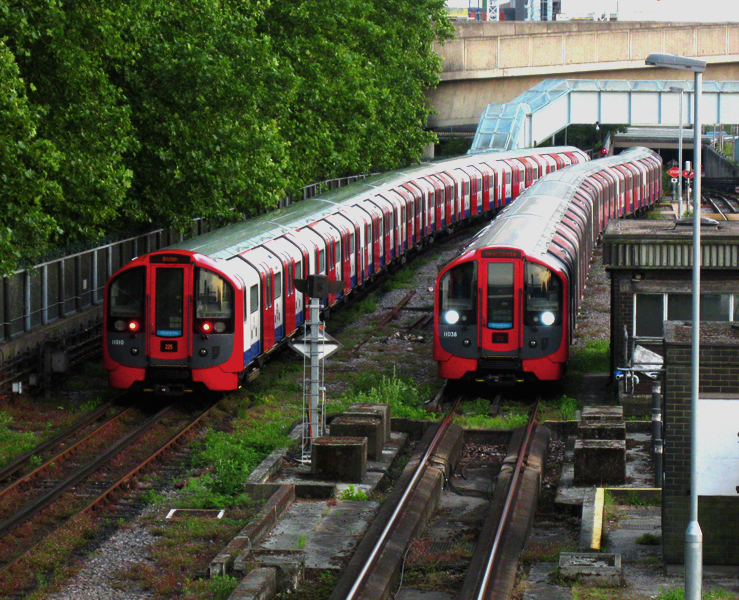


Route and characteristics
The Victoria line is a deep‑level tube, meaning it runs in smaller diameter tunnels beneath the central parts of London; this is highlighted by the line’s description as a deep-level underground route. Apart from a short operational connection that rises briefly when accessing maintenance facilities, the line is entirely below ground—like the two‑stop Waterloo & City line, it has virtually no open‑air running on its passenger route. The only surface section related to the line is the link from Seven Sisters toward the depot at Northumberland Park used for maintenance and storage (depot access).
Design and engineering
When constructed the Victoria line incorporated several engineering features to improve performance and efficiency. Many platforms were built with a slight longitudinal profile often described as "hump‑backed" so arriving trains move gently uphill into stations and depart downhill, allowing gravitational forces to assist braking and acceleration. This use of gradient reduces energy consumption and improves journey times: the design is reported to save around 5% energy and to make services about 9% faster overall. Standard platform lengths were established for the route; each new platform was built to a consistent size (noted in planning documents as 132.6 metres) to accommodate the trains and passenger flows.
History and development
Conceived in the mid‑20th century as part of a program of post‑war transport improvements, the Victoria line was constructed in stages and commissioned for public service in 1968. From its inception it incorporated modern signalling and operational concepts: it was designed to work with automatic train operation and high frequencies to deliver fast, regular services through central London. Over subsequent decades the line has seen upgrades to signalling, rolling stock and stations to maintain reliability and capacity as passenger demand has grown.
Operations, usage and importance
The Victoria line is one of the busiest lines on the network, carrying well over a hundred million passenger journeys per year—commonly cited figures for annual use run to around 200 million passengers in busy years—making it a vital artery for commuters and visitors. It links with numerous other Underground and main‑line services at key interchanges, giving quick cross‑city transfers and reducing pressure on other central routes. Its role in distributing passengers into major hubs and shopping and employment areas underpins its strategic value to the city’s public transport network.
Distinctive facts and practical notes
- The line’s light‑blue colour makes it easy to identify on the schematic Tube map and on station signage where it is shown as separate from adjacent lines.
- Engineering choices such as the hump‑backed platforms exploit the train’s weight and local changes in grade so that gravity assists operations.
- Although mainly underground, the line maintains surface connections for fleet servicing and strategic operation; these are essential to the line’s day‑to‑day functioning and resilience.
Today the Victoria line remains a core element of London’s rapid transit system: a purpose‑built, high‑capacity, mostly subterranean corridor that combines mid‑20th century planning with continuing modernisation to meet contemporary travel needs. For more technical details, service patterns or planning references, consult official transport publications and system maps linked by local transit authorities (further technical notes, design summaries, energy reports, infrastructure data). Additional authoritative resources and historical accounts are available through transport archives and specialist guides (route history, regional context), or general network overviews (line identity, map interpretation).
Questions and answers
Q: What is the Victoria line?
A: The Victoria line is a deep-level underground metro line that runs from Brixton in south London to Walthamstow Central in the north-east, and is part of the London Underground network.
Q: When did it start running?
A: The Victoria line started running in 1968.
Q: What color does it appear on the Tube map?
A: On the Tube map, the Victoria Line appears with a light blue color.
Q: How busy is it compared to other lines on the London Underground network?
A: It is the fourth busiest line on the London Underground network.
Q: Is there any track that comes above ground?
A: Yes, there is one section of track that comes above ground - from Seven Sisters to Northumberland Park - but otherwise all of its track remains underground.
Q: How does this save energy and make trains run faster? A: The stations are built on top of small hills or humps which allow trains to store gravitational potential energy as they arrive and use this energy as they leave, saving 5% energy and making trains run 9% faster.
Q: How long are each new platform built for the Victoria Line? A: Each new platform built for the Victoria Line is 132.6 metres long.
Q: How many people use this line each year? A: Around 200 million people use the Victoria Line each year.
Related articles
Author
AlegsaOnline.com Victoria line Leandro Alegsa
URL: https://en.alegsaonline.com/art/104994
Sources
- tfl.gov.uk : "LU Performance Data Almanac" · web.archive.org
- metronetrail.com : "Northumberland Park Depot" · web.archive.org
- trainweb.org : "Tube Prune - London Underground Statistics"
- withouthotair.com : Sustainable Energy - without the hot air
- lurs.org.uk : "2009 Tube Stock on Track"
- davros.org : "CULG - Victoria Line"
- books.google.com : London's lost railways
- tfl.gov.uk : "Tube Update Plan — Victoria" · web.archive.org
- livis.co.uk : "Victoria Line Platform Humps and RVAR"
- marshalls.co.uk : "Creating Step Free Access for All"