
Vickers Viscount
British four‑engined turboprop airliner introduced after WWII. Noted for a quiet pressurised cabin, widespread airline use in the 1950s–60s, and later stretched/cargo variants such as the Vanguard.
Overview
The Vickers Viscount is a British civil airliner developed after World War II and one of the first successful turboprop airliners. Built by Vickers, it used four turboprop engines and carried roughly 65–75 passengers depending on the model and interior layout. The design emphasised passenger comfort, with a pressurised cabin and comparatively quiet engines for its era.
Image gallery
10 Images



Design and characteristics
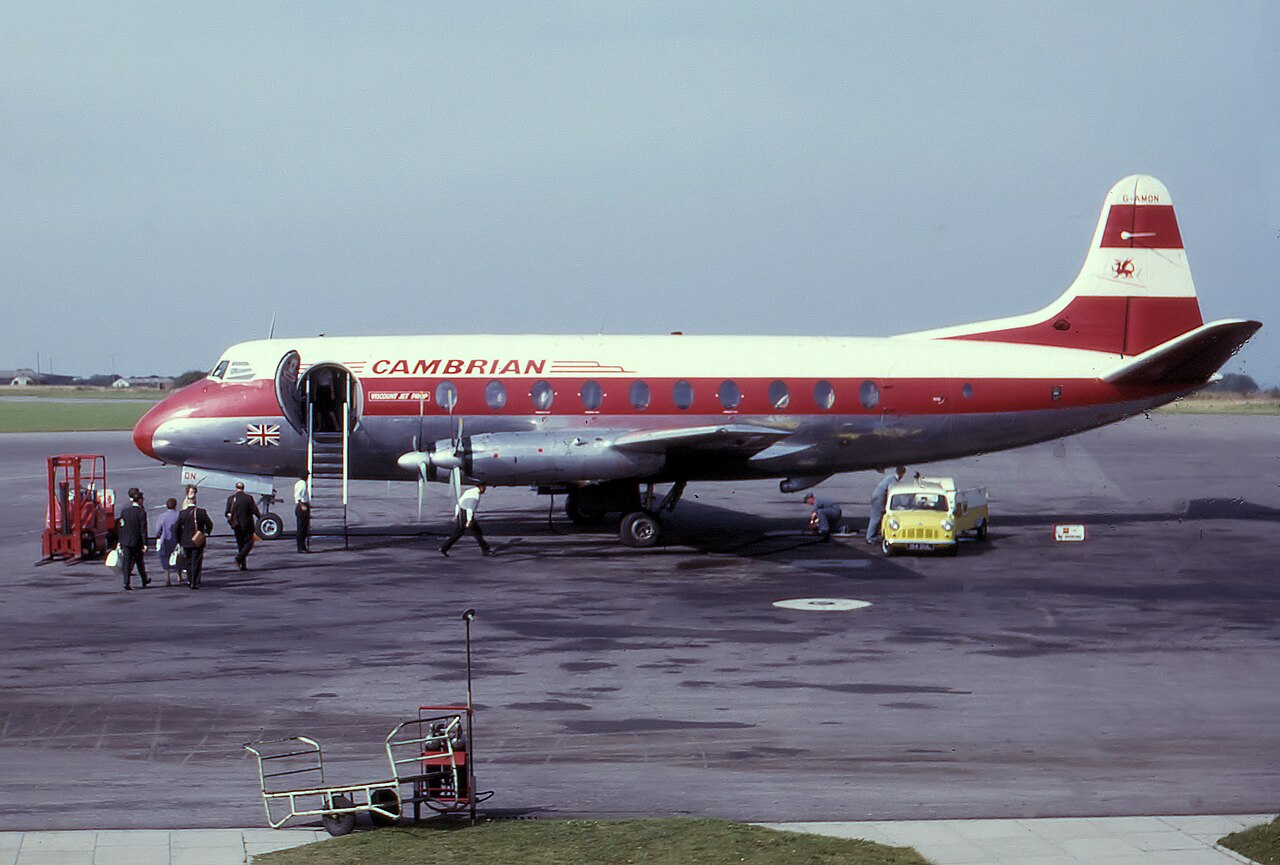
The Viscount combined a conventional low-wing airframe with four turboprop powerplants mounted on the wings. Its engines offered better reliability and lower vibration than contemporary piston‑engined airliners, improving passenger experience and operational economics. Typical features included a pressurised fuselage, multiple cabin windows for natural light, and configurations tailored to short- and medium-haul routes.
Development and variants
Work on the Viscount began in the late 1940s; the type made its first flights during that period and entered airline service in the early 1950s. Vickers produced several subtypes with different weights, ranges and cabin capacities. A later, enlarged derivative intended for higher payloads and cargo use was marketed as the Vanguard, which shared lineage with the Viscount but had a stretched fuselage and other structural changes.
Operators and operational history
The Viscount was adopted by many carriers around the world because of its passenger appeal and economics. Major operators included European and transatlantic airlines of the 1950s and 1960s; notable examples are Air France and BOAC, while airlines in North America also used the type. It flew scheduled passenger services on short- and medium-range routes, and some examples were later converted for freight, executive or military use.
Legacy and notable facts
As one of the first widely used turboprop airliners, the Viscount influenced subsequent regional airliner design and helped establish turboprops as practical airliner powerplants. Its quieter cabin and pressurisation made it popular with travelers in its day. The family spawned derivatives and saw diverse roles beyond passenger transport, contributing to its long service career with a variety of operators.
Further reading and resources
- Technical overview and specifications
- Development history and design notes
- Engine and performance details
- Civil and military variants
- Passenger capacity and cabin arrangements
- Operational roles and airline use
- Vanguard and cargo-stretched derivatives
- Air France historical operations
- BOAC and British airline operators
- North American operators such as United Airlines
- Global list of Viscount operators
Related articles
Author
AlegsaOnline.com Vickers Viscount Leandro Alegsa
URL: https://en.alegsaonline.com/art/104929