
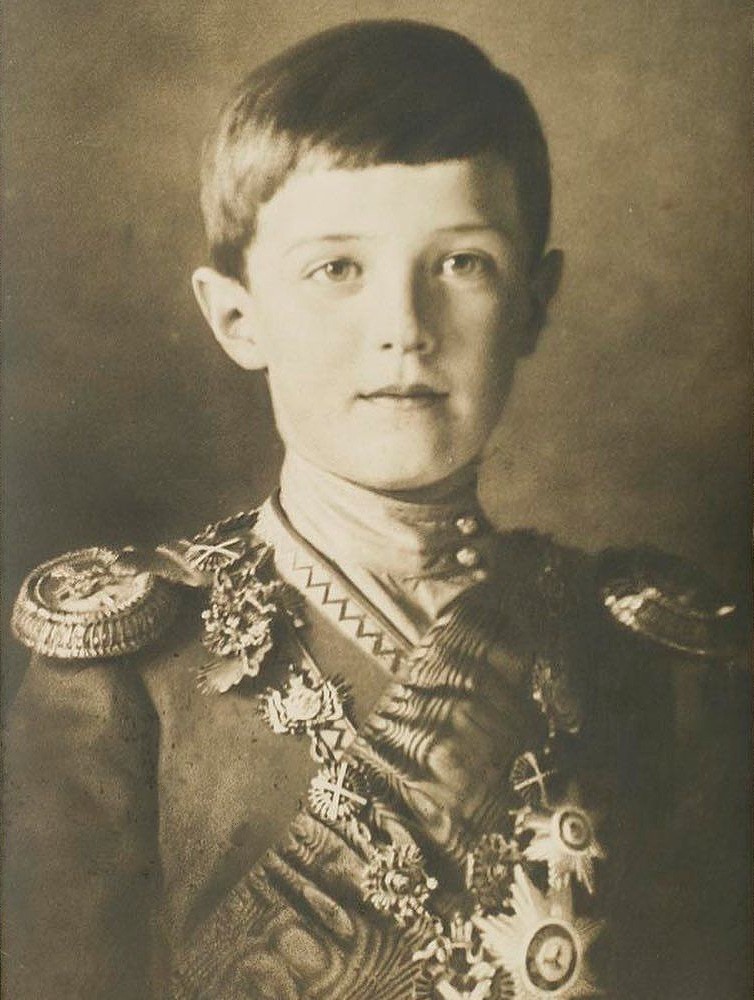
Tsarevich Alexei Nikolaevich of Russia (1904–1918)
Only son and heir of Nicholas II, remembered for his hemophilia, the family's final years during the Russian revolutions, their execution in 1918, and later canonization and identification of remains.
Tsarevich Alexei Nikolaevich Romanov (12 August 1904 – 17 July 1918) was the only son and heir apparent of Emperor Nicholas II and Empress Alexandra of Russia. As tsarevich he was the designated successor to the Russian throne and would have taken the regnal name Alexei II had the monarchy continued. He grew up in the closing years of imperial Russia and his brief life was shaped both by intimate family circumstances and by the political crisis that led to the end of Romanov rule.
Image gallery
9 Images



Early life and family
Born at the Alexander Palace in Tsarskoye Selo, Alexei was the youngest of five children. His four older sisters—Olga, Tatiana, Maria and Anastasia—were close companions during his childhood. Contemporary memoirs and letters describe a warm domestic atmosphere within the imperial household, though much of the family’s life was private and conducted under rigid court routines. The tsarevich received tutoring appropriate to his rank but, because of his health, had a more sheltered upbringing than many royal heirs.
Hemophilia and its consequences
Alexei suffered from hemophilia, an inherited bleeding disorder that made physical injuries and internal bleeding particularly dangerous. The condition was transmitted through his mother, Alexandra, whose maternal ancestry linked to the British royal family; historically the disorder in several European royal houses has been associated with Queen Victoria. Alexei’s illness affected daily life: family members and servants learned to avoid jostling him, and his episodes of bleeding prompted urgent medical attention. In an era before modern clotting-factor therapies, treatment options were limited and often experimental.
Rasputin and public controversy
The Romanov family’s reliance on unconventional advisors during crises, most famously the Siberian peasant and mystic Grigori Rasputin, became a focal point for public rumor and political criticism. Some contemporaries credited Rasputin with easing Alexei’s bleeding episodes, while others accused him of undue influence over the imperial household. Historians continue to debate Rasputin’s precise medical role and the extent to which perceptions about his influence contributed to erosion of public confidence in the monarchy.
World War I and the fall of the monarchy
World War I placed enormous strains on Russian society and on the imperial family. Nicholas II’s decision to take personal command of the armed forces in 1915 further complicated public perceptions of leadership. In March 1917, amidst popular unrest and political collapse known as the February Revolution, Nicholas II abdicated. He initially named Alexei as his successor but then renounced the throne on behalf of both himself and his son, effectively ending more than three centuries of Romanov rule.
House arrest, exile and execution
After abdication, the former imperial family was placed under house arrest and later moved to Tobolsk in Siberia and then to Yekaterinburg. On the night of 16–17 July 1918, Alexei and his immediate family were executed by Bolshevik forces in the Ipatiev House in Yekaterinburg. The killings and subsequent disposal of the bodies were long shrouded in secrecy; for decades their exact fate and burial place were uncertain, generating persistent public interest and research.
Discovery and identification of remains
Remains believed to be those of the imperial family were recovered in the 1990s, and additional remains discovered later were subjected to forensic and DNA analysis. Scientific studies, including comparisons with living maternal-line relatives, led to a high degree of confidence that the remains were those of Nicholas II, Alexandra and most of their children. The discoveries closed many questions about the family’s fate, though some forensic and historical debates about details have continued.
Canonization and legacy
In 2000 the Russian Orthodox Church canonized the family as passion-bearers, honoring their pious endurance in suffering; this act reflected a religious and cultural response to their story rather than a political vindication of the imperial regime. The Romanovs, and Alexei in particular, have remained subjects of books, films and exhibitions. Alexei’s life is often discussed in studies of royal medicine, the social impact of hemophilia, and the human dimensions of political collapse.
Historical perspective
Alexei’s short life intersects medical history and high politics. While his illness had personal consequences for the family, historians caution against simplistic causal links between private medical matters and major political events. Instead, Alexei’s story is usually presented as one thread—important but not solely determinative—within the larger tapestry of early twentieth-century Russian history.
Further reading and sources
- Biography and early life
- Title and succession
- Russia before the revolutions
- The Russian Revolution overview
- The institution of the Tsar
- Nicholas II: life and reign
- Olga Nikolaevna
- Tatiana Nikolaevna
- Maria Nikolaevna
- Anastasia Nikolaevna
- Hemophilia: medical background
- Genetic inheritance in royal lines
- Connection to Queen Victoria
- Abdication documents
- The murders in Yekaterinburg
- Grigori Rasputin
- Rasputin: biography and controversy
- Canonization by the Russian Orthodox Church
- Russian Orthodox Church resources
- DNA testing and identification of remains
Related articles
Author
AlegsaOnline.com Tsarevich Alexei Nikolaevich of Russia (1904–1918) Leandro Alegsa
URL: https://en.alegsaonline.com/art/101858