
Tournament — formats, history, and organisation
A tournament is an organised series of competitive matches or events, held in various formats (knockout, round-robin, Swiss, league). This article explains types, structure, history, uses and distinctions.
A tournament is an organised sequence of contests in which a group of competitors—individuals or teams—compete according to a defined schedule and rules. Modern tournaments appear across sports, board and card games, combat disciplines and intellectual contests. The term itself traces back to medieval jousting and mêlées but now applies to anything from local club events to global championships and multi-week festivals. For a basic overview of competition formats see competition.
Image gallery
1 Image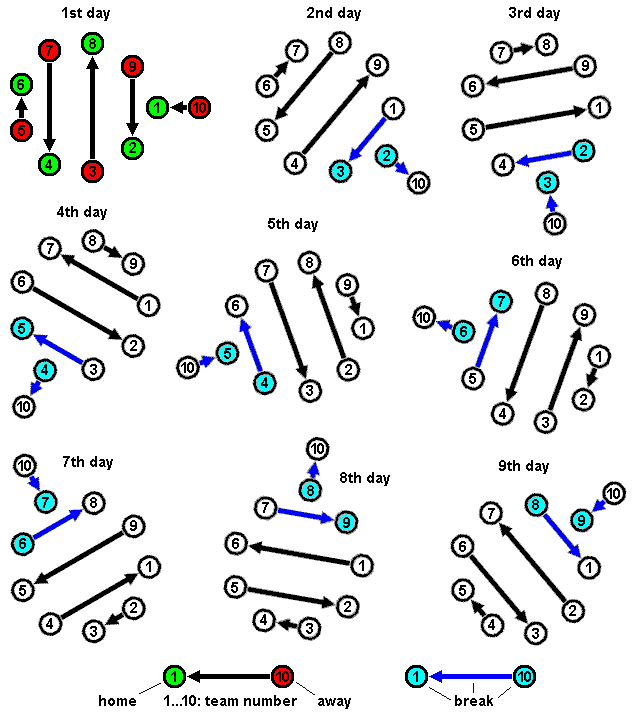
Common formats and structures
Tournaments take many shapes depending on goals such as finding a single champion, ranking participants, or giving every entrant multiple games. Typical formats include:
- Single-elimination (knockout): Losers are eliminated after a single loss; efficient for producing a winner from many entrants.
- Double-elimination: Competitors have a second chance via a losers' bracket.
- Round-robin (league): Every entrant faces all others; common in team sports and leagues.
- Swiss system: Players with similar records meet each round; often used in chess and large amateur events.
- Pool or group play: Entrants are divided into groups with internal round-robin play, followed by a knockout stage.
Format choice affects scheduling, fairness, spectator interest and commercial viability. Some events, like many golf tournaments, are staged at a single venue over a few days, while others—such as national football leagues—are spread across locations and months.
Organisation, rules and components
Well-run tournaments rely on clear rules, seeding or ranking systems, match officials, scheduling and tie-break procedures. Time controls and equipment standards are crucial in chess (chess) and board competitions, while referees and medical staff are central in contact sports. Tournaments also appear in non-physical contests: card competitions (card games), board gaming (board games), debating (competitive debating) and electronic sports.
History and evolution
Originally, medieval tournaments were martial spectacles combining training and pageantry. Over centuries they evolved into codified sporting events. The rise of clubs, governing bodies and mass media in the 19th and 20th centuries professionalised tournament play and standardized formats across disciplines. Today large-scale tournaments range from regional amateur meets to internationally televised competitions such as the lawn tennis championships (Wimbledon).
Uses, examples and notable distinctions
Tournaments serve several functions: they determine champions, rank players, qualify entrants for higher levels, promote a sport or game, and create spectator spectacles. Different sports emphasise different models—combat sports (combat sports) often use elimination brackets, while many clubs promote players through leagues and ladder systems. Organisations that run tournaments—clubs, federations and commercial promoters—may follow distinct objectives from grassroots development to broadcast revenue.
Key distinctions
- Tournament vs league: A tournament is typically a contained event over a short period or a staged set of matches; a league usually denotes a season-long competition with home-and-away fixtures.
- Event-based vs match-based definition: Some definitions emphasise a single-site event, others the aggregation of many small matches into a larger competition.
- Amateur vs professional: Scales and stakes differ, but organisational principles—rules, scheduling and adjudication—remain similar across levels.
For further reading about specific sports, formats or organisational practice see resources on sports, games and governing bodies that oversee tournament rules.
Related articles
Author
AlegsaOnline.com Tournament — formats, history, and organisation Leandro Alegsa
URL: https://en.alegsaonline.com/art/100889