
Chess: rules, pieces, history, strategy and competitive play
Chess is a two-player strategic board game played on 64 squares. This article explains the pieces, rules, history, common strategies, and how modern competition and technology shape the game.
Overview
Chess is a two-player strategy board game played on a square board of 64 alternating light and dark squares. Each side controls sixteen pieces arranged on the two rows nearest them; the objective is to checkmate the opponent's king, a position in which the king is threatened with capture and no legal move can remove the threat. Players alternate turns, and the side with the light-colored pieces (White) moves first — a small initiative that affects practical play and statistical outcomes (White's advantage).
Image gallery
10 Images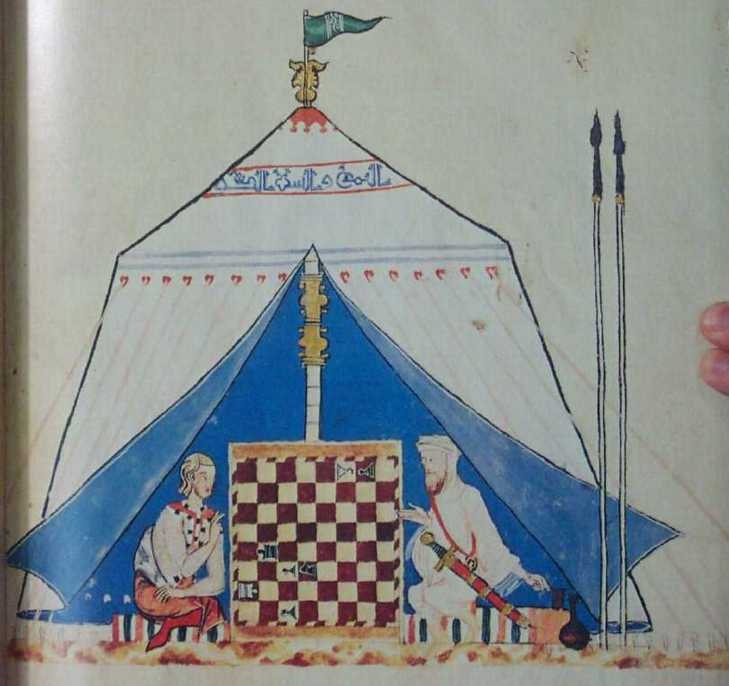




Pieces and movement
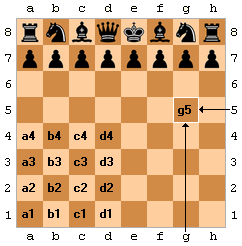
Each player begins with the same set of sixteen pieces: eight pawns, two knights, two bishops, two rooks, one queen and one king. The pieces have distinct patterns of movement and capture; pawns advance forward and capture diagonally, knights move in an L-shape, bishops travel along diagonals, rooks along ranks and files, the queen combines rook and bishop movement, and the king moves one square in any direction. Captured pieces are removed from the board. A concise reference for the playing surface is often given simply as the board.
Rules, objectives and outcomes
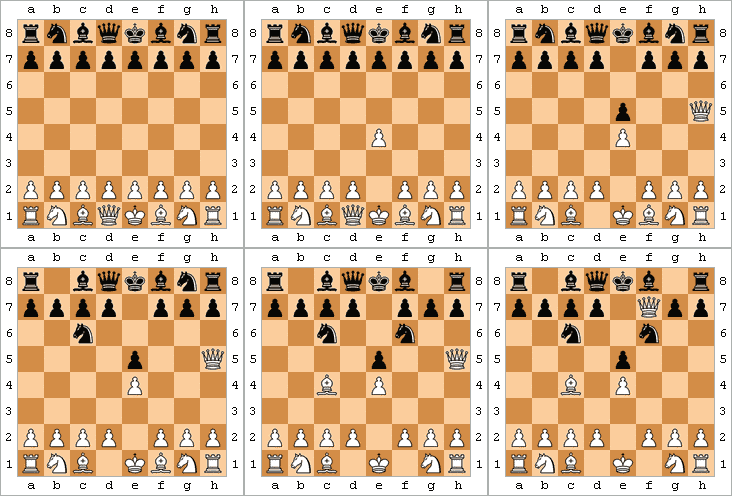
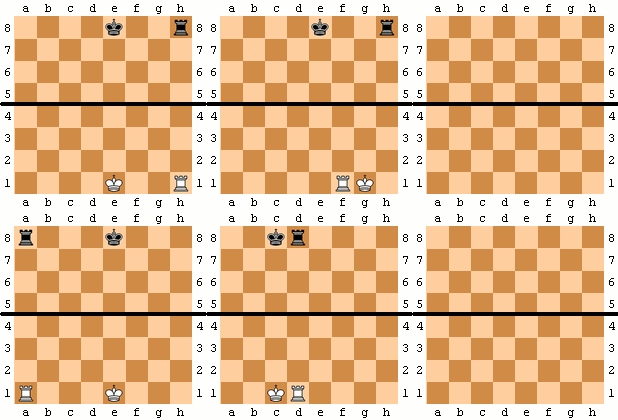
The principal goal is checkmate, but games can also end in draw by agreement or by specific rules such as stalemate, threefold repetition, or the fifty-move rule. Special moves include castling (a joint king-and-rook move to improve king safety) and pawn promotion (a pawn that reaches the far rank may promote, usually to a queen). Players use turns to develop pieces, control key squares, and coordinate attacks while protecting their own king. The set of pieces and legal moves together form the game's basic mechanics (pieces).
History and development
Chess evolved from early strategy games in South Asia and the Middle East. Its ancestor, often called chaturanga, appeared in the early medieval period; over centuries the rules transformed into the modern form widely established in Europe by the late medieval and early modern eras. Standardized piece design and tournament rules emerged later, and organized competitive play became global in the modern era. For more on the game's cultural background see sources about its spread and evolution (history).
Strategy, study and competition
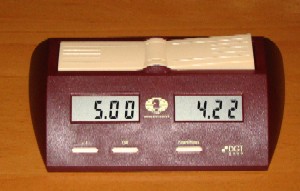
Players commonly divide a game into opening, middlegame and endgame phases. Openings emphasize rapid development and central control; middlegames revolve around tactics and long-term plans; endgames focus on the precise use of a few pieces. Competitive chess is structured into tournaments and matches of varying time controls; professional events and rating systems shape player careers (tournaments). Modern analysis relies heavily on databases and engines, and computer programs have reshaped preparation and evaluation in recent decades.
Global reach and notable facts
- Chess enjoys worldwide popularity and organized play in clubs, schools and online platforms; some countries have deep cultural ties to the game, including strong traditions in places such as Russia, among many others.
- Common instructional topics include tactics (pins, forks, discovered attacks), strategic themes (pawn structure, weak squares) and endgame technique.
- Resources for learning and reference include dedicated rule guides and introductory material on the board, specific piece behaviour (pawns, knights, bishops, rooks, queen, king) and historical summaries (history).
For concise rule descriptions, introductory lessons and tournament information, consult trusted chess guides and organizational pages (pieces, statistics, events).
Questions and answers
Q: What is chess?
A: Chess is a board game for two players.
Q: What is the goal of the game of chess?
A: The goal of the game is for each player to try and checkmate the king of the opponent.
Q: How many pieces does each player start with in chess?
A: Each player starts with sixteen pieces: eight pawns, two knights, two bishops, two rooks, one queen and one king.
Q: What is checkmate in chess?
A: Checkmate is a threat ('check') to the opposing king which no move can stop. It ends the game.
Q: How do the two opponents take turns in chess?
A: During the game, the two opponents take turns to move one of their pieces to a different square of the board.
Q: Who makes the first move in chess?
A: The player with white pieces always makes the first move.
Q: Where is chess popular and considered a national hobby?
A: Chess is enjoyed in many countries, and is a national hobby in Russia.
Related articles
Author
AlegsaOnline.com Chess: rules, pieces, history, strategy and competitive play Leandro Alegsa
URL: https://en.alegsaonline.com/art/19345
Sources
- fide.com : "Laws of Chess"
- chessgames.com : "Chess Opening Explorer"
- chesslab.com : "Chess [[wikt:basic|Basics]]"
- gamesinfodepot.com : "Chess Moves - How chess pieces move - chess piece movements"
- chesscentral.com : "Checkmate in Chess"
- chesscorner.com : "Castling, by Chess Corner"
- helium.com : "Chess tips: How to promote a pawn"
- chess.com : "Learn Chess:Check and Checkmate"
- rules-of-chess.com : "Chess Rules :: Draw threefold repetition"
- fide.com : "E.I.01B. Appendices"
- logicalchess.com : "Chess Notation"
- dwheeler.com : "A beginner's garden of chess openings"
- eudesign.com : "CHESSOPS: A basic guide to chess openings"
- chessguru.net : "chessguru"
- news.bbc.co.uk : "Chess champion loses to computer"