
Thrymr (moon)
Thrymr is a small, retrograde irregular moon of Saturn discovered in 2000. It orbits far from the planet on a highly inclined, eccentric path and is considered part of the Norse group, possibly linked to Phoebe.
Overview
Thrymr (Saturn XXX) is a small, distant irregular satellite of Saturn discovered in 2000 by a team led by J. J. Gladman; it was initially given the provisional designation S/2000 S 7. Like other outer irregular moons of the giant planets, Thrymr follows a retrograde orbit with a high inclination and substantial eccentricity. Its modest size and faintness make it observable only with large ground-based telescopes and careful follow-up astrometry to secure its orbit. For the discovery announcement and initial data see the original discovery announcement.
Image gallery
1 Image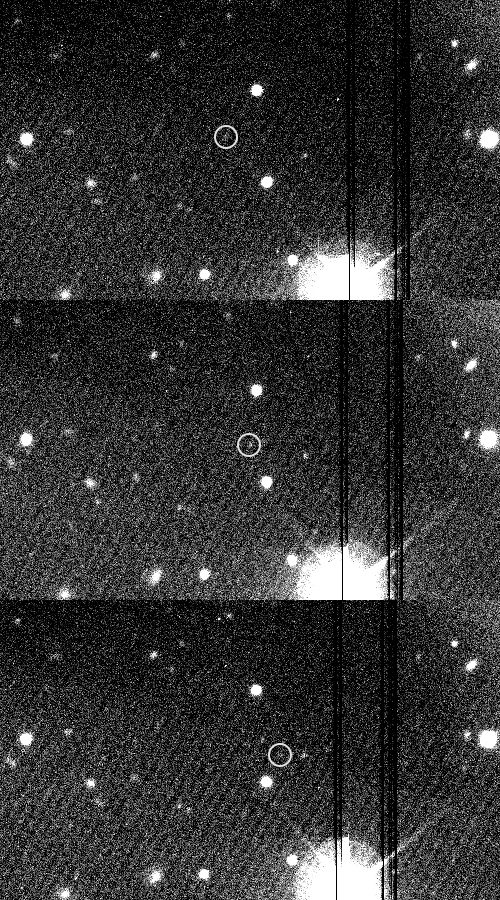
Physical and orbital characteristics
Thrymr is estimated to be about 5.6 kilometres in diameter. Its small size implies a highly irregular shape and a surface likely dark and cratered, similar to other tiny outer satellites. Observational data give the following approximate orbital parameters, which can be found in published catalogs and orbit tables maintained by planetary scientists and observatories (orbital catalog):
- Diameter: ~5.6 km
- Semi-major axis (average distance): ~20,810,000 km from Saturn
- Orbital period: ~1,120.8 days
- Inclination: ~175° to the ecliptic (≈151° to Saturn's equator), indicating retrograde motion
- Eccentricity: ~0.453
The eccentricity and inclination indicate a dynamically excited orbit that is typical of captured or collisionally produced irregular satellites. Lists and discussions of orbital eccentricities and related dynamical properties provide context for Thrymr's motion and stability (eccentricity summary).
Discovery and naming
The object was located in 2000 in a series of faint moving objects around Saturn and followed over subsequent months to confirm a bound, retrograde orbit. The provisional label S/2000 S 7 was used until the International Astronomical Union approved an official name. Early communications used the form "Thrym" in IAU Circular 8177 (IAU Circular 8177), but the IAU Working Group on Planetary System Nomenclature later adopted the nominative Old Norse ending, and the name was standardized as Thrymr (IAU working group, nominative ending decision).
Origin and group membership
Thrymr is normally assigned to Saturn's Norse group, a collection of small, retrograde irregular satellites that share broadly similar distant and inclined orbits. One plausible origin scenario is that Thrymr is a fragment produced by impact disruption of a larger progenitor. In particular, some researchers have suggested a connection with Phoebe: collisions that excavated material from Phoebe could have produced smaller fragments placed onto similar orbits around Saturn. This hypothesis remains under study and is evaluated through comparisons of orbital dynamics, color and spectral data, and collisional modelling (Phoebe connection, fragmentation models).
Scientific significance
Although small and faint, Thrymr contributes to the larger picture of how planetary satellite systems acquire and evolve populations of irregular moons. Its orbit helps constrain capture mechanisms, collisional history, and dynamical interactions in the outer Saturnian system. Continued observations refine its orbit, improve size and albedo estimates, and may eventually supply photometric or spectroscopic data that test compositional links to Phoebe or other Norse-group members. Curated catalogs and mission archive summaries collect updates on observation campaigns, orbit solutions, and any available physical measurements (discovery archive, orbital catalog).
Further reading and resources
For technical lists, nomenclature details and follow-up references consult the IAU working documents and published satellite catalogs. The naming history is summarized in the IAU communications noted above (IAU Circular 8177, IAU working group) and the specific reasoning for the adopted Old Norse nominative form is available in the working group's notes (nominative ending decision). Additional dynamical analyses and observational summaries are available through the orbital databases and specialist literature (eccentricity and dynamics, Phoebe connection).
Related articles
Author
AlegsaOnline.com Thrymr (moon) Leandro Alegsa
URL: https://en.alegsaonline.com/art/99689
Sources
- cfa-www.harvard.edu : IAUC 7538: S/2000 S 7, S/2000 S 8, S/2000 S 9
- cfa-www.harvard.edu : MPEC 2000-Y15: S/2000 S 1, S/2000 S 2, S/2000 S 7, S/2000 S 8, S/2000 S 9
- cfa-www.harvard.edu : IAUC 8177: Satellites of Jupiter, Saturn, Uranus
- cfa-www.harvard.edu : IAUC 8471: Satellites of Saturn