
Thyone (Jupiter XXIX): an irregular, retrograde moon of Jupiter
Thyone (Jupiter XXIX) is a small, retrograde irregular satellite of Jupiter discovered in 2001. It belongs to the Ananke group and provides insight into capture and collisional processes in the Jovian system.
Overview
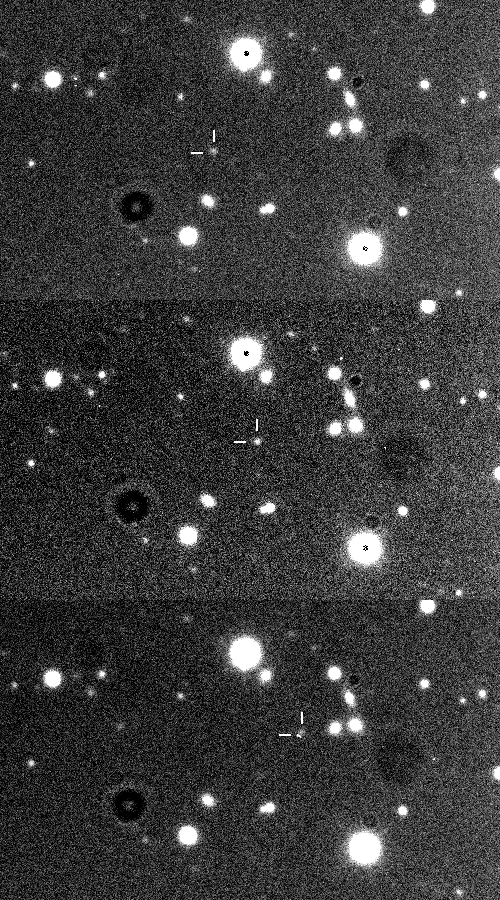
Thyone, also designated Jupiter XXIX and provisionally S/2001 J 2, is one of Jupiter's many small irregular satellites. It is classified as a non-spherical or irregular moon: a small body with an elongated or otherwise non-round shape, reflecting a low mass and insufficient gravity to form a sphere. Thyone follows a distant, retrograde orbit around Jupiter and is too faint and tiny to be observed without large telescopes and long exposures.
Image gallery
3 Images

Physical characteristics
Thyone is estimated to be roughly 4 kilometres across, which places it among the smaller known Jovian moons. Like other irregular satellites of this size, its surface composition and detailed geology remain largely unknown; observations to date are limited to positional tracking and light-curve measurements. Its small size implies a low surface gravity and an irregular, fragmentary shape rather than a spherical form.
Orbit and group membership
Thyone orbits Jupiter at an average distance of about 21,406,000 kilometres and completes a revolution in approximately 639.8 days. Its orbit is inclined significantly relative to the ecliptic—about 147°—and is retrograde, meaning it travels in the direction opposite to Jupiter's rotation. The orbit is noticeably elliptical, with an orbital eccentricity near 0.25, indicating a fairly elongated path rather than a near-circular one.
- Average distance: ~21,406,000 km
- Orbital period: ~639.8 days
- Inclination: ~147° (retrograde)
- Eccentricity: ~0.25
These parameters place Thyone within a dynamical family of satellites that share similar orbits and are thought to have a related origin.
Group association and origin
Thyone is regarded as a member of the Ananke group, a cluster of retrograde irregular moons orbiting Jupiter at distances roughly between 19.3 and 22.7 million kilometres and with inclinations near 150°. The uniformity of orbital elements among Ananke group members suggests that they may be fragments of a single captured body that later broke apart, likely from a collisional event or tidal disruption after capture. Studying Thyone and its companions helps astronomers reconstruct that collisional history and the processes by which giant planets capture small bodies.
Discovery and naming
Thyone was discovered in 2001 by a team of astronomers from the University of Hawaii led by Scott S. Sheppard and colleagues, receiving the provisional designation S/2001 J 2 at the time of discovery in 2001. In August 2003 the moon was given the name Thyone, which in classical sources corresponds to Semele—one of the mortal lovers of Zeus—and connects the satellite to the tradition of naming Jovian moons after characters associated with the Roman god Jupiter or his Greek counterpart. The name has ties to Greek mythology and to the figure often better known by the alternative name Semele.
Scientific importance and observation
Although Thyone itself is small and of limited practical significance, it contributes to broader scientific questions about the formation and evolution of the Jovian satellite system. Observations of Thyone's orbit refine models of gravitational interactions, aid in mapping the distribution of irregular satellites, and support hypotheses about capture mechanisms for retrograde moons. Continued monitoring and occasional targeted observations—using improved detectors and larger telescopes—can gradually improve knowledge of its orbit, rotation, and possibly surface properties.
Related articles
Author
AlegsaOnline.com Thyone (Jupiter XXIX): an irregular, retrograde moon of Jupiter Leandro Alegsa
URL: https://en.alegsaonline.com/art/99749
Sources
- cfa-www.harvard.edu : IAUC 7900: Satellites of Jupiter
- cfa-www.harvard.edu : MPEC 2002-J54: Eleven New Satellites of Jupiter
- cfa-www.harvard.edu : IAUC 8177: Satellites of Jupiter, Saturn, Uranus