
Phoebe (satellite of Saturn)
Phoebe is a small, dark, irregular moon of Saturn with a distant retrograde orbit. Likely a captured primitive body, it is a roughly equal mix of rock and ice and was explored by the Cassini spacecraft.
Overview
Phoebe is one of Saturn's outer moons, notable for its dark surface, irregular shape and unusual orbit. It orbits the planet Saturn at a large distance and completes one revolution in roughly eighteen months. Unlike the large regular satellites that formed in place, Phoebe moves on a retrograde, highly inclined path and is broadly considered a captured object from the outer Solar System rather than a native satellite.
Image gallery
10 Images






Physical characteristics
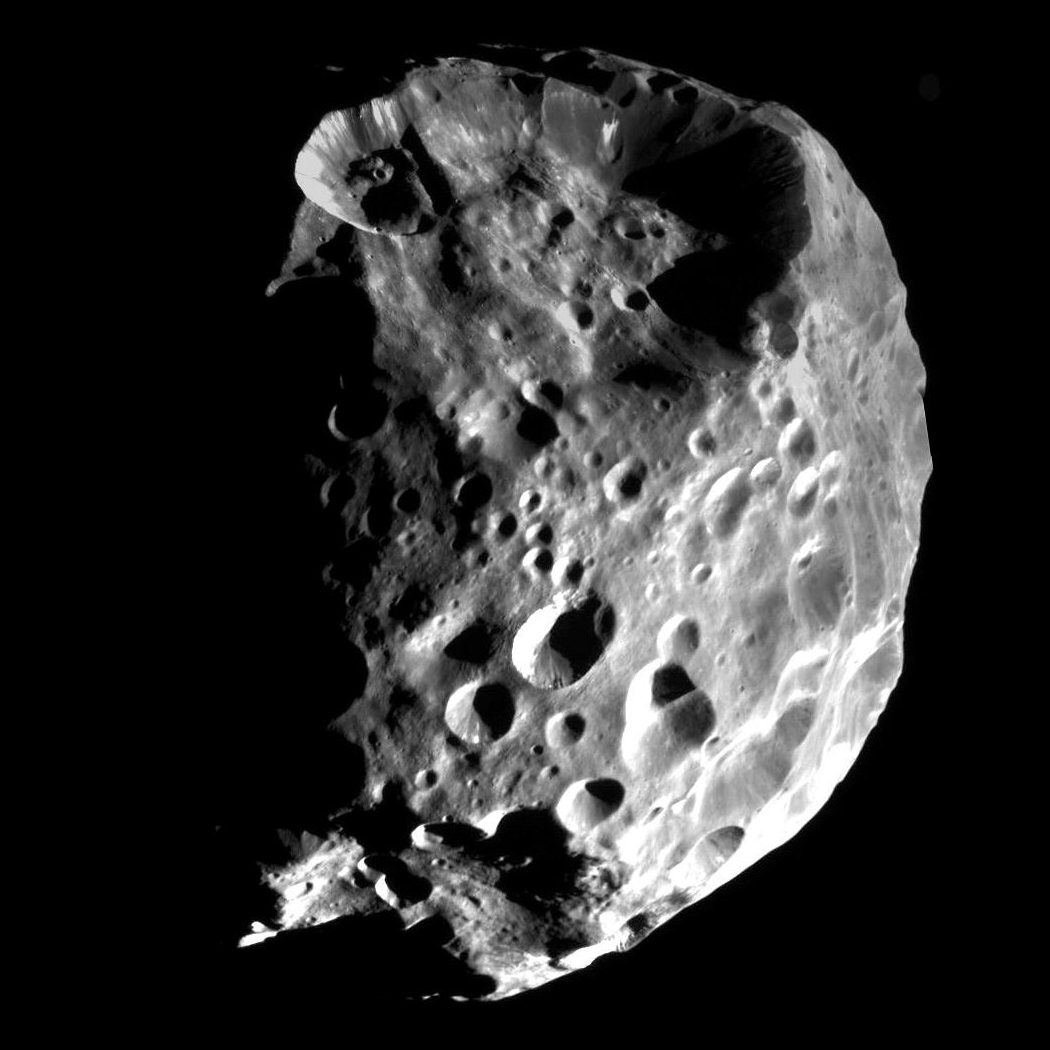
Phoebe has a mean diameter of about 213 km (diameter), making it far smaller than Earth’s Moon. It is irregular rather than spherical, indicating it never became massive enough for gravity to produce a round shape. Observations indicate a low surface reflectivity and a dark, charcoal-colored surface. Its bulk composition is consistent with a roughly mixed rock and ice interior — roughly half rock (rock) and half volatile ices (ice) — which, together with its low albedo, give Phoebe its dark appearance.
Orbit and rotation
Phoebe follows a distant, retrograde orbit around Saturn, meaning it travels in the opposite direction of most of the planet's larger moons. Its orbital period is about eighteen months, and its rapid spin gives it a rotation period of roughly nine hours and some minutes between consecutive sunrises. Because Phoebe is so remote, sunlight is faint there and the view from Earth (Earth) shows it as a faint, dark point despite its relatively large size for an irregular satellite.
Surface, craters and environment
The surface of Phoebe is heavily cratered, bearing scars from countless impacts over its history. Many round depression features come from collisions with asteroids and cometary fragments; the abundance of craters records a long, violent collisional past (craters). There is no appreciable atmosphere (atmosphere) and no standing liquid water (water) on the surface; any volatiles are present as ices or bound in minerals on the ground (surface).
Discovery and exploration
Phoebe was discovered in the late 19th century and remained little studied until the Cassini spacecraft conducted a close flyby in 2004. Cassini's instruments returned images and compositional data that changed understanding of Phoebe's origin: its mix of dark material, water-related minerals and organics strongly suggests a relationship to primitive outer Solar System bodies such as Centaurs or Kuiper Belt objects. These findings support the idea that Phoebe is a captured object rather than having formed in place with Saturn's regular moons.
Significance and comparisons
Phoebe is important as a preserved relic of early Solar System material. Its small size and irregular shape contrast with Saturn's large, round moons; for scale, Earth's Moon is roughly fifteen times larger in diameter. Studies of Phoebe help scientists understand processes of capture, the distribution of volatile-rich bodies, and the collisional history of the outer Solar System. For further background or images, consult mission summaries and planetary data resources via these links: orbit data, Saturn system guides, rock composition, ice signatures, observing from Earth, atmosphere notes, water and volatiles, surface studies, crater catalogs, size comparisons.
Key facts:
- Type: irregular, retrograde satellite
- Approximate diameter: 213 km
- Surface: dark, heavily cratered, mixture of rock and ice
- Rotation: roughly nine hours between sunrises
- Explored by: Cassini spacecraft (flyby in 2004)
Questions and answers
Q: What is Phoebe?
A: Phoebe is a moon that orbits the planet Saturn.
Q: How long does it take Phoebe to go all the way around Saturn?
A: It takes eighteen months for Phoebe to go all the way around Saturn.
Q: What is Phoebe made of?
A: Phoebe is half made out of rock and half made out of ice.
Q: What is the color of the ground on Phoebe?
A: The ground on Phoebe is black, which means that it is very dark when seen from Earth.
Q: What is the surface of Phoebe like?
A: The surface of Phoebe has many craters from asteroids and other objects crashing into it, and leaving round marks on the surface. It is slightly irregular, meaning it is not a perfectly round ball.
Q: What is the size of Phoebe compared to the Earth's moon?
A: The average diameter of Phoebe is 213 km, which is 15 times smaller than the Earth's moon.
Q: How long is a day on Phoebe?
A: A day on Phoebe (duration between two sunrises) is only 9 hours and 16.5 minutes long.
Related articles
Author
AlegsaOnline.com Phoebe (satellite of Saturn) Leandro Alegsa
URL: https://en.alegsaonline.com/art/76529