
Titan (moon of Saturn)
Titan is Saturn's largest moon, notable for a dense nitrogen atmosphere, hydrocarbon lakes, and exploration by the Cassini–Huygens mission. It is larger than Mercury but less massive.
Overview
Titan is the largest moon of Saturn and the second-largest natural satellite in the Solar System. Its name derives from the Ancient Greek Τῑτάν. The body was discovered by the Dutch astronomer Christiaan Huygens on 25 March 1655. Titan's diameter exceeds that of the planet Mercury, but its overall mass is smaller because Titan is composed largely of ices and rock rather than metallic material.
Image gallery
10 Images




Physical characteristics
Titan's equatorial diameter is roughly 5,150 km, and it orbits Saturn at an average distance of about 1,221,865 km. Its interior is believed to include a mixture of rock and water ice and may host a subsurface layer of liquid water beneath an ice shell. Surface temperatures are extremely low, so volatile compounds that are gases on Earth can be liquids on Titan.
Atmosphere and surface
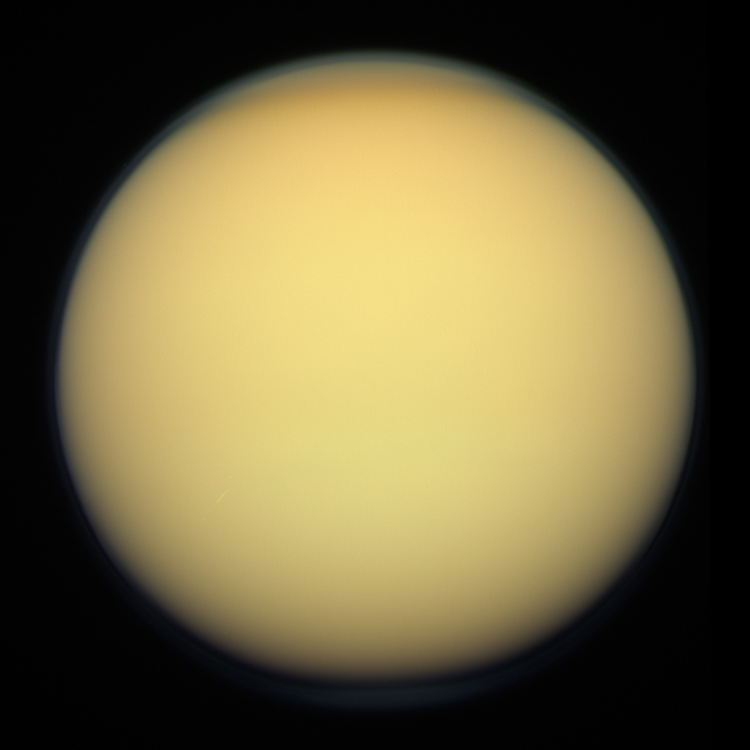
Titan is unique among moons in the Solar System because it has a dense atmosphere, thicker than that of Earth. The atmosphere is dominated by molecular nitrogen with significant amounts of methane and other hydrocarbons. Photochemical reactions in the upper atmosphere produce complex organic aerosols that give Titan a hazy, orange appearance.
At the surface there are river channels, dunes, and extensive seas and lakes filled with liquid hydrocarbons rather than water. Liquid methane and ethane collect in polar basins and participate in a meteorological cycle analogous to Earth's water cycle: evaporation, cloud formation, and precipitation. Liquid water exists on Titan mainly as frozen ice in the crust and possibly as a subsurface ocean.
History of exploration
Titan has been a major target of planetary exploration. The Cassini orbiter and the Huygens probe studied the Saturn system in detail; Huygens descended to Titan's surface in 2005, sending back the first ground-level images and measurements. The Cassini spacecraft performed many close flybys, mapping surface features with radar and studying the atmosphere's composition and dynamics over more than a decade.
Scientific importance and notable facts
Scientists study Titan because its dense, organic-rich atmosphere and surface liquids make it a natural laboratory for prebiotic chemistry and for studying planetary processes in a very different environment from Earth. Key points include:
- Presence of a thick nitrogen atmosphere with methane-driven weather systems.
- Surface lakes and seas of liquid hydrocarbons, a phenomenon otherwise only observed on Earth (with water).
- Potential subsurface ocean and complex organic chemistry driven by sunlight and particle radiation.
Further reading and resources
For more information, see mission summaries and reviews that describe Titan's geology, climate, and exploration history. Popular and technical sources provide detailed discussions of the Cassini–Huygens discoveries and ongoing hypotheses about Titan's potential habitability and future missions.
Name origin • Saturn • Discoverer • Solar System context • Comparison to Mercury • Orbital parameters • Earth comparison • Nitrogen • Methane • Liquid hydrocarbons • Water (ice)
Questions and answers
Q: What is Titan?
A: Titan is a moon that orbits Saturn.
Q: Who discovered Titan?
A: Titan was discovered by Christiaan Huygens on March 25, 1655.
Q: What makes Titan unique?
A: Titan is the only moon in the Solar System to have an atmosphere, and it has lakes and much liquid on its surface.
Q: How does Titan compare in size to other objects in the Solar System?
A: Titan is the largest moon of Saturn and the second largest in the Solar System. It is larger than the planet Mercury, but it has less mass.
Q: What is Titan's atmosphere made of?
A: Titan's atmosphere is made of nitrogen and methane, and it is thicker than Earth's atmosphere.
Q: Why can't humans breathe Titan's atmosphere?
A: Humans can't breathe Titan's atmosphere because it is very cold and also poisonous.
Q: What type of liquid is found on Titan's surface?
A: The liquid found on Titan's surface is methane, not water.
Related articles
Author
AlegsaOnline.com Titan (moon of Saturn) Leandro Alegsa
URL: https://en.alegsaonline.com/art/100108
Sources
- solarsystem.nasa.gov : "NASA: Solar System Exploration: Planets: Saturn: Moons: Titan"
- nature.com : "The lakes of Titan"
- bbc.co.uk : "BBC: Science: Space: Solar System: Moons: Titan: Methane rain on Titan"
- museumboerhaave.nl : "Telescope by Huygens, Christiaan Huygens, The Hague, 1683 Inv V09196"
- astrobio.net : "Comparing the Triad of Great Moons"
- adsabs.harvard.edu : adsabs.harvard.edu/cgi-bin/nph-bib_query?bibcode=2005Icar..175..496.html
- saturn.jpl.nasa.gov : NASA's Cassini Discovers Potential Liquid Water on Enceladus
- news.bbc.co.uk : "Probe reveals seas on Saturn moon"
- cnn.com : "NASA reveals first-ever photo of liquid on another world"
- scientificamerican.com : "Huge Saturn Moon Titan Glows in the Dark"