
Tethys Ocean: Mesozoic seaway between Gondwana and Laurasia
A broad shallow ocean that separated Gondwana and Laurasia during much of the Mesozoic; its shrinking and closure shaped modern Eurasian basins and mountain belts.
Overview
The Tethys Ocean was a major marine seaway that lay between the southern supercontinent Gondwana and the northern landmass Laurasia for much of the Mesozoic. Named after the Greek sea goddess Tethys, it functioned as a warm, shallow tropical corridor connecting oceans and influencing global climate and marine life.
Image gallery
5 Images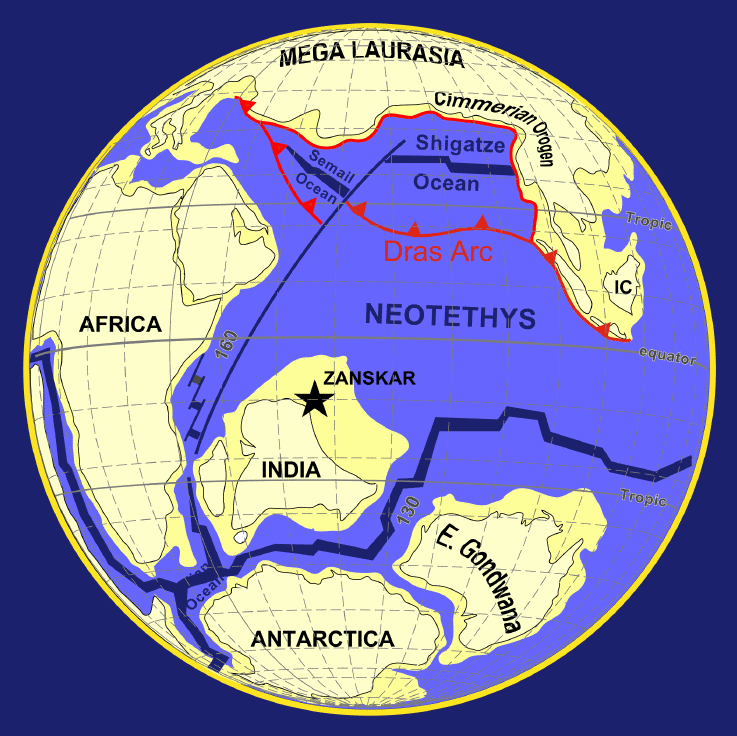



Characteristics and subdivisions
Geologists distinguish several phases and related seas: the older Paleo‑Tethys, the expansive Neo‑Tethys, and later fragmented basins sometimes called the Paratethys. These waters supported extensive carbonate platforms and reefs, left rich fossil assemblages, and deposited thick marine sediments that later became limestone and other sedimentary rocks.
Tectonic evolution
The Tethys formed as Pangaea broke apart and progressively narrowed as Africa, India and other continental fragments drifted north. Collision of these fragments with Eurasia closed much of the seaway, driving mountain building from the Alps to the Himalayas and reorganizing ocean circulation. The process continued into the Cenozoic, transforming an open seaway into a complex set of inland basins and seas.
Remnants and modern examples
Fragments of the ancient Tethys survive as present-day inland seas and basins that occupy former parts of the seaway. Notable remnants include the Black Sea, the Caspian Sea, and the Aral Sea. Other Mediterranean and Eurasian basins also trace aspects of Tethyan history, preserving marine sediments and fossil records that record environmental change over millions of years.
Significance and legacy
The Tethys Ocean is central to understanding paleogeography, the distribution and evolution of marine organisms, and the origin of many hydrocarbon-bearing sedimentary basins. Its sediments and fossils provide key evidence for plate motions, climate change, and the timing of collisions that shaped present-day continents and mountain ranges.
- Separated major continental blocks during the Mesozoic: Gondwana and Laurasia.
- Important source of marine fossils and sedimentary rocks.
- Left modern remnants such as the Black Sea, Caspian Sea and Aral Sea.
Related articles
Author
AlegsaOnline.com Tethys Ocean: Mesozoic seaway between Gondwana and Laurasia Leandro Alegsa
URL: https://en.alegsaonline.com/art/97227