
Thunderstorms: formation, structure, hazards, and occurrences
Thunderstorms are convective storms producing lightning, thunder, heavy rain, strong winds and sometimes hail. This article explains their formation, life cycle, types, hazards and safety guidance.
Thunderstorms are concentrated convective storms in the atmosphere that produce lightning and thunder and are commonly accompanied by heavy rain, gusty winds and sometimes hail. They form when warm, moist air near the Earth's surface rises into a cooler, unstable layer of the atmosphere, allowing condensation and freezing to release latent heat that fuels vigorous updrafts.
Image gallery
10 Images

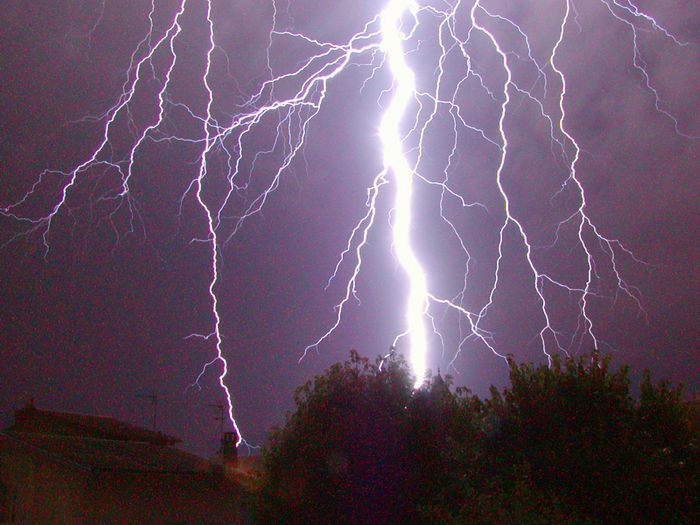


Formation and essential ingredients
Three basic ingredients are required for thunderstorm development: abundant low-level moisture, an unstable atmospheric profile that allows air parcels to rise, and a lifting mechanism such as frontal zones, sea breezes, or terrain. Moisture in the lower atmosphere—water vapor and droplets—provides the energy when it condenses; see general moisture and cloud references for background. Lifting can come from daytime heating, collisions of air masses, or orographic ascent.
Structure and life cycle
A typical isolated thunderstorm progresses through three stages. The developing (cumulus) stage features dominant updrafts and cloud growth. The mature stage includes both strong updrafts and downdrafts, heavy precipitation, and frequent lightning. In the dissipating stage downdrafts dominate and precipitation decreases as the storm loses its warm, moist inflow. More organized systems—multicell clusters, squall lines and supercells—exhibit complex interactions, longer duration and greater potential for severe weather.
Types and special cases
Storms range from short-lived single-cell storms to multicell systems and rotating supercells. Supercells have persistent rotating updrafts and are most associated with very large hail and tornadoes. Thunderstorms are primarily a warm-season phenomenon in many regions, but a winter variant known as thundersnow can occur within strong snowstorms where instability and lift coincide.
Hazards
- Lightning: Cloud-to-ground and intra-cloud discharges that can injure people, ignite wildfires and damage infrastructure; monitored by lightning-detection networks and referenced in lightning studies.
- Heavy rain and flash flooding: Intense rainfall over short periods can overwhelm drainage and pose severe flood risks.
- Strong winds and downbursts: Straight-line winds and microbursts can damage buildings, trees and vehicles.
- Hail: Hailstones can damage crops, vehicles and roofs; size and frequency vary with storm intensity.
- Tornadoes: In some organized storms, rotating updrafts can produce tornadoes with localized but severe impacts.
Observation, forecasting and safety
Meteorologists use radar, satellite imagery, surface observations and lightning networks to detect and forecast thunderstorms; operational and educational material is often available from national services and weather guidance portals. Practical safety measures include seeking substantial shelter indoors, avoiding open water and isolated tall objects, and staying away from conductive equipment during nearby lightning. After thunder is heard, it is advised to wait before resuming outdoor activities.
Role in the climate system and closing notes
Thunderstorms play a role in redistributing heat and moisture and in atmospheric chemistry—for example, lightning contributes to natural nitrogen fixation. They are frequent and sometimes localized, so public awareness, timely forecasts and preparedness remain key to reducing risk. For further technical reading, consult acoustic descriptions of thunder (thunder), surface interaction studies (boundary-layer material) and cloud physics summaries (condensation and cloud studies).
For seasonal and regional information, and for explanations of winter storm electrification and snow-associated lightning, refer to winter storm resources (thundersnow) and local meteorological agencies.
Questions and answers
Q: What are thunderstorms?
A: Thunderstorms are intense weather systems that produce strong winds, heavy rain, lightning, and thunder.
Q: Where can thunderstorms occur?
A: Thunderstorms can occur anywhere with two conditions: the air near the Earth's surface must be warm and moist, and the atmosphere must be unstable.
Q: How often do lightning bolts hit the Earth?
A: 100 lightning bolts hit the Earth every second.
Q: How many thunderstorms happen around the Earth at any one moment?
A: At any one moment, about 1,800 thunderstorms happen around the Earth.
Q: Why are thunderstorms rare in winter?
A: Thunderstorms are rare in winter mostly because of the cold weather.
Q: What is thundersnow?
A: Thundersnow is a phenomenon where thunder and lightning occur during a snowstorm.
Q: In what weather condition is thundersnow common?
A: Thundersnow is common in blizzards.
Related articles
Author
AlegsaOnline.com Thunderstorms: formation, structure, hazards, and occurrences Leandro Alegsa
URL: https://en.alegsaonline.com/art/99710