
Laurasia: the northern half of Pangaea
Laurasia was the northern supercontinent that formed when Pangaea split. It comprised the major northern cratons and landmasses and played a central role in Mesozoic paleogeography and biogeography.
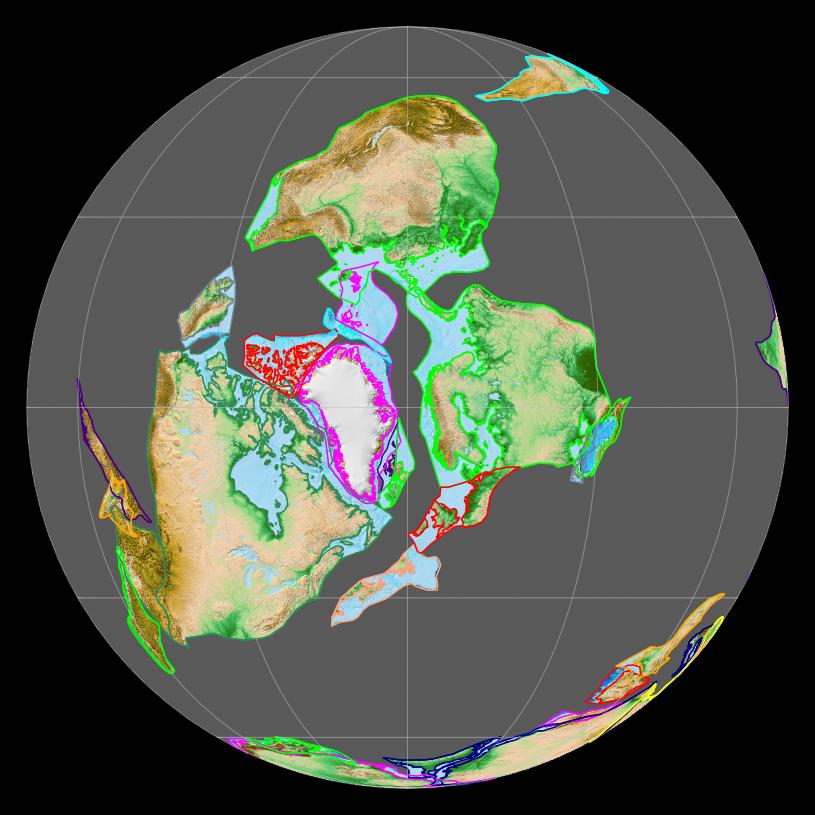
Laurasia is the name given to the large northern landmass that existed after the breakup of the global supercontinent Pangaea. Formed in the wake of Pangaea’s rifting in the Early Jurassic, Laurasia assembled many of the crustal blocks and cratons that today form North America, northern Eurasia and adjacent regions. The term emphasizes a long-lived paleogeographic association of those northern continents during the Mesozoic and later geologic intervals.
Image gallery
10 Images



Composition and extent
Laurasia is not a single modern country or simple continent but a composite of several ancient cratons and continental fragments. Its core included Laurentia (Laurentia), the cratonic basement of much of present-day North America (North America), together with Baltica and other blocks that eventually made up Europe (Europe) and Scandinavia (Scandinavia). To the east and northeast it incorporated extensive parts of western Russia (western Russia), Siberia (Siberia), and several Central Asian terranes such as Kazakhstan (Kazakhstan). Blocks that are now part of China (China) are also commonly included in reconstructions of Laurasia. In geological descriptions the term often appears alongside the word craton (craton) to indicate the ancient, stable pieces of continental lithosphere that formed its backbone.
Formation, name and deep-time relationships
The name Laurasia combines the names Laurentia and Eurasia (Eurasia) to reflect its mixed heritage. Laurasia emerged when Pangaea (Pangaea), the single supercontinent, began to rift apart in the Mesozoic era (Mesozoic), with the split between northern and southern continental masses occurring during the Jurassic (Jurassic). The southern counterpart that formed at the same time is known as Gondwana (Gondwana). Some studies point out an even older association of these northern blocks: after the fragmentation of the Precambrian supercontinent Rodinia (Rodinia) there was a recurrent clustering of similar continental pieces that is sometimes called Proto-Laurasia.
Importance and evidence
Laurasia is important in paleogeography, paleoclimate and paleobiology because its configuration influenced ocean circulation, climatic belts, and routes for animal and plant dispersal. Evidence for Laurasia comes from matching geological features (mountain belts, rock types and mineral deposits), similarities in fossil assemblages across distant modern continents, and paleomagnetic data that reconstruct past latitudes and orientations of continents. Plate tectonic reconstructions that chart continental drift show how Laurasia gradually fragmented into the separate continents and terranes we recognize today.
Distinctions and notable facts
Laurasia should not be confused with individual modern continents: it describes a past, unified arrangement rather than a single, continuous landmass that survived unchanged. The northern/southern dichotomy of Laurasia versus Gondwana is a central organizing idea in Mesozoic Earth history and helps explain large-scale patterns such as the distribution of dinosaur groups, flowering plants and climatic shifts. The label is a convenient shorthand used by geologists, paleontologists and geographers to discuss continental-scale processes.
Further reading and links
Questions and answers
Q: What was Laurasia?
A: Laurasia was a supercontinent of the northern hemisphere.
Q: What was Pangaea?
A: Pangaea was a global supercontinent that split into Laurasia and Gondwana.
Q: When did Pangaea split into Laurasia and Gondwana?
A: Pangaea split into Laurasia and Gondwana during the Jurassic period.
Q: Which landmasses made up Laurasia?
A: Laurasia included most of the landmasses that make up today's continents of the northern hemisphere, including Laurentia (the name given to the North American craton), Europe, Scandinavia, western Russia, Siberia, Kazakhstan, and China.
Q: Where does the name Laurasia come from?
A: The name Laurasia combines the names of Laurentia and Eurasia.
Q: Is Laurasia a Mesozoic phenomenon only?
A: Although Laurasia is known as a Mesozoic phenomenon, today it is believed that the same continents that formed Laurasia also existed as a coherent continent after the breakup of Rodinia around 1 billion years ago.
Q: What is Proto-Laurasia?
A: To avoid confusion with Laurasia, the same continent that formed around 1 billion years ago is referred to as Proto-Laurasia.
Related articles
Author
AlegsaOnline.com Laurasia: the northern half of Pangaea Leandro Alegsa
URL: https://en.alegsaonline.com/art/56294