
Stellar precession (precession of the equinoxes)
Slow, long-term change in the orientation of Earth's rotation axis that makes the apparent positions of the stars drift over millennia and shifts the identity of the pole star.
Stellar precession, commonly called the precession of the equinoxes, is the gradual change in the orientation of Earth's rotation axis that makes the apparent positions of the stars drift relative to the planet. Observed from the Earth, precession causes the north and south celestial poles to trace large circles on the sky over many thousands of years. A familiar consequence is that the star used as the "north star" changes with time: the star now near the north celestial pole will not hold that position indefinitely.
Image gallery
10 Images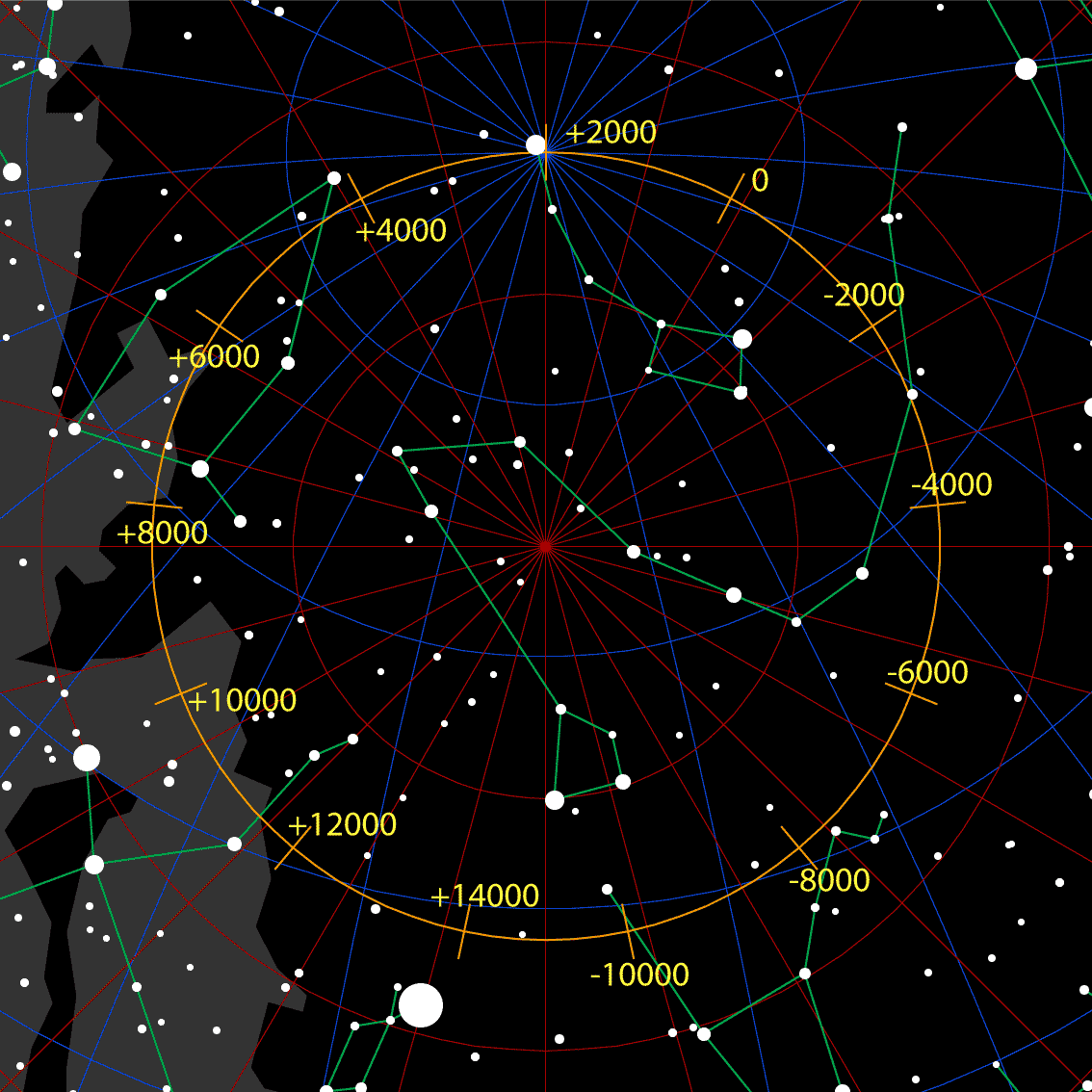





How precession works
Precession is caused by a steady torque exerted on the oblate, spinning Earth by external bodies such as the Sun and the Moon; this torque arises through their differential gravity acting on Earth's equatorial bulge. Rather than tipping the axis over, the torque makes the rotational axis slowly sweep out a cone, so the geographic poles point toward different directions among the fixed stars. The Earth's axial tilt — the angle between the rotation axis and the plane of the orbit — remains approximately constant during a precession cycle (about 23.4° today), though that tilt itself changes slightly over tens of thousands of years. The axis completes one full circuit roughly every 26,000 years with respect to the background orbit, so precession is a slow but cumulative motion.
Historical discovery and study
The effect has been noticed and used for millennia. Ancient builders aligned structures to celestial directions without the same pole star we use now; for example, Egyptian monuments reflect older celestial references. Classical astronomers documented changes in star positions, and the Greek astronomer Hipparchus (often dated to about 130 BC) is traditionally credited with quantifying precession, though awareness of the phenomenon may predate him in ancient Greece and elsewhere.
Consequences and examples
- Pole star identity shifts: different bright stars become the north or south reference over millennia, because the celestial pole moves relative to fixed stars.
- Celestial coordinate drift: right ascension and declination of stars slowly change, so star catalogs and navigation systems specify an epoch to indicate when coordinates are valid.
- Archaeastronomy applications: the orientations of old monuments and ritual sites can be reinterpreted by accounting for precession when estimating their builders' intended celestial alignments.
These consequences matter both for practical astronomy and for understanding historical observations and alignments. Modern observers correct for precession when pointing telescopes, cataloguing sources, or comparing positions measured centuries apart.
Scientific importance and related phenomena
Precession is one component of the long-term variations in Earth's orientation that influence astronomical reference frames and, on geologic timescales, Earth's climate. It is part of the suite of orbital cycles known as Milankovitch variations, which alter the seasonal distribution of sunlight and can modulate climate patterns over tens to hundreds of thousands of years. Precession is distinct from shorter, smaller motions such as nutation — a wobble superimposed on the steady precessional motion — and from slow changes in axial tilt magnitude. Professional astronomers and geophysicists model these effects to high precision to support navigation, space missions, and climate studies.
Because precession is predictable, it allows reconstruction of the sky as seen in the past or future, helping to date historical records that reference stellar positions and to forecast how the sky will look millennia hence. For a quick visualization: imagine the Earth's axis drawing a very large circle on the celestial sphere; that slow circuit defines the changing backdrop against which all stars and constellations are observed from the Earth.
Related articles
Author
AlegsaOnline.com Stellar precession (precession of the equinoxes) Leandro Alegsa
URL: https://en.alegsaonline.com/art/93708