
Styx (moon) — small satellite of the dwarf planet Pluto
Styx is a small irregular moon of the dwarf planet Pluto, discovered in 2012 with the Hubble Space Telescope. It orbits within Pluto’s system of small satellites and was named after the mythological river Styx.
Overview
Styx is one of the minor moons orbiting the dwarf planet Pluto. Initially designated S/2012 (134340) 1 and informally called P5, it was revealed from observations made with the Hubble Space Telescope on June 26, 2012. Styx is the fifth satellite of Pluto to be identified, joining Charon, Nix, Hydra, and Kerberos.
Image gallery
10 Images





Physical characteristics
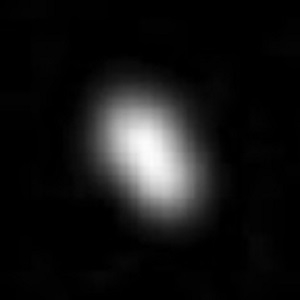
Styx is a very small, irregularly shaped body. Its surface likely contains water-ice mixed with darker, carbon-rich material, similar to the other small satellites in the Pluto system. Because Styx is faint and tiny compared with Charon, many of its detailed physical properties — including exact dimensions, composition, and surface features — are known only approximately or remain unconstrained.
Orbit and rotation
Styx orbits within Pluto’s system of inner satellites and is part of a dynamically complex group. The small moons of Pluto exhibit near-resonant orbital relationships with the central binary (Pluto–Charon), and their gravitational interactions lead to unusual rotational behaviors. Like its companions, Styx is thought to experience irregular or chaotic rotation rather than a simple synchronous spin.
Discovery and naming
The discovery of Styx arose from a Hubble imaging campaign to search for additional moons around Pluto prior to the New Horizons flyby. After its confirmation, the moon received the mythological name Styx in 2013, following the International Astronomical Union’s naming conventions for Pluto’s satellites. The name refers to the river Styx from classical mythology, which formed a natural thematic link with Pluto and its other satellites.
Exploration and scientific importance
The New Horizons spacecraft’s 2015 flyby of the Pluto system provided improved orbital measurements and system context for Styx, although the moon remained difficult to resolve in detail. Studying Styx and the other small moons helps scientists understand the history and evolution of the Pluto–Charon binary, including probable origins by a giant impact and subsequent accretion of debris into multiple small satellites.
Context and distinctions
- Styx is one member of a compact satellite system dominated by the relatively large, close-in moon Charon.
- Its discovery followed those of Charon (1978), Nix and Hydra (2005), and Kerberos (2011), and preceded detailed reconnaissance by the New Horizons probe.
- Continued observations from Earth and space telescopes, including additional data tied to Pluto studies, aim to refine Styx’s orbit, rotation, and surface properties.
Although small and faint, Styx is a meaningful component of Pluto’s satellite system. Its presence, along with the other tiny moons, provides clues about collisional processes, satellite formation, and the dynamical evolution of binary dwarf-planet systems.
Questions and answers
Q: What is Styx?
A: Styx is a small moon of the dwarf planet Pluto.
Q: When was Styx discovered?
A: Styx was discovered on June 26, 2012.
Q: How was Styx discovered?
A: Styx was discovered using the Hubble Space Telescope.
Q: What was Styx formerly known as?
A: Styx was formerly known as S/2012 (134340) 1 and informally as P5.
Q: How many moons of Pluto have been discovered so far?
A: Five moons of Pluto have been discovered so far, including Styx.
Q: Can you name the other four moons of Pluto?
A: The other four moons of Pluto are Charon, Nix, Hydra, and Kerberos.
Q: When were the other four moons of Pluto discovered?
A: Charon was discovered in 1978, Nix and Hydra were discovered in 2005, and Kerberos was discovered in 2011.
Related articles
Author
AlegsaOnline.com Styx (moon) — small satellite of the dwarf planet Pluto Leandro Alegsa
URL: https://en.alegsaonline.com/art/94442
Sources
- solarsystem.nasa.gov : "S/2012 (134340) 1 (P5): Overview"
- bbc.co.uk : "Hubble discovers new Pluto moon"
- scientificamerican.com : "New Moon for Pluto: Hubble Telescope Spots a 5th Plutonian Satellite"
- nasa.gov : "Hubble Discovers a Fifth Moon Orbiting Pluto"
- apod.nasa.gov : "Astronomy Picture of the Day - 16 July 2012"
- phys.org : "Hubble Space Telescope detects fifth moon of Pluto (Update)"