
Stellar wind: outflows from stars and their effects
Overview of stellar winds: mechanisms that drive mass outflows from stars, types across stellar classes, observational methods, and their effects on stellar evolution, planetary environments and the interstellar medium.
Stellar wind refers to the continuous flow of gas and charged particles expelled from the outer layers of a star into surrounding space. These outflows occur across most types of stars and vary widely in speed, density and driving mechanism. Stellar winds remove mass and angular momentum from stars, influence the environments of nearby planets, and supply material to the interstellar medium.
Image gallery
4 Images

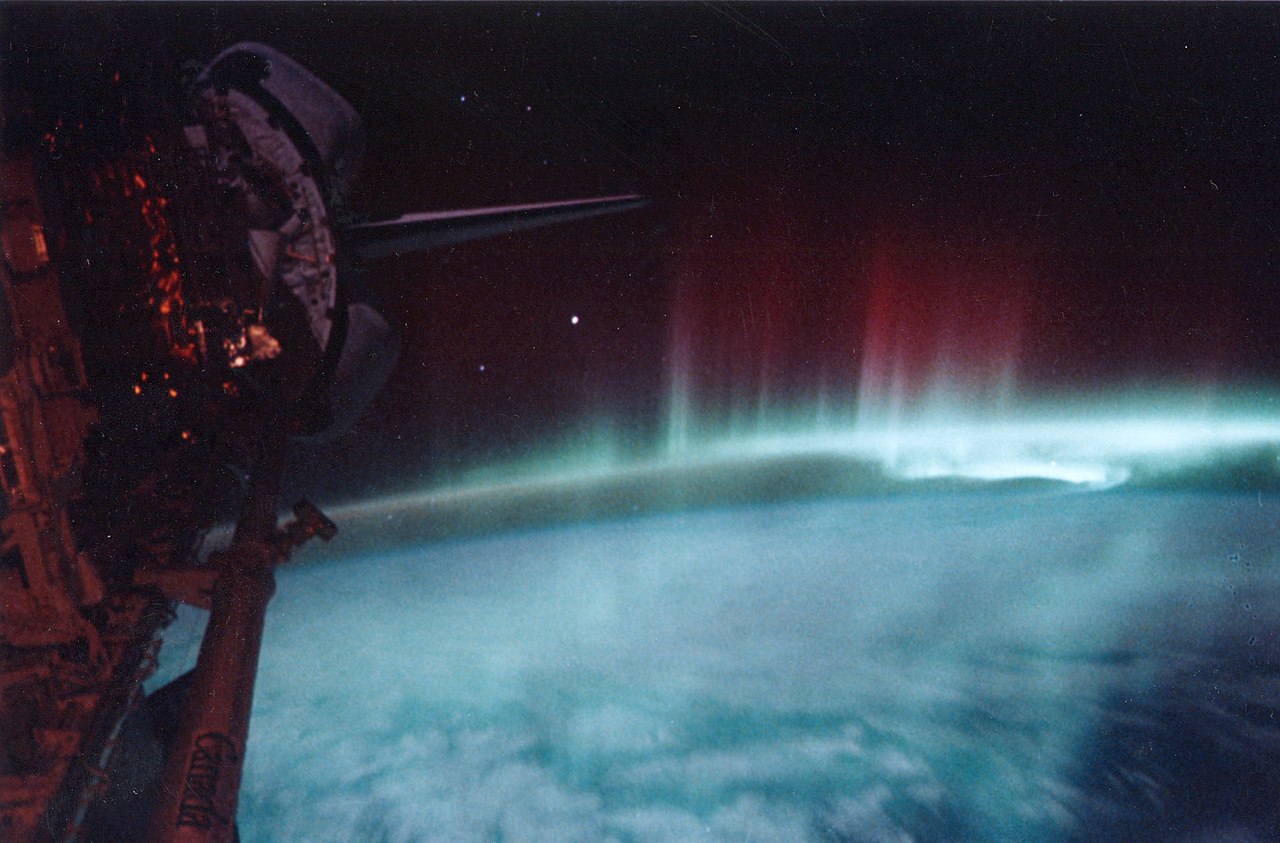

Basic characteristics
Winds are commonly characterized by two macroscopic quantities: the mass-loss rate (how much mass a star loses per unit time) and the terminal velocity (the typical speed reached far from the star). Winds also differ in composition, degree of ionization, temperature and magnetic structure. For cool, Sun-like stars the flow is persistent but low in mass flux; for luminous hot stars and evolved giants the mass-loss can be much higher and velocities can be very large. Observational signatures depend on these properties.
Physical mechanisms
Multiple physical processes can drive stellar winds. In stars with hot coronae, such as the Sun, magnetic heating accelerates charged particles into a coronal wind. In cool evolved giants, stellar pulsations and radiation pressure on dust grains lift material away from the surface. In hot, luminous stars radiation pressure acting on atoms and ions—especially through spectral lines—can launch fast, line-driven winds. Magnetic fields, rotation and shocks modify flows in many systems, and in some cases more than one mechanism is important.
Types of stellar wind
- Solar-type (coronal) winds: low-density, magnetically controlled outflows from stars with hot outer atmospheres; the Sun’s solar wind is the best-studied example; see solar wind resources.
- Radiation-driven winds: fast winds from O and B stars and some supergiants where radiation force on ions and lines is dominant; theoretical summaries are available at line-driven wind summaries.
- Dust- and pulsation-driven winds: typical of red giants and asymptotic giant branch stars, where dust formation and pulsation assist mass loss.
- Wolf–Rayet and eruptive winds: dense, often clumpy outflows from evolved massive stars and episodic mass ejections in luminous blue variables.
Observational signatures and measurement
Astronomers detect winds using spectroscopy (for example P Cygni profiles and blueshifted absorption), radio and millimetre emission from circumstellar gas and dust, ultraviolet and X-ray diagnostics, and by imaging of wind–interstellar medium interactions such as bow shocks and astrospheres. For the Sun, spacecraft provide in situ plasma measurements; for other stars, remote sensing and modelling are used. Data compilations and observational guides can be found at observational guides and research portals such as research portals.
Effects and importance
Stellar winds shape the evolution of stars by removing mass and angular momentum, influence the formation and appearance of planetary nebulae, and affect the pre-supernova structure of massive stars. Winds also drive space weather that can erode planetary atmospheres and alter habitability, and they enrich the interstellar medium with processed material that later participates in star and planet formation.
Modeling and open questions
Modern research combines multiwavelength observations with numerical simulations to study wind acceleration, clumping, magnetic confinement and time variability. While the broad classes of winds and their basic drivers are well established, detailed properties—especially for extreme, rapidly rotating, magnetic or eruptive stars—remain active areas of study. Improved observations and models continue to refine our understanding of how winds influence stars and their environments.
Related articles
Author
AlegsaOnline.com Stellar wind: outflows from stars and their effects Leandro Alegsa
URL: https://en.alegsaonline.com/art/93709