
Stephano (moon)
Stephano is a small, retrograde irregular moon of Uranus discovered in 1999. Named after a character in Shakespeare's The Tempest, it is non-spherical and likely a captured object in a distant, inclined orbit.
Overview
Stephano is one of the irregular satellites of Uranus. Discovered in 1999 by a team led by Brett J. Gladman, it received the provisional designation S/1999 U 2 and was later confirmed as Uranus XX. Like several other distant Uranian moons, Stephano follows a retrograde orbit and is too small to be rounded by its own gravity.
Image gallery
7 Images



Physical characteristics
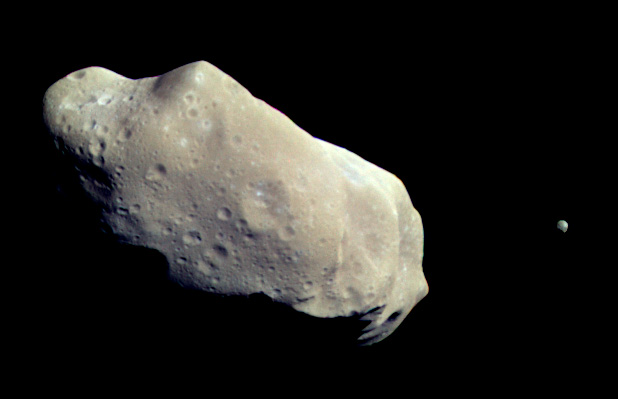
Stephano is non-spherical and diminutive in size, measuring on the order of tens of kilometres across rather than hundreds. Its surface is presumed dark and composed of a mixture of water ice and darker, rocky material, a common trait among irregular satellites. Detailed information on its rotation, shape, and surface geology is limited because it has only been observed as a faint point of light in ground-based surveys.
Orbit and dynamical class
Stephano belongs to the population of irregular, distant moons that orbit far from Uranus on inclined and eccentric paths. Its retrograde motion — orbiting in the opposite direction to Uranus's rotation — and its distant, tilted orbit suggest it did not form in place with the large regular satellites but was captured into its present orbit early in the Solar System's history.
Discovery and name
The moon was discovered in 1999 by Gladman and collaborators using telescopic surveys optimized for faint, distant objects. After the provisional designation S/1999 U 2, it was assigned the permanent name Stephano, following the convention of naming Uranian moons after characters from the works of William Shakespeare and Alexander Pope. The name refers to Stephano, the drunken butler in Shakespeare's The Tempest.
Significance and comparisons
As an irregular moon, Stephano helps astronomers study capture processes, collisional histories, and the population of small bodies around the giant planets. Compared with Uranus's larger, regular moons, Stephano and its peers are much smaller, darker, and dynamically more chaotic, making them valuable tracers of the planet's early environment.
Key facts
- Designation: S/1999 U 2; permanent name: Stephano (Uranus XX).
- Type: retrograde, irregular, non-spherical satellite (non-spherical).
- Origin: likely a captured minor body composed of ice and rock.
Related articles
Author
AlegsaOnline.com Stephano (moon) Leandro Alegsa
URL: https://en.alegsaonline.com/art/93747