
Rover (space exploration)
A rover is a mobile vehicle designed to travel across the surface of another world. Articles covers purpose, design features, history, examples and how rovers are powered and operated.
A rover is a vehicle built to move across the surface of a planet, moon, or other solid astronomical body. Most modern rovers are robotic and carry scientific instruments to study geology, atmosphere and potential signs of past or present life. Some rovers are teleoperated from Earth, receiving daily instructions from mission teams, while others have onboard autonomy enabling them to drive short distances or avoid hazards without real‑time input.
Image gallery
10 Images


Typical design and power
Rovers are adapted to the environment they will explore. Key elements include a mobility system (wheels or tracks), a chassis that protects instruments, communications hardware and one or more science payloads. Energy systems are critical: many rely on solar panels for daytime power and batteries for short‑term storage, while others use radioisotope or nuclear power systems to supply heat and electricity in low‑sunlight conditions. Their electrical systems are designed for reliability and efficiency; in broad terms they are specialized electric vehicles optimized for extreme temperatures and rough terrain.
Operations and navigation
Rovers operate by combining commands from human controllers and onboard software. Mission control on Earth sends plans that the rover executes, and the vehicle returns telemetry and imagery so teams can update goals; this process is often described as teleoperation or telerobotics, with mission teams acting as ground controllers. For local decision making, rovers carry sensors and cameras that allow them to perform obstacle avoidance, path planning and autonomous science targeting. They are built to cope with communication delays to distant planets and moons, where direct remote piloting is impractical.
History and notable examples
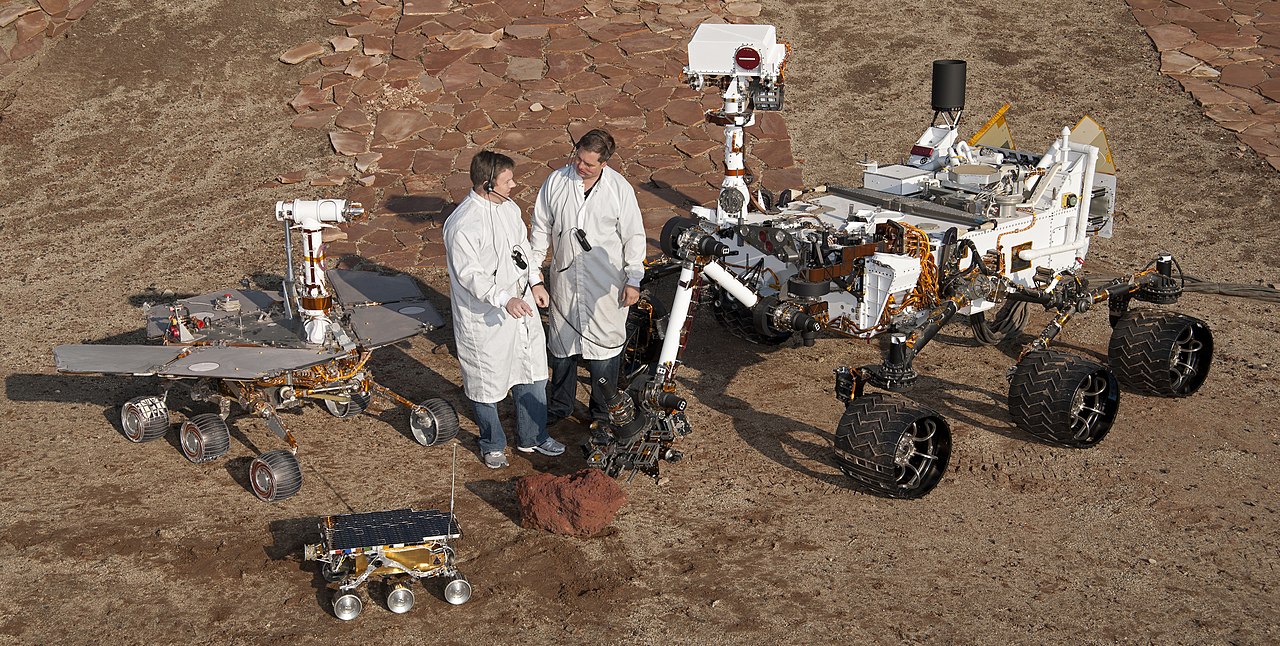
Early rover experiments began in the 20th century; important milestones include crewed lunar rovers used during the Apollo program and robotic explorers on the Moon and Mars. Famous robotic rovers include the small Sojourner, the twin Mars rovers Spirit and Opportunity, the laboratory‑class Curiosity and the more recent Perseverance, each progressively more capable. Robotic lunar rovers and mobile platforms have also been flown by different space agencies to study diverse solar system bodies.
Scientific value and uses
Rovers extend the reach of planetary science by combining mobility with in situ measurements. They examine rocks, drill or scoop samples, analyze chemical composition, and capture high‑resolution views of landscapes. Mobile platforms can explore multiple sites within a single mission, helping to contextualize orbital observations and select targets for sample return or human exploration planning.
Distinguishing features and future directions
Unlike stationary landers, rovers provide horizontal mobility and the ability to revisit targets. Their complexity ranges from simple ambulatory probes to sophisticated laboratories on wheels; many missions now include autonomous navigation, advanced instrument suites and plans for sample caching. Future developments aim to increase endurance, autonomy, and cooperation between multiple rovers or between rovers and orbiters to build more comprehensive surveys of other worlds.
For further reading, see mission pages and technical summaries by space agencies and research institutions: planetary mission sites, rover engineering overviews at lunar program pages, and comparative studies of power systems at research repositories. Operational guidelines and daily planning tools are available through agency documentation often referenced by ground teams and engineering groups. Technical reviews of power options discuss electric vehicle designs, solar solutions and nuclear options in the context of long‑duration missions.
Related articles
Author
AlegsaOnline.com Rover (space exploration) Leandro Alegsa
URL: https://en.alegsaonline.com/art/84377
Sources
- airandspace.si.edu : Exploring the solar system - Tools of Exploration - Rovers
- nasa.gov : "NASA - Soviet Union Lunar Rovers"
- solarsystem.nasa.gov : "In Depth | Yutu"