
Rigel (Beta Orionis): a blue supergiant in Orion
Rigel is a luminous blue supergiant star in the constellation Orion. It is a multiple system, far larger and more luminous than the Sun and visible from both hemispheres as a bluish star marking Orion's foot.
Overview
Rigel is one of the brightest stars in the night sky and a prominent member of the constellation commonly known as Orion. It carries the Bayer designation Beta Orionis but is often brighter than the Alpha star in that constellation. Rigel lies within the Milky Way and is easily seen with the naked eye as a blue-white point on clear nights.
Image gallery
9 Images





Physical characteristics
Rigel is classified as a blue supergiant, a massive, hot star that has exhausted hydrogen in its core and expanded. Compared with the Sun, Rigel is enormously larger: stellar radius estimates place it at many tens of times the Sun's radius (commonly cited values are on the order of several dozen to around eighty times). It emits far more light than the Sun, with total luminosity measured in the many thousands to tens of thousands of solar luminosities. Its surface temperature gives Rigel a blue-white color typical of B-type supergiants.
Key characteristics
- Spectral class: B-type supergiant
- Color: blue-white
- Size: tens of times the Sun's radius
- Luminosity: many thousands of times that of the Sun
- Distance: several hundred light-years (estimates vary)
System and variability
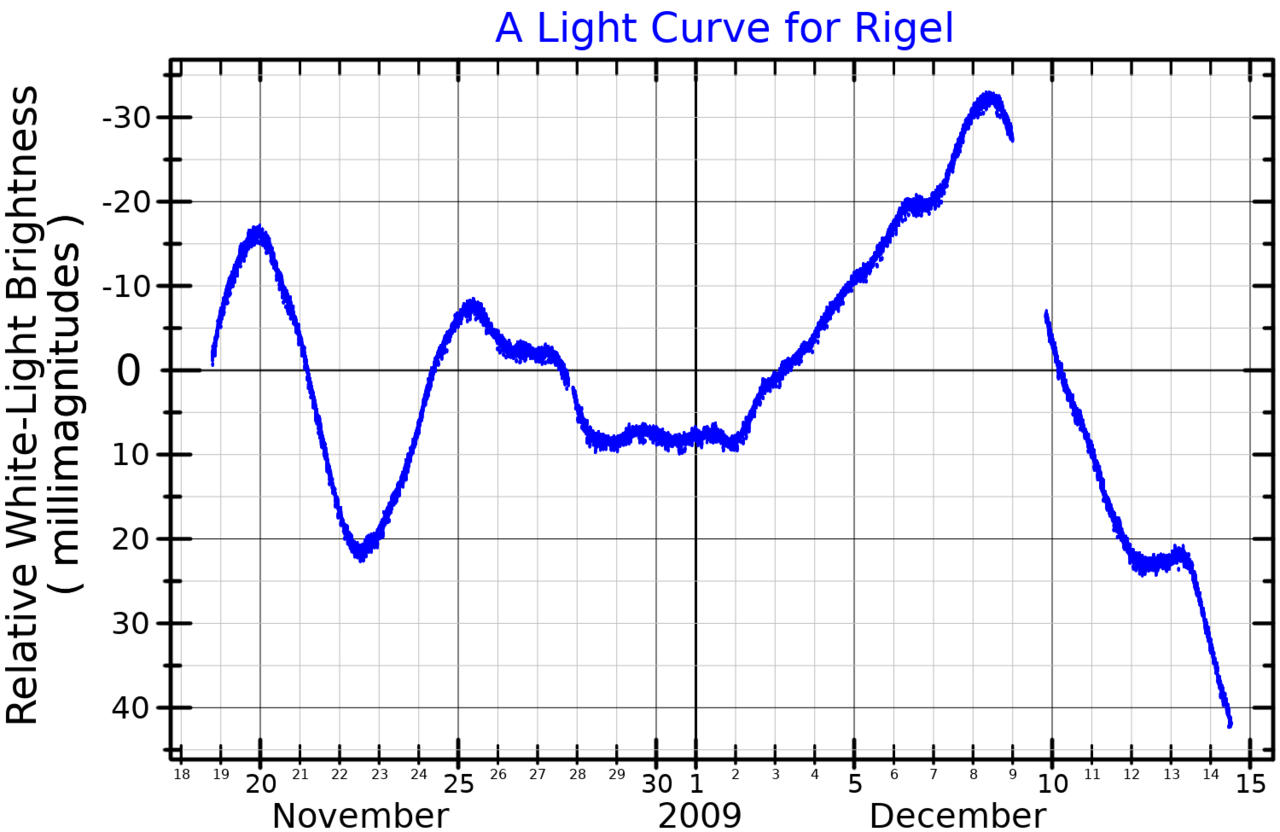
Rigel is not a single, simple star but part of a multiple system: the bright primary (often called Rigel A) has at least one close, fainter companion and other more distant companions that can be seen with telescopes. The primary shows small-scale brightness changes typical of supergiant stars; it is sometimes classified among the irregular or low-amplitude variable stars. These properties are important when astronomers model Rigel's mass, age and future evolution.
History, naming and visibility
The traditional name "Rigel" derives from an Arabic word meaning "foot" and reflects the star's role in representing one of Orion's feet. Because it sits close to the celestial equator, Rigel is visible from both northern and southern hemispheres and serves as a useful reference point for navigation and for locating other features of Orion, such as the belt and the bright star Betelgeuse. Observers often note its distinct bluish tint compared with the redder Betelgeuse.
Importance and future
As a massive blue supergiant, Rigel represents a late stage in the life of a high-mass star. Astronomers study it to understand stellar structure, mass loss, and the processes that lead to core collapse. In the distant future Rigel is expected to end its life in a core-collapse supernova, enriching its surroundings with heavy elements. For now, it remains a conspicuous and well-studied beacon in the Milky Way, of interest to amateur and professional observers alike.
For further introductory resources on Rigel and related topics, see general star catalogs and sky guides: Rigel in catalogues, blue supergiants overview, and constellation references at Orion guides and constellation maps. Observational notes and parallax discussions can be found via databases and mission archives indicated at solar comparisons and equatorial visibility resources.
Related articles
Author
AlegsaOnline.com Rigel (Beta Orionis): a blue supergiant in Orion Leandro Alegsa
URL: https://en.alegsaonline.com/art/82885
Sources
- doi.org : doi.org/10.1088/0004-637X/747/2/108