
Rings of Jupiter: composition, structure, discovery and significance
A concise encyclopedia overview of Jupiter’s faint ring system: its components, origin, discovery by Voyager 1, later study, and how it differs from the prominent rings of other planets.
Overview
The rings of Jupiter form a subtle system of dusty bands that encircle the giant planet. Unlike the broad, icy rings of Saturn, Jupiter’s rings are faint and composed mostly of fine dust. They are one of the few planetary ring systems known in the Solar System, and their low reflectivity makes them hard to observe from Earth without large instruments and favorable lighting. The presence of these rings was first recognized in 1979 when the Voyager 1 mission imaged them; subsequent missions and observatories, including the Galileo space probe and the Hubble Space Telescope, provided better views and measurements.
Image gallery
10 Images





Structure and components
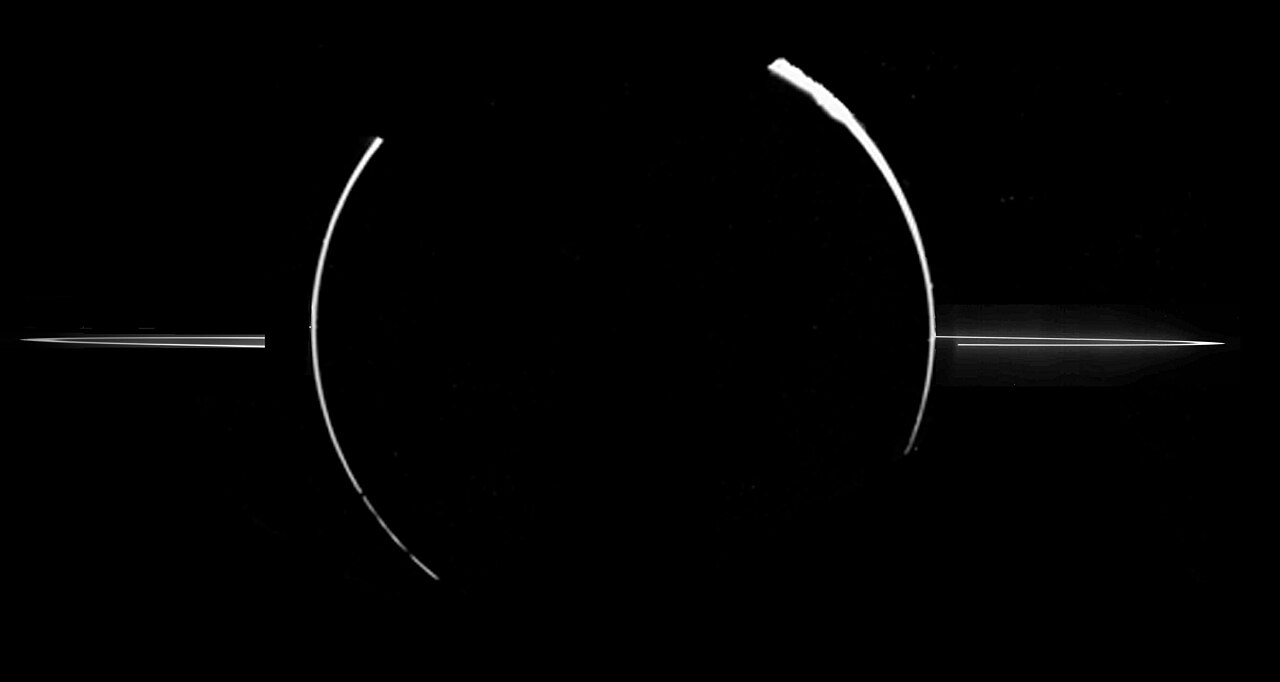
Jupiter’s ring system is conventionally divided into four principal components. From the planet outward these are described as:
- Halo: an innermost, diffuse and vertically extended torus of dust close to the planet.
- Main ring: a relatively narrow, brighter and thin band that lies outside the halo.
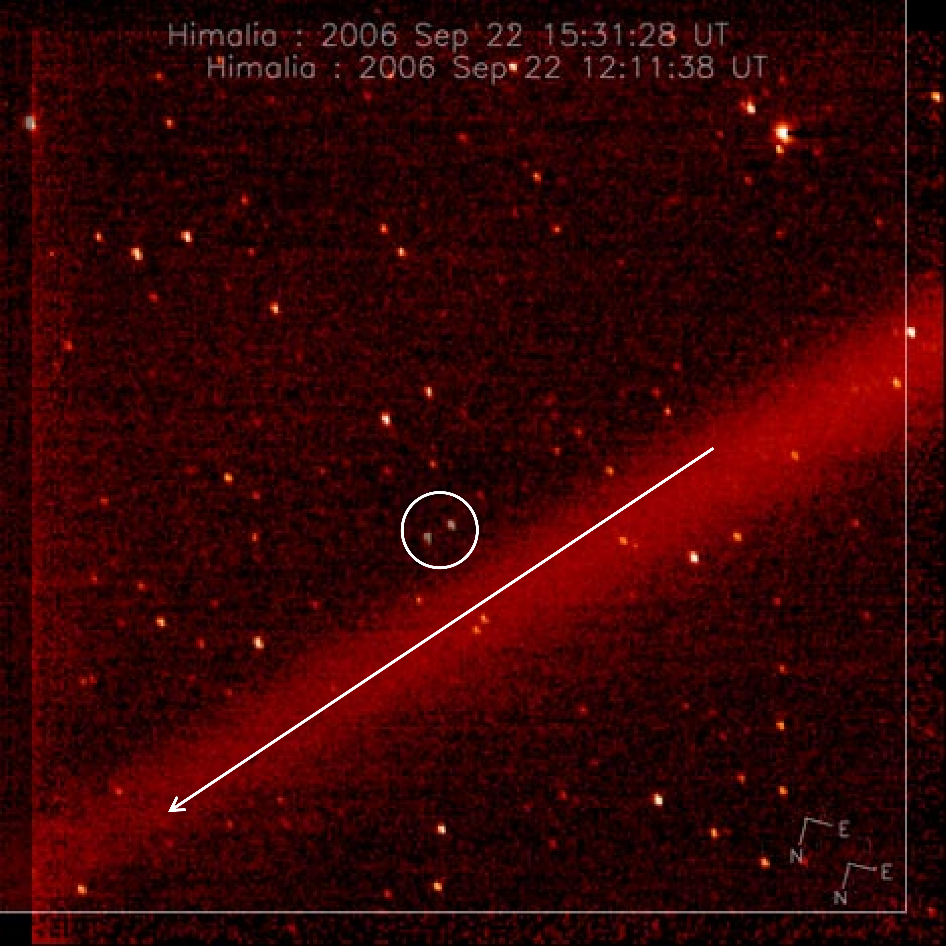
- Amalthea gossamer ring: a broad, faint sheet of dust associated with the orbit of the small moon Amalthea.
- Thebe gossamer ring: an even more extended, tenuous component linked to the moon Thebe.
The term “gossamer” reflects how transparent and delicate these outer rings appear; they are visible mainly when sunlight is scattered at specific angles.
Origin and dynamics
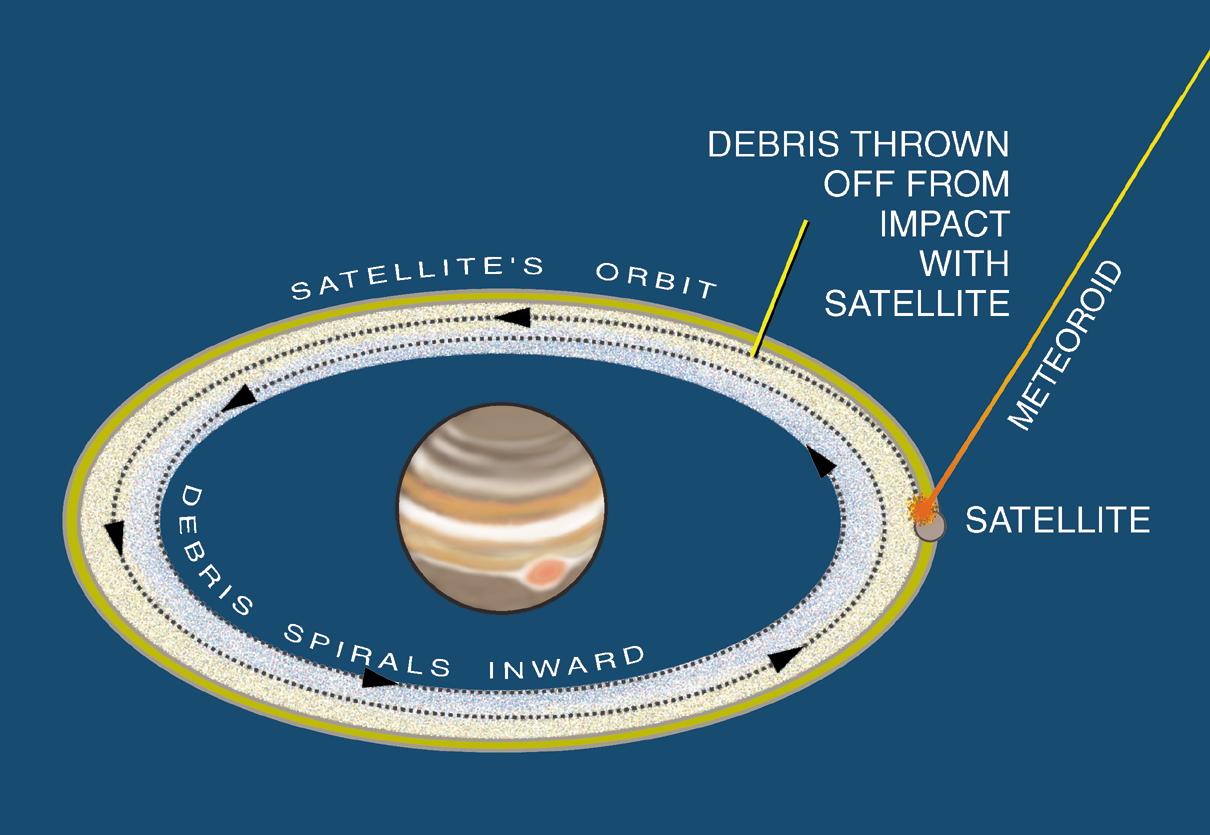
The dominant source of ring material is dust produced when micrometeoroids strike small inner moons and eject material into orbit. Electromagnetic forces from Jupiter’s strong magnetic field and radiation-related effects such as Poynting–Robertson drag alter the orbits of tiny charged grains, causing inward migration and creating the observed distributions. Larger fragments and centimeter-scale particles contribute to the main ring’s brightness, while micron-sized grains dominate the faint gossamer components. Scattering behavior of small particles means the rings are often easier to detect when backlit by the Sun.
Observation history and study
Discovery by the Voyager 1 images in 1979 established that Jupiter possessed a ring system, making it the third such system identified after the rings of Saturn and Uranus. In the 1990s the Galileo space probe obtained higher-resolution data, and later observations with the Hubble Space Telescope and large ground-based telescopes have refined models of particle sizes, composition and dynamics.
Importance and notable facts
Although much less prominent than Saturn’s rings, Jupiter’s system is scientifically valuable because it provides a natural laboratory for studying dust production, satellite–ring interactions, and the influence of a strong magnetosphere on small particles. Its material is renewed continuously by impacts on small moons, so the rings are dynamic and can change over time. The study of these faint rings also helps astronomers interpret disk and ring phenomena elsewhere, from other planets to debris disks around distant stars.
Further reading
- Primary discovery images and mission reports: Voyager 1 and follow-up by Galileo.
- Modern observations and imaging: Hubble Space Telescope results and adaptive-optics studies using large telescopes.
- Context in the Solar System alongside rings of Saturn and Uranus.
Questions and answers
Q: What are the Rings of Jupiter?
A: The Rings of Jupiter are a number of rings which circle the planet Jupiter.
Q: Where do the Rings of Jupiter rank in terms of discovery?
A: The Rings of Jupiter were the third set of rings found in the Solar System after the rings found around Saturn and Uranus.
Q: When were the Rings of Jupiter discovered?
A: The Rings of Jupiter were not discovered until the Voyager 1 space probe visited the planet in 1979.
Q: What studies were carried out on the Rings of Jupiter in the 1990s?
A: The Galileo space probe carried out more studies on the Rings of Jupiter in the 1990s.
Q: What has provided information on the Rings of Jupiter recently?
A: The Hubble Space Telescope and large Earth telescopes have provided information on the Rings of Jupiter recently.
Q: What is the composition of the ring system of Jupiter?
A: The ring system of Jupiter is faint and is made mainly of dust.
Q: What are the four parts that make up the ring system of Jupiter?
A: The four parts that make up the ring system of Jupiter are a thick inner ring known as the "halo" ring, a bright but very thin "main" ring, and two outer, wide, faint "gossamer" rings.
Related articles
Author
AlegsaOnline.com Rings of Jupiter: composition, structure, discovery and significance Leandro Alegsa
URL: https://en.alegsaonline.com/art/82974
Sources
- astro.umd.edu : "Keck Infrared Observations of Jupiter's Ring System near Earth's 1997 Ring Plane Crossing"
- ui.adsabs.harvard.edu : 1999Icar..138..214D
- doi.org : 10.1006/icar.1998.6068
- ui.adsabs.harvard.edu : 1979Sci...204..951S
- doi.org : 10.1126/science.204.4396.951
- pubmed.ncbi.nlm.nih.gov : 17800430
- ui.adsabs.harvard.edu : 1987Icar...69..458S
- doi.org : 10.1016/0019-1035(87)90018-2
- ui.adsabs.harvard.edu : 1999Icar..141..253M
- doi.org : 10.1006/icar.1999.6172
- iop.org : "Planetary rings"
- ui.adsabs.harvard.edu : 2002RPPh...65.1741E
- doi.org : 10.1088/0034-4885/65/12/201