
Rings of Saturn
Saturn's rings are a vast, thin system of ice-rich particles and gaps that encircle the planet; they reveal disk dynamics, shepherding moons, and an active, still-debated history.
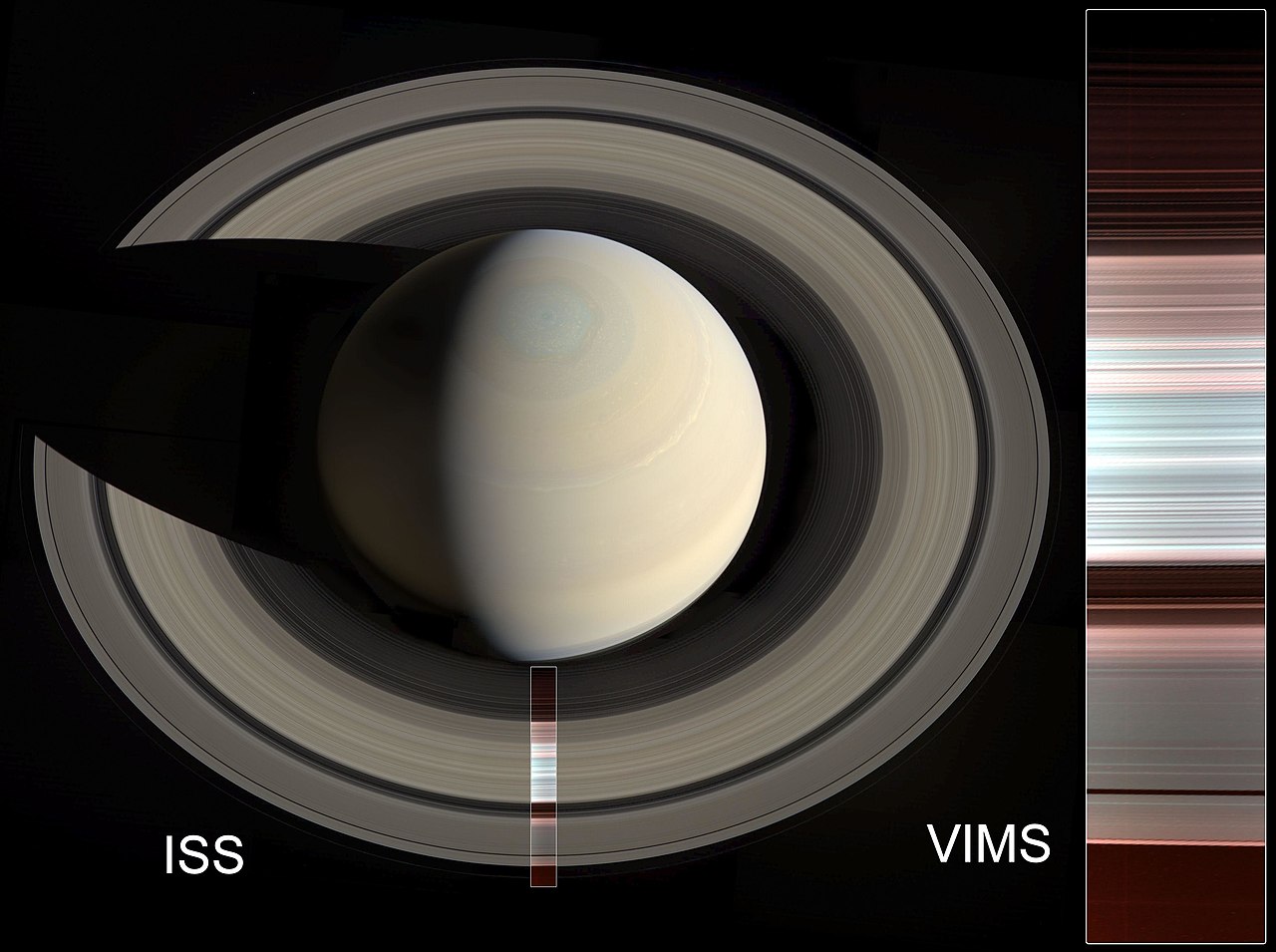
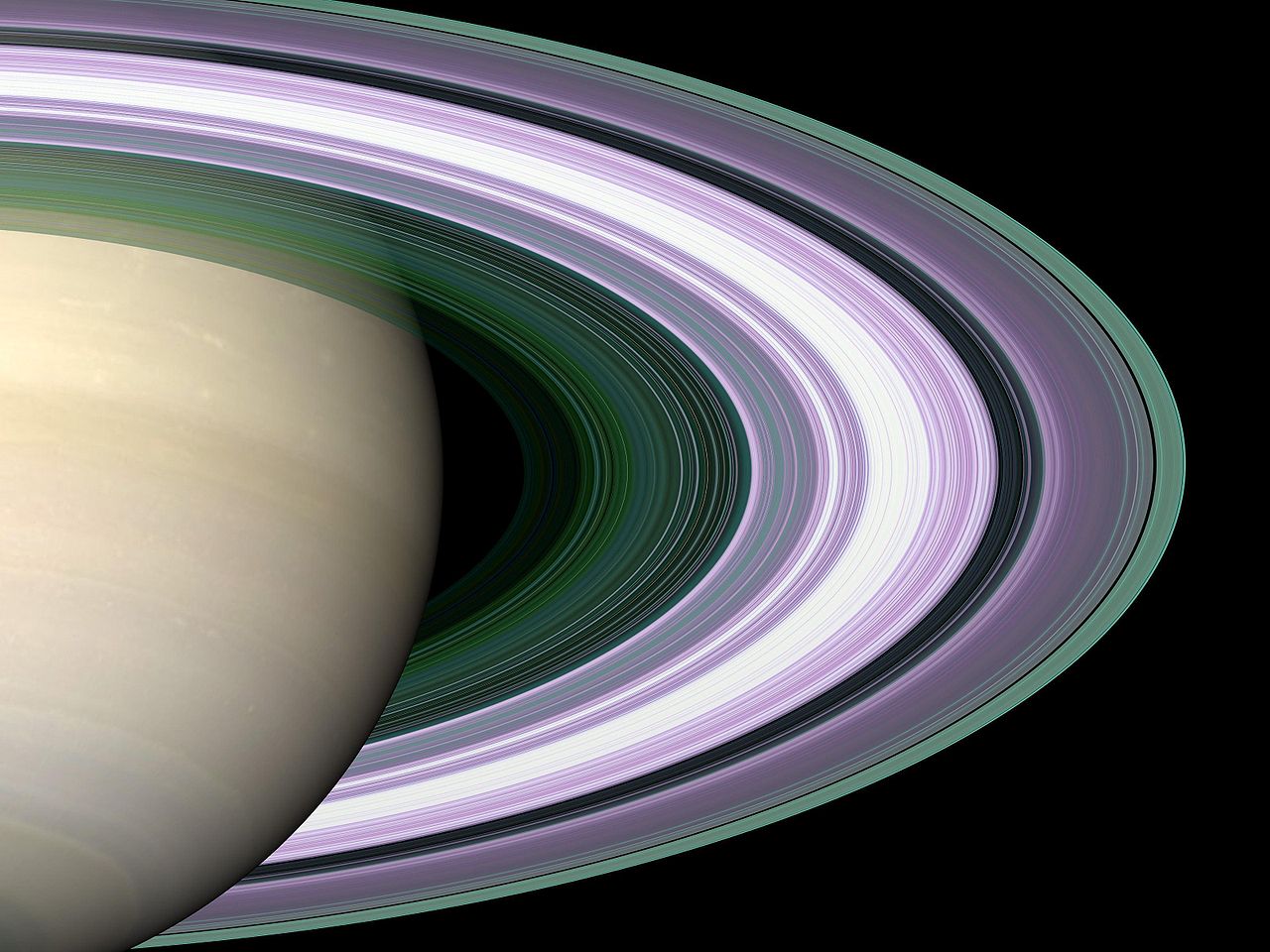
The rings of Saturn are the planet's most prominent and complex system of planetary rings, visible from Earth with modest telescopes and impressive in spacecraft imagery. Rather than a single solid band, the rings comprise countless individual small particles that orbit Saturn in a flattened, disk-like arrangement. These particles range in size from microscopic grains to pieces comparable to a bus or larger, and in some places they cluster into transient clumps and waves that travel around the planet (size diversity, collective motion).
Image gallery
10 Images






Composition and physical properties
Analyses by telescopes and the Cassini mission show the ring material is overwhelmingly water ice with a small admixture of darker dust and organic compounds (water ice, dust and contaminants). The rings are extraordinarily thin compared with their radial extent: dense regions are typically only a few to a few tens of meters thick, yet span tens of thousands of kilometers from the planet. Optical depth, particle size distribution, and local density vary between the major ring groups, producing bright and dark bands, sharp edges, and fine radial structure.
Major structures and gaps
Saturn's main rings are traditionally labeled A, B, and C (with additional fainter rings and diffuse components). Between the A and B rings lies the well-known Cassini Division, a relatively empty band first identified by Giovanni Domenico Cassini. The A ring itself contains narrower gaps such as the Encke Gap, which is maintained by the embedded moon Pan. Many gaps and edge sharpness arise from gravitational interactions and orbital resonances with Saturn's moons, which drive density waves and shepherd material into characteristic patterns.
Dynamics, phenomena, and shepherd moons
The rings are a living laboratory of orbital mechanics. Small moons, sometimes called shepherds, confine ring edges and sustain gaps by their gravitational influence. Embedded moonlets produce propeller-shaped disturbances, while larger moons impose spiral density waves. Electromagnetic interactions also create transient features such as radial spokes and charged dust behavior near Saturn's magnetic field. The rings reflect sunlight strongly, affecting Saturn's overall brightness and appearance.
Origin and age
The origin and age of Saturn's rings remain active research questions. Leading hypotheses propose they formed from the breakup of a comet or icy moon, or as a remnant of the circumplanetary disk that accompanied Saturn's formation. Observations suggesting a high proportion of clean ice have been interpreted to support relatively young ages (hundreds of millions of years), but alternative models allow much older ages if continuous processes replenish or cleanse the material. Cassini's detailed measurements narrowed possibilities but did not produce a definitive consensus.
Scientific importance and exploration
Beyond their visual splendor, Saturn's rings are scientifically valuable because they are a nearby example of a self-gravitating disk, analogous in some ways to protoplanetary and accretion disks. Studies of ring particle collisions, wave propagation, and resonant interactions inform our understanding of planet and satellite formation. The ring system was investigated extensively by the Cassini spacecraft, which provided high-resolution imagery, in situ dust measurements, and gravity studies that transformed our knowledge of ring mass, structure, and composition.
Notable facts and observations
- The rings are not solid; they are composed of trillions of separate particles that can collide and stick or rebound.
- Gaps like the Encke Gap are associated with specific moons such as Pan; others arise from resonances with more distant satellites (resonance effects).
- Historical milestones include early telescopic sightings, Huygens' ring hypothesis, and Cassini's mapping of ring divisions (Cassini).
For visual resources and further reading about ring dynamics and observations, see general overviews of planetary rings and spacecraft mission summaries (particle studies, size distributions, kinematic behavior, composition, non-icy material, ring moons, historical accounts, resonance theory).
Related articles
Author
AlegsaOnline.com Rings of Saturn Leandro Alegsa
URL: https://en.alegsaonline.com/art/82977
Sources
- csep10.phys.utk.edu : "The Rings of Saturn"
- saturn.jpl.nasa.gov : "Cassini Solstice Mission: Pan"