
Ring galaxies: structure, formation, and notable examples
Overview of ring galaxies, their defining features, formation theories, observation methods, and well-known examples such as Hoag's Object, the Cartwheel Galaxy, and NGC 1291.
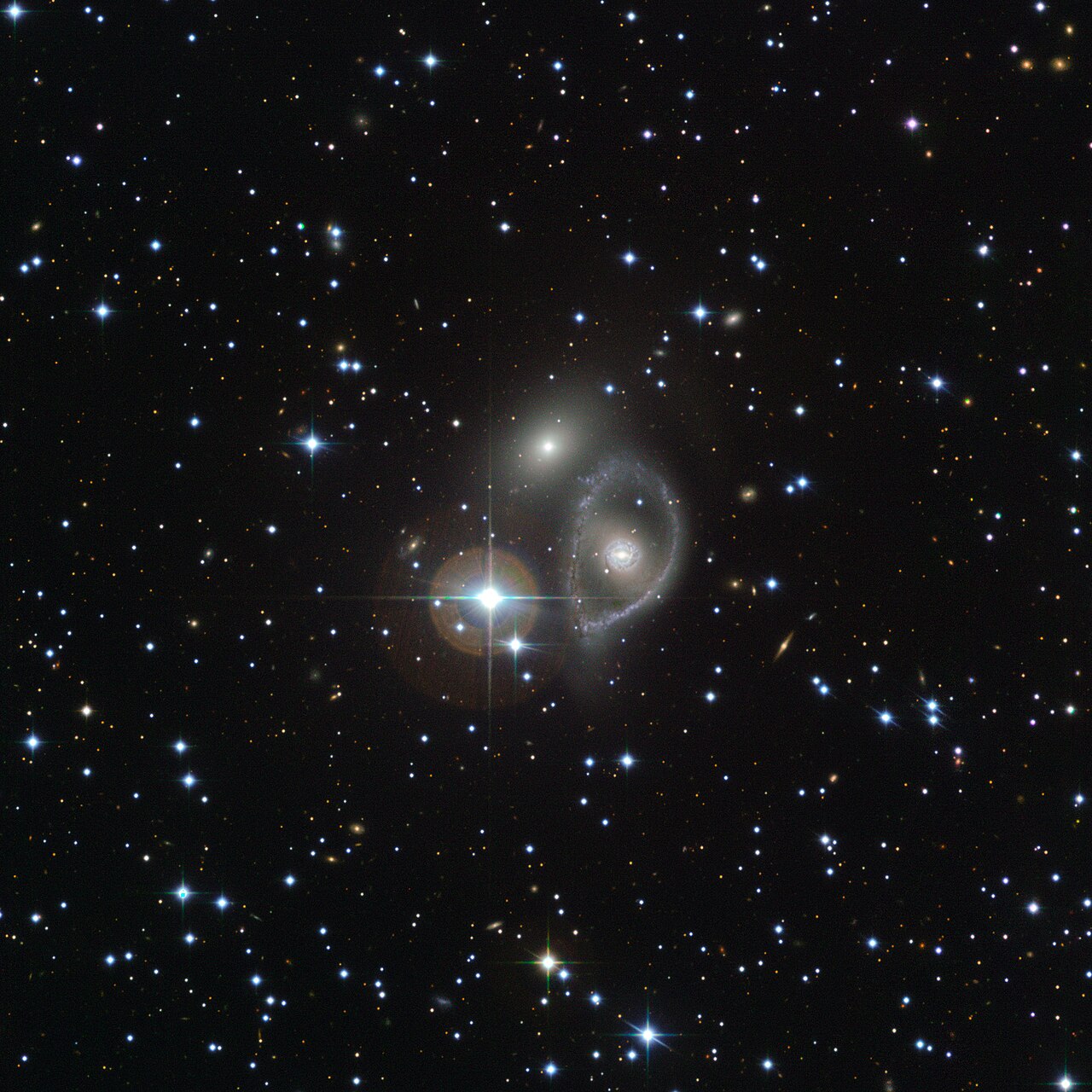
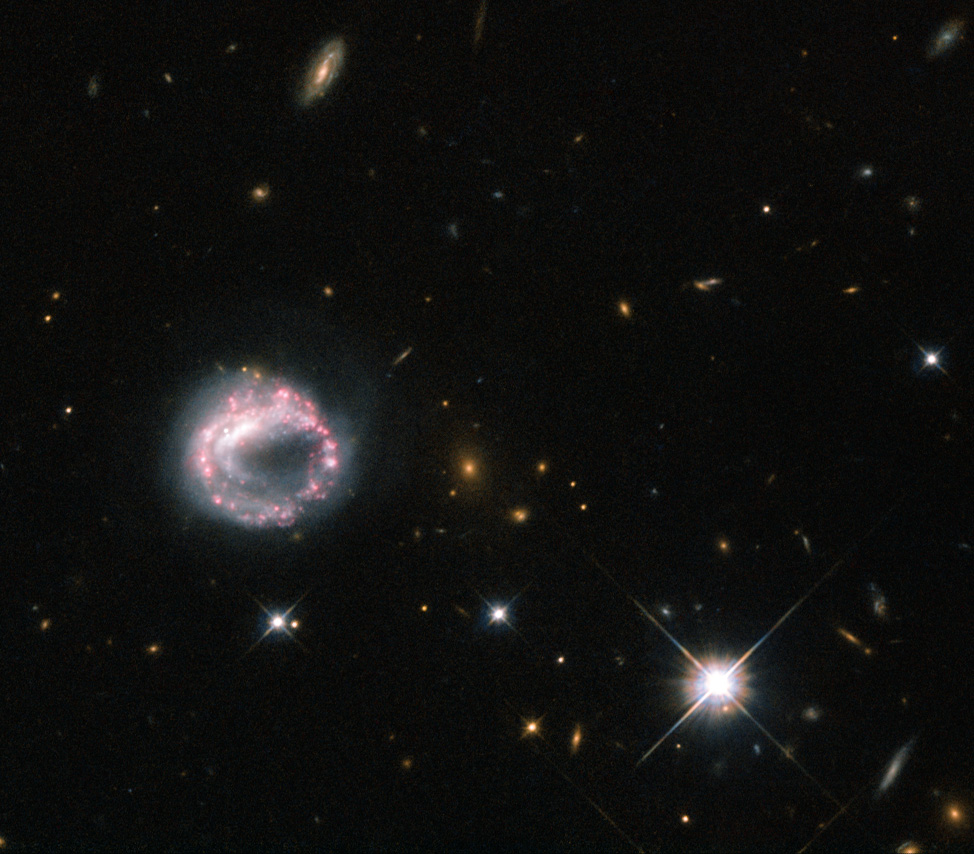
A ring galaxy is a type of galaxy in which stars, gas and dust are concentrated in a ring-like structure that encircles a relatively faint central region. The ring often stands out because it contains many young, hot, blue stars and luminous star-forming regions, while the nucleus or inner disk appears comparatively quiescent. Ring systems range from nearly perfect circular rings to broken or partial arcs, and they are visually striking targets for both amateur and professional observers.
Image gallery
8 Images




Characteristics
Typical features include a bright, star-forming ring, a low-luminosity interior, and sometimes spokes or filamentary connections between ring and center. The ring is usually rich in neutral hydrogen and molecular gas, which fuels rapid star formation and produces strong emission lines in optical spectra. Rings can vary in size, symmetry and color: young rings appear blue because of hot, massive stars, while older rings redden as those stars evolve. Some rings are narrow and well defined, others are broad or clumpy.
Formation mechanisms
A variety of processes can produce ring morphologies. One well-known route is a head-on, bull's-eye collision in which a smaller intruder galaxy passes through the disk of a larger galaxy. The gravitational disturbance launches an outward-propagating density wave that compresses gas and triggers star formation in a ring. This collisional scenario explains dramatic examples with clear radial waves.
Not all rings require a collision. Rings can also arise from internal dynamical resonances: bar-driven torques and orbital resonances in a disk can concentrate gas at particular radii, forming resonance rings. A third path is the accumulation of externally acquired material: gas accretion or minor mergers can build a ring or a polar ring if the infalling material orbits at a different inclination.
Observations, significance and examples
Ring galaxies are studied across the electromagnetic spectrum. Optical imaging reveals young star clusters and H II regions; infrared observations trace older stars and dust; radio maps show the distribution of neutral hydrogen. Because rings often host recent, localized star formation, they are useful laboratories for studying triggered star formation, radial propagation of starbursts, and the response of stellar disks to perturbations.
- Hoag's Object — a nearly perfect ring galaxy with a round central core and a detached luminous ring.
- Cartwheel Galaxy — a dramatic collisional ring with spokes and an expanding wave of star formation.
- NGC 1291 — a barred galaxy with ring-like features often discussed in the context of resonance rings.
Ring galaxies are relatively rare compared with ordinary spirals and ellipticals. Their study has helped astronomers understand how collisions, resonances and accretion shape galaxy morphology over time. Because multiple physical processes can produce ring-like appearances, detailed imaging and spectral analysis are typically required to determine a ring galaxy's origin in any individual case.
Related articles
Author
AlegsaOnline.com Ring galaxies: structure, formation, and notable examples Leandro Alegsa
URL: https://en.alegsaonline.com/art/82955
Sources
- apod.nasa.gov : "Hoag's Object: a strange ring galaxy"