
Right ascension — celestial coordinate for locating objects
Right ascension (RA) is the angular coordinate used along the celestial equator to locate objects on the sky, measured eastward from the vernal equinox and usually expressed in hours, minutes and seconds.
Overview
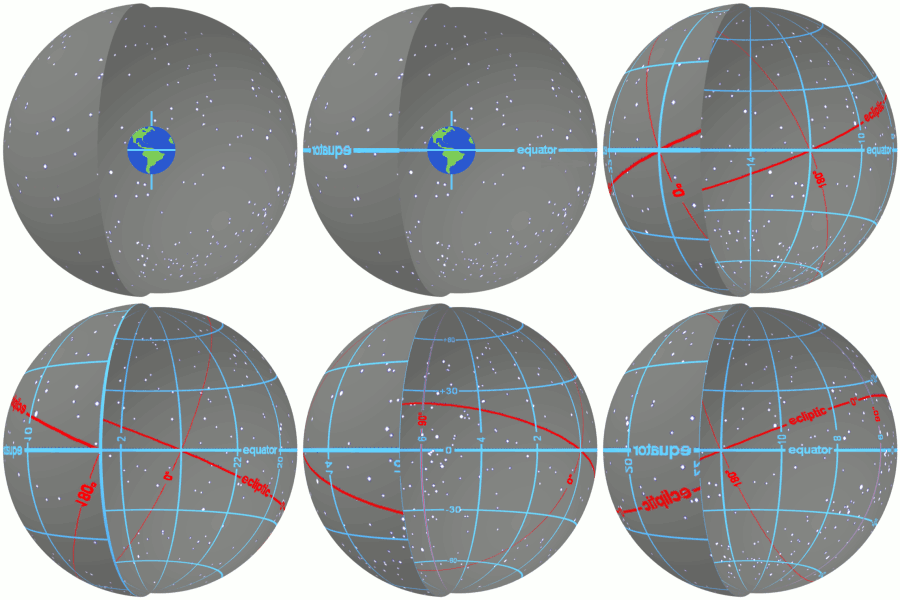
Right ascension (RA, symbol α) is one of two coordinates in the equatorial coordinate system used to specify positions on the celestial sphere. It is the analogue of terrestrial longitude but is measured along the celestial equator from the vernal equinox eastward. The complementary coordinate is declination, which corresponds to terrestrial latitude.
Image gallery
8 Images





Measurement and units
RA is normally given in units of hours, minutes and seconds rather than degrees; the full circle of 360° corresponds to 24 hours, so 1 hour equals 15 degrees. Values increase eastward from 0h to 24h and wrap around. Catalogues and star charts record RA so observers can find objects by comparing an object's RA with the local sidereal time.
How RA is used
When the local sidereal time equals an object's RA, that object is crossing the local meridian and is at its highest point in the sky. Practical applications include pointing equatorial telescope mounts, planning observations, and converting RA and declination into altitude and azimuth for a particular place and time. Detailed ephemerides and charts list celestial positions; many observers consult an almanac or catalogue for RA values.
Applications and examples
- Amateur and professional astronomers use RA to slew telescopes and schedule observations.
- Navigators historically used celestial coordinates for positioning and timekeeping.
- Astrometry and star catalogs record RA to identify and cross-match objects across surveys; modern catalogs provide RA tied to a standard reference frame.
Conventions, epochs and precision
Because Earth’s axis slowly changes direction (precession) and positions shift slightly with time, RA values depend on the chosen epoch. Standard reference epochs (for example, J2000.0) are used in modern catalogs to ensure consistency. There are also distinctions between mean RA and apparent RA, the latter including short-term effects such as nutation and aberration.
History and related concepts
The term derives from historical practice distinguishing movement measured along the equator from oblique measures along other circles. RA is central to the equatorial system and is taught alongside astronomical coordinate basics and the geometry of the celestial sphere. For comparison with Earth-based terminology see longitude.
Related articles
Author
AlegsaOnline.com Right ascension — celestial coordinate for locating objects Leandro Alegsa
URL: https://en.alegsaonline.com/art/82890