
Bagaceratops — small horned-face ceratopsian
Bagaceratops, a small beaked ceratopsian from Late Cretaceous Mongolia, had a short frill and no large horns. Fossils reveal its anatomy, ecology, and importance for understanding dinosaur diversity in Asia.
Overview
Bagaceratops ("small horned face") was a small, herbivorous ceratopsian dinosaur known from Late Cretaceous deposits in Central Asia. It is usually interpreted as a protoceratopsid or closely related basal ceratopsian, characterized by a parrot-like beak, modest bony frill at the back of the skull, and no large facial horns. Paleontologists have recovered multiple skulls and partial skeletons that illuminate its anatomy and lifestyle.
Image gallery
10 Images




Anatomy and distinguishing features
Bagaceratops was a compact, quadrupedal animal with a robust skull bearing a short, plate-like frill rather than the sweeping frills of later large ceratopsians. Its jaws supported a keratinous beak and battery of leaf‑shearing teeth suited to cropping and processing plant material. Limb proportions suggest it moved primarily on all fours but may have been able to adopt a bipedal posture briefly. Size estimates indicate a relatively small animal compared with well-known ceratopsids.
Discovery and classification
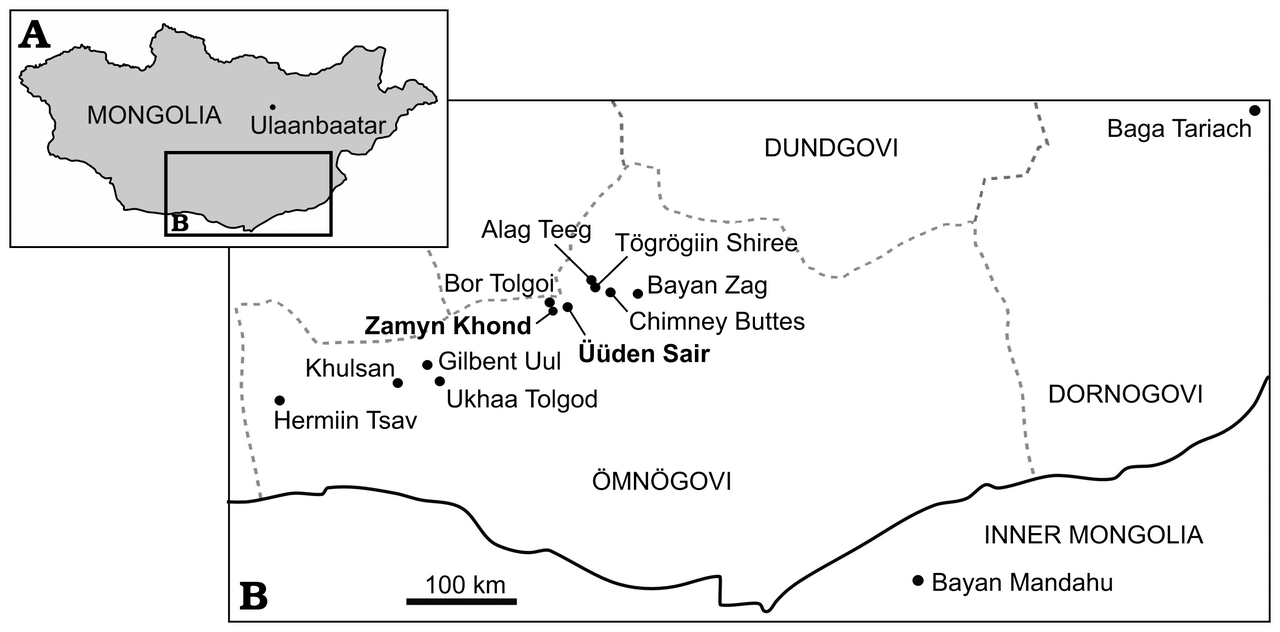
Fossils of Bagaceratops have been found in Late Cretaceous rock formations in Mongolia. The genus was recognized and named in the latter part of the 20th century following fieldwork that produced numerous small ceratopsian skulls. Researchers placed it among the smaller, more basal members of the ceratopsian lineage, a group that includes both protoceratopsids and their relatives. Ongoing study of its skull features helps refine how early horned dinosaurs diversified across Asia.
Paleobiology and ecology
As a plant-eating dinosaur, Bagaceratops fed on low-lying vegetation, using its beak and tooth rows to slice fibrous plants. It lived during the late Cretaceous period, sharing its environment with other small herbivores, predators, and a variety of vertebrates adapted to arid to semi-arid plains. Interpreting social behavior from the fossil record is difficult, but multiple specimens from similar horizons suggest these animals were relatively common in their ecosystems.
Significance and notable facts
Bagaceratops helps paleontologists understand the early evolution of ceratopsians in Asia and the transition from small, frilled forms to the larger horned dinosaurs of later Cretaceous faunas. Its fossils, recovered from Mongolia and described in scientific literature, contribute to regional biostratigraphy and diversity studies. The genus is often cited in discussions of ceratopsian anatomy and the adaptive radiation of herbivorous dinosaurs in Asia.
Key characteristics
- Small-bodied ceratopsian with a beaked mouth and shearing teeth
- Short bony frill at the rear of the skull, without prominent horns
- Known from Late Cretaceous localities in Mongolia
- Important for understanding early ceratopsian diversification and Asian dinosaur faunas
For further general background on ceratopsian dinosaurs and Late Cretaceous ecosystems see overview resources on ceratopsians and broader summaries of the Late Cretaceous period. Specific museum collections and research papers hold detailed descriptions of Bagaceratops specimens and their stratigraphic contexts.
Related articles
Author
AlegsaOnline.com Bagaceratops — small horned-face ceratopsian Leandro Alegsa
URL: https://en.alegsaonline.com/art/8264