
Bagualosaurus — a small Late Triassic sauropodomorph from southern Brazil
Bagualosaurus is an early sauropodomorph dinosaur from the Late Triassic of southern Brazil, described in 2018 from a partial skeleton and notable for its role in understanding sauropodomorph evolution.
Overview
Bagualosaurus is an extinct genus of early sauropodomorph dinosaur that lived during the Late Triassic, roughly 223–230 million years ago. As a member of the broad group that eventually gave rise to the giant, long-necked sauropods, Bagualosaurus represents a small-bodied, early stage in that evolutionary story. Recovered from what is now southern Brazil, the animal is estimated to have reached about 2.5 metres in total length and is known from a single partial skeleton described in 2018. The genus is usually presented in the context of other primitive sauropodomorph dinosaurs from Gondwana.
Image gallery
10 Images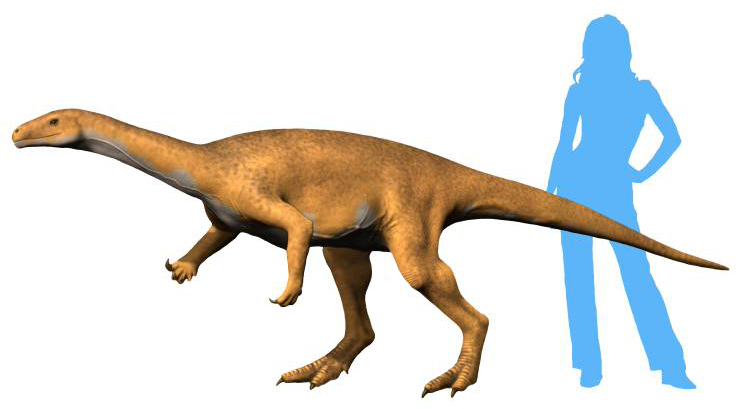


Discovery and naming
The holotype specimen was discovered in 2007 in a ravine near a rural pond in the municipality of Agudo, state of Rio Grande do Sul, Brazil. Excavation recovered a partial skull and lower jaw, twelve dorsal (back) vertebrae, two caudal (tail) vertebrae, two chevrons, elements of the pelvis, portions of both hindlimbs, and several fragmentary ribs. For a time the fossil material remained curated at the Laboratory of Paleovertebrates of the Federal University of Rio Grande do Sul before being formally described and named in 2018. The genus name reflects the describers' choice; the species name recognizes the Agudo locality from which the fossil originated.
Anatomy and classification
Bagualosaurus displays a mosaic of features typical of basal sauropodomorphs. The preserved skull and jaw show tooth shapes and jaw mechanics consistent with an herbivorous to omnivorous diet, while the postcranial skeleton indicates a lightly built, erect-limbed animal capable of efficient locomotion. Key preserved elements include:
- Partial skull and mandible that provide information on tooth form and feeding.
- Twelve dorsal vertebrae and a few tail vertebrae that reveal vertebral structure and proportions.
- Pelvic bones and fragments of hindlimbs that help infer posture and possible locomotor habits.
Phylogenetically, Bagualosaurus is placed among early sauropodomorphs — a diverse assemblage of mostly small- to medium-sized dinosaurs that occupied terrestrial herbivore and omnivore niches in the Triassic and Early Jurassic. It is one of several Early–Middle Triassic to Late Triassic sauropodomorphs known from Brazil and contributes data about the anatomy and diversity of these basal forms.
Paleoenvironment and paleobiology
The sediments preserving Bagualosaurus date to the Late Triassic, a time of continental rearrangement and climatic shifts that influenced early dinosaur evolution. The animal likely lived in a terrestrial environment with seasonal resources, feeding on plants and possibly supplementing its diet with other foodstuffs. Its size and limb structure suggest it was far smaller and more gracile than later sauropods, and it probably combined agile locomotion with browsing close to the ground or on low vegetation.
Scientific significance
Bagualosaurus is important for several reasons: it increases the known diversity of Brazilian sauropodomorphs, provides new anatomical data on early members of the group, and helps clarify the morphological changes that occurred as early sauropodomorphs evolved toward the large, quadrupedal sauropods of the Jurassic. Each new Triassic specimen from South America helps paleontologists reconstruct patterns of early dinosaur radiation across Gondwana and the ecological roles occupied by primitive dinosaurs.
Further notes
- The specimen is part of a growing set of Triassic fossils from Rio Grande do Sul that illuminate early dinosaur evolution in South America.
- Bagualosaurus was formally described in a 2018 scientific publication; readers seeking technical details and comparisons should consult the primary literature and museum records for the holotype.
For general overviews of basal sauropodomorphs and Late Triassic faunas, see broader summaries and curated museum pages linked by researchers and institutions working on Gondwanan paleontology. Detailed specimen information and technical descriptions are available in the formal description and associated datasets. Learn more about sauropodomorphs and regional Triassic discoveries through specialist resources and institutional repositories.
Questions and answers
Q: What is Bagualosaurus?
A: Bagualosaurus is a sauropodomorph dinosaur.
Q: How many sauropodomorphs have been discovered in Brazil?
A: Bagualosaurus is the seventh known sauropodomorph discovered in Brazil.
Q: When did Bagualosaurus live?
A: Bagualosaurus lived about 223-230 million years ago.
Q: How long was Bagualosaurus?
A: Bagualosaurus grew to about 2.5 meters (8.2 ft) long.
Q: What parts of Bagualosaurus were found as fossils?
A: The holotype specimen of Bagualosaurus had a partial skull and jaw, twelve back vertebrae, two tail vertebrae, two chevrons, a pelvis, two partial hindlimbs and five fragmentary ribs.
Q: Where were the pieces of Bagualosaurus found?
A: The pieces of Bagualosaurus were found on a ravine at the edge of a pond in rural Agudo.
Q: When was Bagualosaurus described as a sauropodomorph?
A: Bagualosaurus was described as a sauropodomorph on May 25, 2018.
Related articles
Author
AlegsaOnline.com Bagualosaurus — a small Late Triassic sauropodomorph from southern Brazil Leandro Alegsa
URL: https://en.alegsaonline.com/art/8305