
Rib cage (thoracic cage) — structure, function, and clinical notes
The rib cage (thoracic cage) is the bony and cartilaginous framework that protects thoracic organs, supports respiration and the shoulder girdle, and varies across individuals and species.
Overview
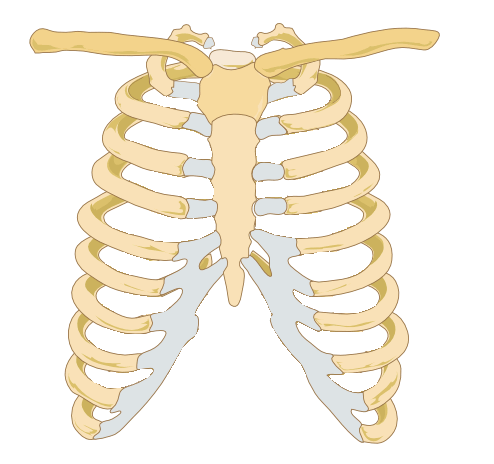
The rib cage, often called the thoracic cage, is the curved bony framework that surrounds and protects the upper internal organs in the chest. It is a principal component of the skeleton in humans and many other vertebrate animals, including some animals commonly studied in anatomy. The cage is formed by paired curved ribs, costal cartilages and the sternum anteriorly, together with the thoracic vertebrae posteriorly. In addition to mechanical protection, the cage provides attachment points for muscles involved in breathing and upper limb movement.
Image gallery
10 Images



Structure and parts
In a typical adult human the thoracic cage includes twelve pairs of ribs, though there is natural variation: some people have one pair fewer or one pair more. Each rib is a curved bone that articulates with a thoracic vertebra at the back and usually connects to the sternum or to other ribs by cartilage at the front. Important components are:
- Ribs: numbered 1–12; ribs can be categorized as true, false and floating.
- Sternum: the central breastbone to which many ribs attach via costal cartilage.
- Costal cartilages: bars of hyaline cartilage that link ribs to the sternum and give the cage flexibility.
- Thoracic vertebrae: posterior bony articulations that anchor the ribs.
Ribs described as "true" (usually ribs 1–7) attach directly to the sternum via their own costal cartilages. "False" ribs (typically ribs 8–10) reach the sternum indirectly by joining the cartilage of the rib above. "Floating" ribs (usually ribs 11–12) do not attach anteriorly to the sternum and end in the musculature of the abdominal wall. The medullary cavities of many ribs contain bone marrow, the tissue responsible for blood cell production.
Function
The rib cage has several overlapping roles. Its principal function is to protect vital organs such as the heart and lungs by forming a semi-rigid enclosure. It also forms the structural scaffold that allows the thorax to expand and contract during breathing: the joints between ribs, vertebrae and costal cartilages permit subtle changes in chest volume driven by the diaphragm and intercostal muscles. Additionally, ribs provide attachment sites for muscles of the neck, back and upper limbs, helping to transfer forces between the trunk and shoulder girdle.
Development, variation and evolution
Ribs develop from costal processes of the thoracic vertebrae during embryogenesis and ossify at characteristic ages during childhood and adolescence. Some people have congenital variations such as cervical ribs (an extra rib above the first rib) or lumbar ribs, which can affect nearby nerves or blood vessels and occasionally cause symptoms. Across vertebrates the form and function of ribs vary: for example, the rib arrangements of birds, mammals and reptiles reflect differences in respiration and locomotion.
Clinical relevance and notable facts
Rib fractures are common injuries from trauma; while single stable fractures often heal without surgery, multiple displaced fractures or flail chest can require specialized care. Conditions involving the rib cage include costochondritis (inflammation of costal cartilage), pectus excavatum or carinatum (structural chest wall deformities) and syndromes related to extra ribs that may compress nerves or vessels. Medical imaging such as X-ray, CT or MRI evaluates rib anatomy and injuries, and clinicians sometimes harvest rib cartilage or bone for reconstructive procedures.
For basic anatomical diagrams and further reading, see resources on thoracic anatomy and comparative rib morphology: rib anatomy overview, detailed rib descriptions, and general chest anatomy pages at major anatomy references: chest/thorax reference. For clinical topics consult standard medical sources or anatomy texts: skeletal system overview and clinical guides to thoracic injury and variation in humans.
Related articles
Author
AlegsaOnline.com Rib cage (thoracic cage) — structure, function, and clinical notes Leandro Alegsa
URL: https://en.alegsaonline.com/art/82575