
Ribosome: the cellular machine that builds proteins
Ribosomes are ribonucleoprotein complexes that translate mRNA into proteins. This article explains their structure, assembly, role in translation, variation across life, and significance in medicine and research.
Overview
Ribosomes are ubiquitous macromolecular assemblies that perform translation, the synthesis of proteins from messenger RNA (mRNA). Often described as molecular machines or tiny factories, ribosomes read the genetic information encoded in mRNA and catalyze formation of peptide bonds between amino acids. As essential cellular components, ribosomes are central to gene expression, cell growth and metabolism; defects in their production or function can impair development and cause disease.
Image gallery
7 Images




Structure and composition
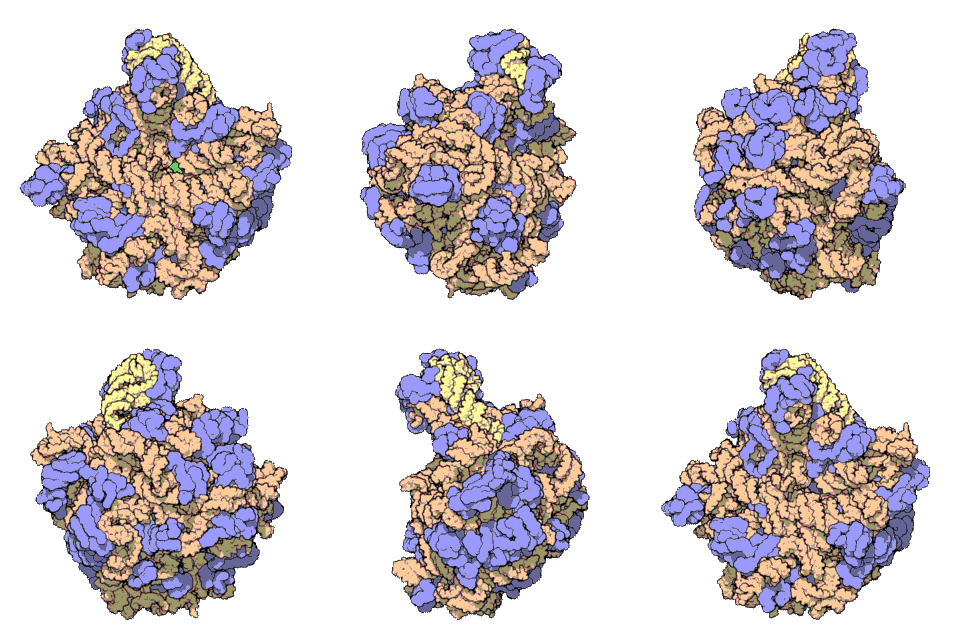
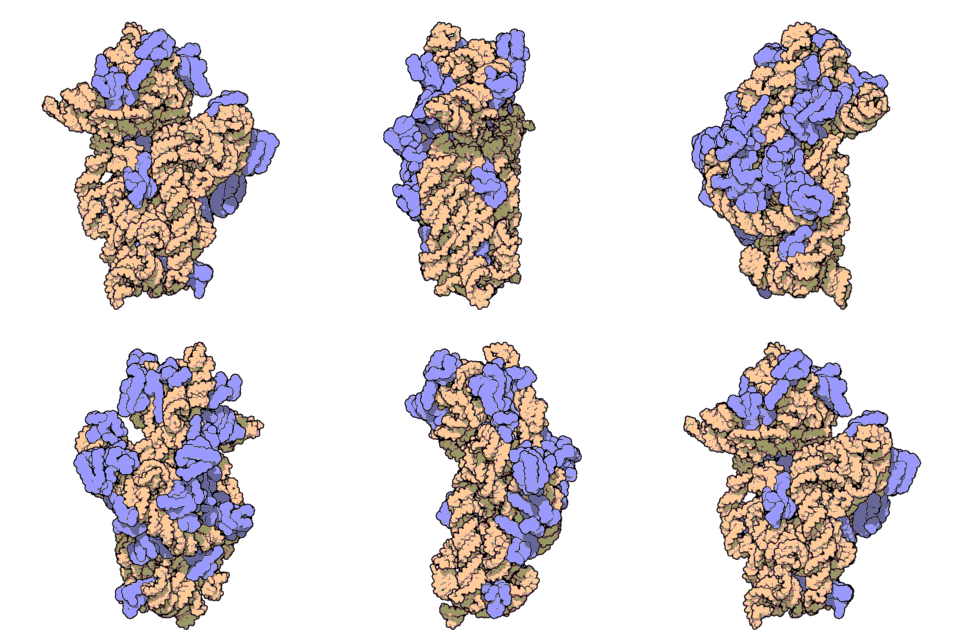
A ribosome is a ribonucleoprotein complex composed of one or more ribosomal RNA (rRNA) molecules and many distinct ribosomal proteins. These components assemble into two unequal subunits that join during translation. In bacteria and many organelles the complete particle is commonly described as a 70S ribosome (30S + 50S subunits) while eukaryotic cytosolic ribosomes are larger (80S; 40S + 60S). The rRNA forms the scaffold and contains the peptidyl transferase center that catalyzes peptide-bond formation, making the ribosome a ribozyme. Ribosomal proteins stabilize rRNA structure and mediate interactions with transfer RNAs (tRNAs), mRNA and protein factors.
Biogenesis and cellular location
In eukaryotes ribosome assembly begins in the nucleolus, a subnuclear body where rRNA genes are transcribed, processed and combined with ribosomal proteins to form preribosomal particles. Subunits undergo further maturation and are exported through nuclear pores to the cytoplasm for final assembly. In prokaryotes transcription, rRNA processing and assembly occur in the cytoplasm. Mature ribosomes may be free in the cytosol or bound to membranes such as the rough endoplasmic reticulum; membrane-bound ribosomes typically synthesize secreted or membrane proteins while free ribosomes make cytosolic or organellar proteins. For broader context see intracellular organization and mRNA translation.
Mechanism of translation
Translation proceeds in three main stages: initiation, elongation and termination. During initiation the small subunit, initiator tRNA and initiation factors position the start codon; the large subunit then joins to form a functional ribosome. During elongation the ribosome traverses the mRNA codons; charged tRNAs enter the A site, peptide bonds form in the P site and deacylated tRNAs exit via the E site. Termination occurs when a stop codon is recognized by release factors, prompting release of the completed polypeptide and dissociation of the complex. Auxiliary factors and energy from GTP hydrolysis coordinate accuracy, timing and translocation across the mRNA.
Functional sites and catalysis
Key functional elements include the decoding center on the small subunit, which ensures correct codon–anticodon pairing, and the peptidyl transferase center on the large subunit, which catalyzes peptide-bond formation. The ribosome also provides an exit tunnel through which the nascent peptide emerges; interactions within this tunnel can influence folding and translational pausing. The RNA-based catalytic core and the conservation of many structural motifs across domains of life highlight the ribosome's ancient origin.
Regulation and quality control
Cells regulate translation at multiple levels: initiation factor activity, mRNA accessibility, ribosome availability and codon usage all influence protein output. Quality-control pathways monitor translation and remove defective mRNAs or stalled ribosomes; examples include nonsense-mediated decay and ribosome-associated quality control. Changes in ribosome composition, called ribosome heterogeneity, may bias translation toward particular mRNAs in development or stress.
Differences across life and evolutionary significance
Ribosomes from bacteria, archaea, eukaryotes and organelles differ in size, rRNA sequences and protein content. Mitochondrial and chloroplast ribosomes resemble bacterial ribosomes, reflecting endosymbiotic ancestry. Because rRNA genes are widespread and evolve relatively slowly, rRNA sequences are widely used in molecular phylogenetics to infer evolutionary relationships. Conservation of the ribosome's core functions supports the idea that translation emerged early in the evolution of life.
Scientific, medical and biotechnological importance
Ribosomes are major antibiotic targets: many antibacterial drugs bind bacterial ribosomes to block translation selectively. High-resolution structural methods, especially cryo-electron microscopy, have revealed detailed ribosome architectures that inform drug design and mechanistic understanding. Experimental techniques such as ribosome profiling map translating ribosomes across the transcriptome and reveal translational control. Synthetic biology explores engineered ribosomes and orthogonal translation systems for new functions. See resources on ribosomal proteins, rRNA functions, and ribosome research for further reading.
Clinical and research applications
Altered ribosome function or biogenesis underlies a group of human disorders known as ribosomopathies; these can affect rapidly dividing tissues and manifest as anemia or developmental anomalies. Antibiotic resistance mechanisms often involve changes to ribosomal binding sites, and structural studies are used to design new therapies. In research, ribosomes serve as models for studying RNA catalysis, macromolecular assembly and the origins of life. For applied perspectives see translation regulation, antibiotic mechanisms, and molecular genetics resources.
Note: the ribosome's peptidyl transferase center is RNA-based rather than protein-based, a distinctive and widely accepted feature that links modern translation to early RNA world hypotheses.
Questions and answers
Q: What are ribosomes?
A: Ribosomes are tiny molecular robots that make proteins by doing RNA translation.
Q: Where are ribosomes found?
A: Ribosomes are found in all living cells, including prokaryotes and eukaryotes.
Q: How are ribosomes made?
A: Ribosomes start being made in the nucleolus of a cell, which is in the nucleus. They are a mixture of protein and RNA.
Q: Where do ribosomes move to after they are made?
A: Ribosomes move from the nucleolus into the cytoplasm, where they sit on the endoplasmic reticulum or throughout the cytoplasm.
Q: What is the job of ribosomes?
A: The job of ribosomes is to make new proteins by moving along a strand of messenger RNA and building a protein based on the code it reads. This is called translation.
Q: How many ribosomes are needed in each cell?
A: We need up to 10 million ribosomes in every cell.
Q: How do cells get the number of ribosomes needed?
A: Cells have many copies of rRNA genes to get the number of ribosomes needed. We inherit about 400 rRNA genes across five different chromosomes.
Related articles
Author
AlegsaOnline.com Ribosome: the cellular machine that builds proteins Leandro Alegsa
URL: https://en.alegsaonline.com/art/82593
Sources
- sciencemag.org : "The structure of the eukaryotic ribosome at 3.0 Å resolution"
- doi.org : 10.1126/science.1212642
- pubmed.ncbi.nlm.nih.gov : 22096102
- sciencemag.org : "Crystal structure of the eukaryotic 40S ribosomal subunit in complex with initiation factor 1"
- doi.org : 10.1126/science.1198308
- pubmed.ncbi.nlm.nih.gov : 21205638
- doi.org : 10.1126/science.1211204
- pubmed.ncbi.nlm.nih.gov : 22052974