
Reinforced concrete
Concrete strengthened with embedded reinforcement (usually steel) to resist tension. Covers materials, behavior, history, common variants (prestressed, precast), uses, durability issues and maintenance.
Overview
Reinforced concrete is a composite building material in which concrete and a separate reinforcing material work together to resist loads. Concrete itself is strong in compression but comparatively weak in tension; the embedded reinforcement supplies the tensile strength and ductility that plain concrete lacks. For a general introduction to the base material see concrete.
Image gallery
10 Images






Components and how it works
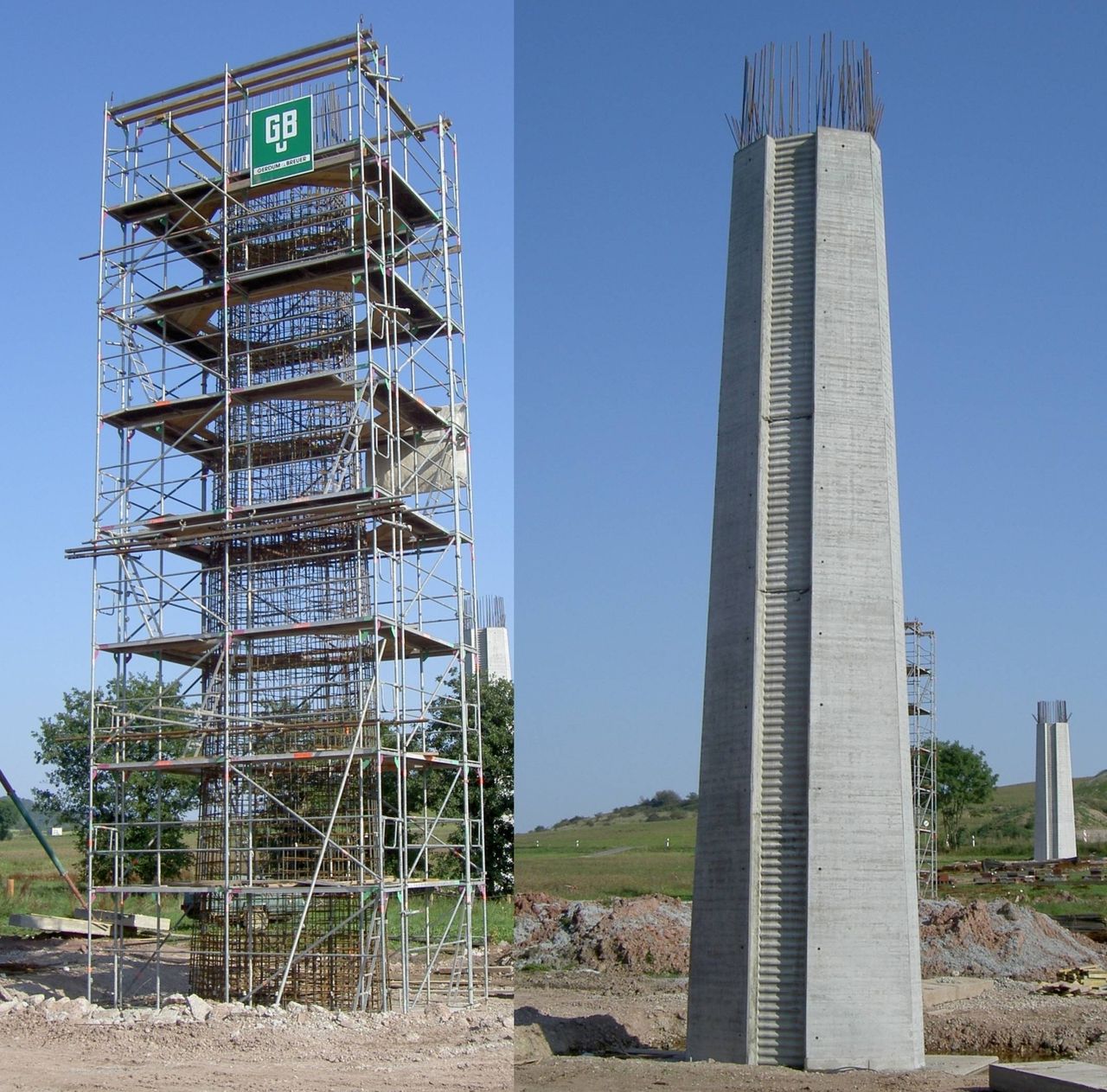
Typical reinforced concrete consists of a cementitious matrix (cement, aggregates and water) and reinforcement members. The reinforcing elements are most often steel bars or mesh because steel has high tensile strength and a thermal expansion behaviour compatible with concrete. Common reinforcing products are steel rebar, welded wire fabric and prestressing strands; the steel itself is commonly described as steel reinforcement.
Protection and durability
Because steel can oxidize, a range of protective measures is used. Coatings such as galvanizing, epoxy paints or stainless-steel reinforcement help reduce the risk of rusting and corrosion. Durability also depends on adequate concrete cover, mix quality and design to limit cracking and the ingress of chlorides or carbon dioxide.
History and development
The use of iron and steel to reinforce masonry and concrete developed during the 19th century as engineers sought materials that combined compressive strength with tensile capacity. Early inventors and patentees experimented with embedded metal in concrete for pipes, tanks and containers, and the technique later evolved into the structural systems used in modern construction.
Variants, construction methods and examples
Reinforced concrete systems include cast-in-place members, precast elements and prestressed concrete. In prestressed concrete, steel tendons are tensioned before or after casting so that the finished member carries compressive stresses that offset service loads. Typical applications are:
- Buildings and floor slabs (building construction),
- Bridges and highway structures (roads and bridges),
- Dams, retaining walls and foundations,
- Precast units such as beams, columns and façade panels.
Advantages, limits and notable facts
Advantages include structural efficiency, fire resistance and the ability to form complex shapes. Limits arise from weight, susceptibility to reinforcement corrosion and the need for careful detailing and quality control. In many regions most structural concrete used in buildings and transport infrastructure is reinforced, and strength can be increased further by prestressing techniques to produce prestressed concrete.
Maintenance and inspection
Long-term performance depends on design that controls cracking, adequate cover, proper concrete mix and maintenance to prevent corrosion. Inspections may include visual checks, cover depth measurements, and testing for chloride content or carbonation. Repair methods range from patching and cathodic protection to replacement of badly corroded reinforcement.
Related articles
Author
AlegsaOnline.com Reinforced concrete Leandro Alegsa
URL: https://en.alegsaonline.com/art/81974