
Reinforcement learning: concepts, history, and applications
Reinforcement learning (RL) teaches agents to make decisions from trial-and-error feedback. This article covers core ideas, historical development, common algorithms, uses, and practical challenges.
Overview
Reinforcement learning (RL) is a branch of machine learning in which an agent learns to make decisions by interacting with an environment and receiving feedback in the form of rewards or penalties. Rather than being given explicit correct answers, the agent must discover which actions lead to desirable outcomes by trial and error. A central goal is learning a policy — a mapping from states to actions — that maximizes cumulative reward over time.
Image gallery
1 Image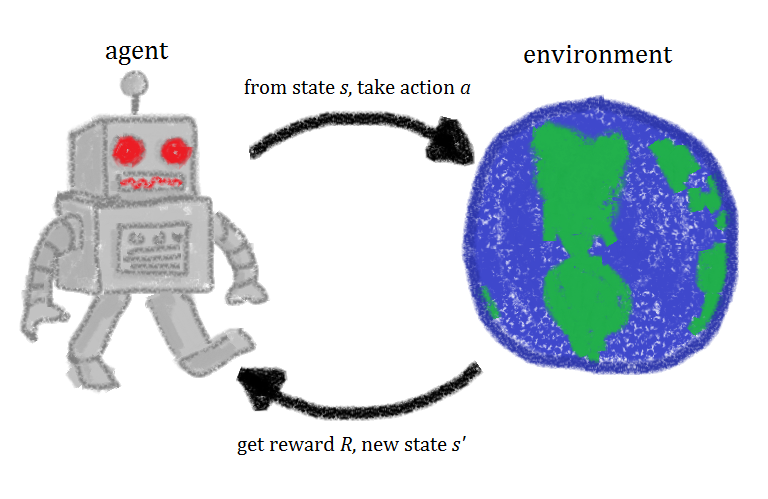
Core concepts and components
RL systems are commonly described using a few basic elements. The agent observes the environment, selects actions, and receives scalar rewards. The environment responds to actions and produces new observations and rewards. Key theoretical notions include:
- Policy: how the agent chooses actions (deterministic or stochastic).
- Reward signal: the scalar feedback guiding learning.
- Value function: an estimate of expected future reward from states or state–action pairs.
- Model: an internal prediction of environment dynamics used by model-based methods.
Algorithms and distinctions
Methods are often classified as model-free (learn a policy or value function directly) or model-based (learn a model of dynamics). Popular approaches include temporal-difference learning and Q-learning, policy gradient methods, and actor-critic architectures. Practical systems must balance exploration (trying new actions to discover better outcomes) against exploitation (using known rewarding actions).
History and intellectual roots
RL draws on behaviorist psychology concepts of rewards and punishments, control theory, and dynamic programming from operations research. Over decades it evolved from theoretical foundations to scalable algorithms through advances in function approximation, especially deep neural networks, which enabled RL to tackle high-dimensional sensory inputs.
Applications and examples
Reinforcement learning has been applied to robotics, autonomous control, game playing, resource allocation, recommendation systems, and simulated scientific discovery. Practical deployments often combine RL with supervised learning components or human-derived priors to improve safety and efficiency. For accessible introductions to agents and learning paradigms see agent overview and broader machine learning resources.
Challenges and notable considerations
Important challenges include sample efficiency (how much experience is needed), reward design (specifying objectives without unwanted side effects), stability of learning with function approximators, and ensuring safety and interpretability. For contrasts with other paradigms, consult summaries comparing RL to supervised learning and to behavioral foundations at behaviorist psychology. Further reading and tutorials often link to surveys and educational material via the referenced resources.
Questions and answers
Q: What is reinforcement learning?
A: Reinforcement learning is a type of machine learning in which a software agent is taught to behave in an environment by receiving feedback about its performance.
Q: How is reinforcement learning different from supervised learning?
A: Reinforcement learning differs from supervised learning in that the correct inputs and outputs are never shown to the agent, and it usually learns as it goes rather than being trained in advance.
Q: What is the main inspiration for reinforcement learning?
A: Reinforcement learning is inspired by behaviorist psychology, which tries to explain behavior as a response to external stimuli.
Q: How does reinforcement learning work?
A: In reinforcement learning, the agent interacts with the environment and receives feedback in the form of rewards or punishments. It then uses this feedback to learn which actions will lead to better outcomes.
Q: What is online learning?
A: Online learning is a type of learning in which the agent learns as it goes, rather than being trained in advance.
Q: What is the challenge faced by agents in reinforcement learning?
A: The main challenge faced by agents in reinforcement learning is choosing between exploring the environment to learn more, or sticking with what they know works best.
Q: What is the goal of reinforcement learning?
A: The goal of reinforcement learning is to teach a software agent to behave in an environment in a way that maximizes its reward over time.
Related articles
Author
AlegsaOnline.com Reinforcement learning: concepts, history, and applications Leandro Alegsa
URL: https://en.alegsaonline.com/art/81975