
Resistance welding: principles, types, uses, and practical considerations
Resistance welding joins metals by heat from electrical resistance. This article explains how it works, common types, equipment, applications (notably automotive), advantages, limits and quality issues.
Overview
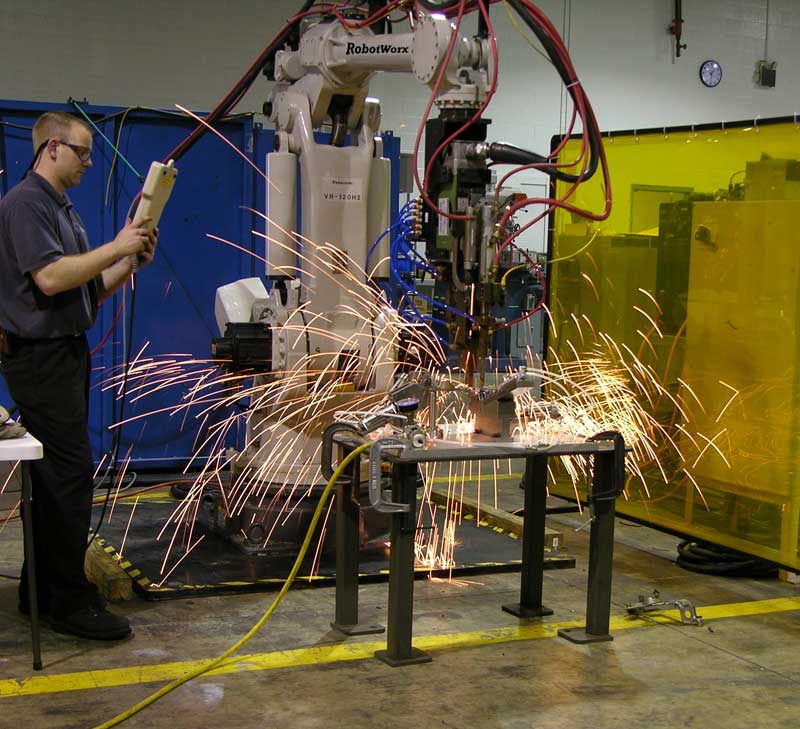
Resistance welding is a family of joining processes in which heat generated by electrical resistance at the contact surfaces melts or softens material to form a joint. The basic concept is simple: an electric current is passed through metal parts held together under pressure so that localized heating at the interface, combined with force, produces a weld. It is one branch of electric resistance welding and is widely used where rapid, repeatable joints are required.
Image gallery
3 Images

Process, equipment and parameters
Key elements are a power supply (often a transformer or inverter), a pair of water-cooled electrodes to clamp the workpieces, and controls for current, time and force. The principal parameters that determine weld quality are welding current, electrode force and weld time (or duty cycle). Electrode shape and cooling influence how heat is concentrated and how the welded "nugget" forms. Modern systems include programmable controls and monitoring to ensure consistent results.
Common types
- Spot welding: two electrodes press at a point to form discrete welds in sheet metal.
- Seam welding: rotating wheel electrodes produce a continuous, overlapping series of spot welds (used for leak-tight joints).
- Projection welding: local projections on one workpiece concentrate current and deformation to form controlled welds.
- Butt/flash and upset welding: used for joining thicker parts or components with end contact.
Applications and advantages
Resistance welding is most familiar in the automotive industry for assembling body panels and structural components, but it is also common in appliances, electrical equipment, battery manufacturing and metal furniture. Advantages include high production speed, no filler metal, good repeatability with automation, and minimal surface preparation for many steels.
Limitations, quality and safety
Limits include restricted thickness range, sensitivity to surface oxides (notably aluminum), electrode wear, and the need to control electrical and mechanical parameters for consistent strength. Quality is assessed by destructive nugget testing and by nondestructive checks such as ultrasonic or electrical monitoring. Safety measures address high currents, pinch points, and fumes from overheated coatings.
History and notable facts
Resistance welding developed alongside industrial electrical power systems in the late 19th and early 20th centuries and expanded with mass production. Advances in power electronics and control systems have improved energy efficiency and weld consistency, allowing broader use with nonferrous alloys and more demanding production systems.
Related articles
Author
AlegsaOnline.com Resistance welding: principles, types, uses, and practical considerations Leandro Alegsa
URL: https://en.alegsaonline.com/art/82289