
Reverse osmosis: principles, components, uses, and limitations
Reverse osmosis (RO) is a pressure-driven membrane process that separates water from dissolved solids. It is used for desalination, water treatment, industrial purification and producing ultrapure water.
Reverse osmosis (RO) is a membrane-based separation process in which pressurised water is forced through a semipermeable membrane. The membrane permits passage of water molecules while retaining many dissolved salts, organic molecules, and larger particles. RO acts at the molecular level and is distinct from mechanical filtration and thermal processes such as distillation.
Image gallery
7 Images


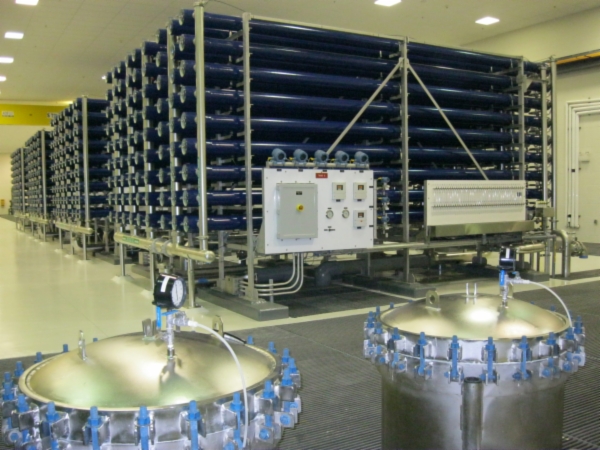

Basic principles
Natural osmosis moves solvent from a dilute solution toward a more concentrated solution through a membrane. In reverse osmosis, applied hydraulic pressure on the concentrated side exceeds the natural osmotic pressure and drives solvent (permeate) in the opposite direction, leaving a concentrated reject or brine on the feed side. System performance depends on membrane permeability, feed quality, applied pressure and temperature.
Key components and pretreatment
- Membranes: most common types are thin-film composite polyamide membranes in spiral-wound modules and, in some applications, hollow-fibre elements. Choice depends on water quality and required recovery.
- Pumps and pressure vessels: provide the pressure needed to overcome osmotic forces and move water through modules.
- Pretreatment: coagulation, sediment filtration, media filters, cartridge filters, softening and removal of oxidants (e.g., chlorine) are often required to prevent fouling, scaling and chemical damage to membranes.
- Post-treatment: remineralisation, pH adjustment and disinfection prepare permeate for distribution or specific end uses.
Operation, maintenance and common issues
RO systems are sensitive to fouling (colloids, biofilms), scaling (inorganic precipitates) and chemical degradation. Operators use antiscalant dosing, regular cleaning-in-place (CIP) procedures, and monitoring of differential pressure and salt passage to maintain performance. Energy recovery devices and improved pump designs reduce the energy penalty associated with high-pressure operation.
Applications and environmental considerations
RO is widely applied for seawater and brackish water desalination, municipal and industrial water treatment, production of ultrapure water for laboratories and pharmaceuticals, and selective concentration in food and beverage processes. Limitations include energy requirements and management of concentrated brine; brine disposal and mitigation of environmental impacts are important planning considerations. RO is often combined with other treatments to meet specific water quality goals.
Distinctions and selection
Reverse osmosis is distinguished from other membrane processes (microfiltration, ultrafiltration, nanofiltration) by the size of species retained and the higher pressures involved. System selection should consider feedwater chemistry, target permeate quality, recovery ratio, lifecycle costs and regulatory constraints.
Related articles
Author
AlegsaOnline.com Reverse osmosis: principles, components, uses, and limitations Leandro Alegsa
URL: https://en.alegsaonline.com/art/82405
Sources
- waterfilteroo.com : WaterFilteroo