
Reign of Terror (French Revolution)
A concentrated period of political repression and executions during the French Revolution (1793–1794), led by revolutionary leaders and institutions to suppress perceived enemies of the Republic.
The Reign of Terror was a phase of the French Revolution in which the revolutionary government used summary trials, executions and measures of political repression to defend and consolidate the Republic. It is commonly dated from the proclamation of emergency measures in early September 1793 to the fall of key Jacobin leaders in late July 1794. The episode is most often associated with Maximilien de Robespierre and the Committee of Public Safety, and it remains one of the revolution's most controversial and studied periods.
Image gallery
10 Images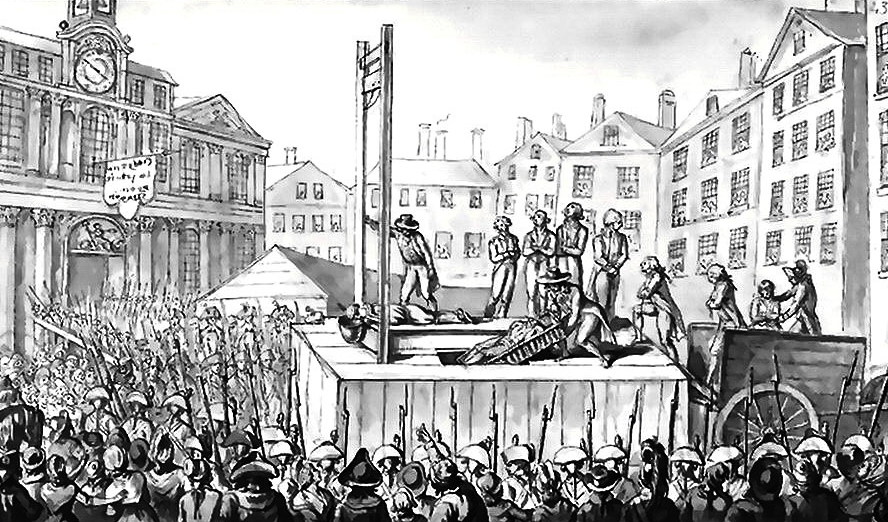


Origins and timeline
After the revolution of 1789, France faced internal revolts, economic crisis and foreign war. In this climate the National Convention and its executive organs expanded their powers to meet real and perceived threats. The period identified as the Terror began in the autumn of 1793 when emergency courts and extraordinary measures were formalized to deal with counter-revolutionary activity and hoarding. Violence reached a peak in the spring and summer of 1794 (a phase sometimes called la Grande Terreur), and then subsided when opponents in the Convention moved against the Committee of Public Safety and its most prominent leaders.
Institutions, laws and procedures
The machinery of the Terror combined existing republican bodies with special measures. Key elements included:
- The Revolutionary Tribunal, an extraordinary court that tried suspects and often sentenced them to death.
- The Committee of Public Safety, which directed policy, military mobilization and policing in the name of public security.
- Extraordinary legislation such as the Law of Suspects and, later, the Law of 22 Prairial, which simplified prosecution and limited defenses available to the accused.
Accusations could come from local representatives, revolutionary committees in towns, or from centralized organs. The guillotine became the public symbol and common means of execution, used for those convicted of opposing the revolutionary government.
Notable figures and notable events
Many leaders and factions played roles in the Terror's operation and its eventual collapse. Maximilien Robespierre is widely associated with its rhetoric and justifications, while other figures such as Saint-Just and various Jacobin allies were influential in policy-making. Opposition came from moderates and rival revolutionaries; some, like Danton, were executed during internal purges. A widely recalled incident involved Carmelite nuns who, publicly defiant, were executed and reported to have sung religious songs as they faced death; this episode attracted attention across Europe.
Characteristics and scope
The Terror combined political repression with measures aimed at stabilizing society and the war effort. Typical features included mass conscription, price controls, surveillance networks, denunciations by citizens, rapid tribunals and widespread use of capital punishment. Estimates of the number of people killed during the Terror vary; historians commonly cite figures in the tens of thousands for those executed by judicial sentence or killed in related repression, while many more suffered imprisonment or exile.
End, legacy and interpretations
The Terror ended when a coalition of deputies moved against the Committee's leadership in the reaction known as the Thermidorian Reaction; Robespierre and several associates were arrested and executed, and the Convention repealed some of the emergency legislation. The episode shaped later debates about revolutionary legitimacy, the limits of emergency power and the risks of concentrating coercive authority. Scholars and commentators continue to debate whether the Terror was an inevitable response to crisis, an instrument of ideological purification, or a distortion of revolutionary aims.
Further reading and context
For overview material and primary-source collections, see general histories of the French Revolution and biographies of its leaders. To understand the legal framework, consult works on the Jacobins, the development of the guillotine as a penal instrument, and specific measures such as laws enacted on 5 September 1793 and during the months that followed. Accounts of the later phase—sometimes labeled the Great Terror—detail the intensification of trials in June and July 1794 and episodes such as the execution of the Carmelite nuns who were publicly condemned and charged with treason. The collapse of the Terror and its aftermath are discussed under the Thermidorian Reaction, a decisive turning point in revolutionary politics.
While often reduced in popular memory to images of mass executions, the Reign of Terror was a complex mixture of wartime exigency, political struggle and ideological fervor. Its study helps explain how revolutionary regimes confront internal division, the legal and moral tensions of emergency government, and the long-term consequences for political culture in France and beyond.
Related articles
Author
AlegsaOnline.com Reign of Terror (French Revolution) Leandro Alegsa
URL: https://en.alegsaonline.com/art/81955