
Promethium (element 61) — properties, isotopes, history and uses
Promethium (Pm, atomic number 61) is a radioactive lanthanide with no stable isotopes. Produced in nuclear reactions, it has limited industrial uses and is notable for its rarity and beta-emitting isotopes.
Overview
Promethium is a radioactive chemical element in the lanthanide series with the symbol Pm. Its atomic number, 61, denotes the number of protons in the nucleus of each atom. Unlike most lanthanides, promethium has no stable isotopes; all known isotopes decay radioactively. In that respect it and technetium are distinctive among lighter elements: they are the only two elements with no stable isotopes below lead on the periodic table.
Image gallery
6 Images



Physical and chemical characteristics
Promethium is a soft, silvery metal that behaves chemically like other rare-earth elements. Its chemistry is dominated by the +3 oxidation state, forming salts and coordination compounds similar to adjacent lanthanides. Because all isotopes emit radiation, bulk metallic samples are studied and handled under controlled conditions. Most emitted radiation from commonly used isotopes is beta particles with relatively low gamma output.
Isotopes and radioactivity
More than twenty isotopes of promethium have been identified. The longest-lived isotope in common reference is promethium‑145, which has a half-life of about 17.7 years. Other isotopes, such as promethium‑147, are shorter lived and were historically important in applications because they are convenient beta emitters. Natural traces of promethium can form by spontaneous fission in uranium ores or by cosmic ray interactions, but almost all commercially available promethium is produced artificially.
Production and uses
Commercial promethium is obtained from nuclear fission products and neutron irradiation of certain neodymium or samarium targets. Typical production routes include:
- Separation from the mixture of fission products following uranium or plutonium fission.
- Neutron capture in reactors followed by chemical separation of neighboring rare-earth elements.
Uses are specialized and limited because of radioactivity. Notable applications include:
- Betavoltaic batteries for small, long-lived power supplies.
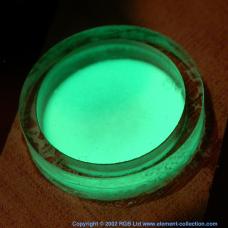
- Thickness gauges and luminous paint in the past, though these uses declined as safer alternatives became available.
History, occurrence and safety
Promethium was first isolated and identified in the mid-20th century from fission products and was named after the mythic Prometheus. It occurs only in trace amounts in nature. Handling promethium requires radiation safety measures: shielding, contamination control and regulatory compliance limit its commercial deployment. Waste management and restricted availability keep its use niche and carefully controlled.
Notable facts
Because it lacks stable isotopes and is primarily produced by nuclear reactions, promethium is of interest to nuclear scientists and collectors of rare elements but has few everyday applications. Research continues into small‑scale power sources and specialized measurement tools that exploit its beta radiation under controlled conditions.
Further reading and technical references: atomic structure, lanthanide group, isotope lists, radioactivity data, element overview.
Related articles
Author
AlegsaOnline.com Promethium (element 61) — properties, isotopes, history and uses Leandro Alegsa
URL: https://en.alegsaonline.com/art/79421