
Poxviridae: family of large double-stranded DNA viruses infecting humans and animals
Poxviridae: family of large double-stranded DNA viruses that infect humans and animals, cause skin and mucous lesions, replicate in the cytoplasm, and include smallpox, vaccinia, monkeypox, and molluscum.
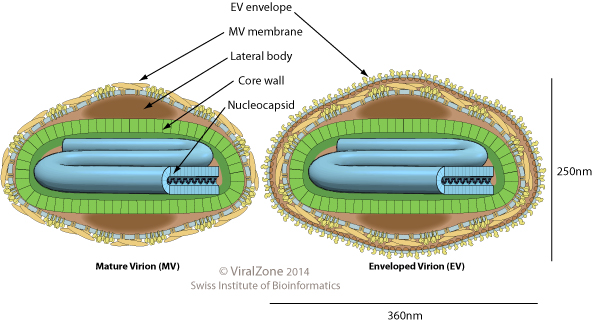
Poxviridae is a family of large, complex double-stranded DNA viruses that infect a variety of vertebrate hosts. Members of this family produce relatively large, brick- or ovoid-shaped virions, carry genomes on the order of 130–375 kilobase pairs, and typically cause lesions of the skin and mucous membranes. Poxviruses are known pathogens of both humans and many animals.
Unlike most DNA viruses, poxviruses replicate entirely in the cytoplasm of the infected cell and therefore encode much of the transcription and replication machinery they require. Several species in the family have important historical and contemporary public-health roles: for example, variola virus — the cause of smallpox — was eradicated by vaccination, and vaccinia virus was used as the vaccine strain. Other poxviruses can cause zoonotic or strictly human disease and vary in severity and transmissibility.
Image gallery
5 Images


Human-infecting genera
- Orthopoxvirus — includes variola (smallpox), vaccinia, cowpox virus, and monkeypox virus. Several orthopoxviruses are zoonotic and can produce pustular skin lesions; variola was declared eradicated in 1980.
- Parapoxvirus — contains viruses such as orf virus, pseudocowpox virus, and bovine papular stomatitis virus, which primarily infect ungulates but can be transmitted to humans, often causing localized skin infections.
- Yatapoxvirus — comprises tanapox virus and yaba monkey tumor virus; these are less widespread but can infect primates and occasionally humans.
- Molluscipoxvirus — represented by molluscum contagiosum virus (MCV), an exclusively human pathogen that produces characteristic pearly, umbilicated skin nodules.
Because poxviruses carry many genes for immune modulation and host interaction, they exhibit a wide range of host specificities and disease outcomes. While global eradication eliminated smallpox, other poxvirus infections continue to occur in animals and humans, and some — such as monkeypox — have caused outbreaks of public-health concern in recent years.
Related articles
Author
AlegsaOnline.com Poxviridae: family of large double-stranded DNA viruses infecting humans and animals Leandro Alegsa
URL: https://en.alegsaonline.com/art/78568