
Platonic Solids: The Five Regular Convex Polyhedra
Platonic solids are the five convex regular polyhedra whose faces are identical regular polygons and whose vertices are all equivalent. They include the tetrahedron, cube, octahedron, dodecahedron and icosahedron.
A Platonic solid is a special type of polyhedron that is both regular and convex: every face is the same regular polygon and the same number of faces meet at each vertex. Because of these symmetry constraints there are exactly five such solids. They are central examples in the classical geometry of solids and appear in art, crystallography, and mathematical symmetry theory.
Image gallery
10 Images
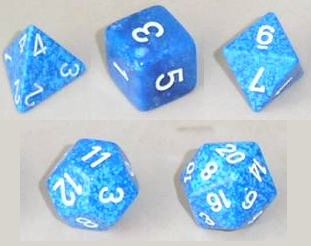


Defining properties
The defining characteristics of a Platonic solid are: identical regular polygonal faces, congruent vertices (the same configuration of faces at every vertex), and convexity. Each satisfies Euler's polyhedron formula V − E + F = 2 (vertices V, edges E, faces F). The combination of face shape and vertex arrangement makes only five distinct convex regular solids possible.
The five Platonic solids
- Tetrahedron
— 4 triangular faces, 4 vertices, 6 edges. The tetrahedron is self-dual and has the smallest number of faces.
- Cube (hexahedron)
— 6 square faces, 8 vertices, 12 edges. The cube is dual to the octahedron and is familiar from everyday objects.
- Octahedron
— 8 triangular faces, 6 vertices, 12 edges. Symmetry-wise it pairs with the cube as its dual.
- Dodecahedron
— 12 regular pentagonal faces, 20 vertices, 30 edges. It is the dual of the icosahedron and has higher face count and rotational symmetry.
- Icosahedron
— 20 triangular faces, 12 vertices, 30 edges. The icosahedron and dodecahedron form a dual pair with rich symmetry.
 — 4 triangular faces, 4 vertices, 6 edges. The tetrahedron is self-dual and has the smallest number of faces.
 — 6 square faces, 8 vertices, 12 edges. The cube is dual to the octahedron and is familiar from everyday objects.
 — 8 triangular faces, 6 vertices, 12 edges. Symmetry-wise it pairs with the cube as its dual.
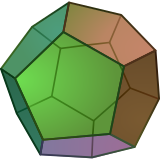 — 12 regular pentagonal faces, 20 vertices, 30 edges. It is the dual of the icosahedron and has higher face count and rotational symmetry.
 — 20 triangular faces, 12 vertices, 30 edges. The icosahedron and dodecahedron form a dual pair with rich symmetry.
History and cultural context
Platonic solids were studied in antiquity by the Pythagoreans and later by Plato, who linked them to the classical elements in the dialogue Timaeus. They reappeared in Renaissance art and in modern mathematics as examples of highly symmetric structures. Their study led to broader classifications of regular and semi-regular polyhedra and informed later work in topology and group theory.
Uses and notable facts
Beyond pure geometry, Platonic solids appear in models of molecular and crystal structures, in gaming (polyhedral dice), and in architectural and sculptural design for their aesthetic symmetry. Important mathematical facts include their dual relationships (cube–octahedron, dodecahedron–icosahedron, tetrahedron self-dual), and the theorem that no other convex regular polyhedra exist.
Related articles
Author
AlegsaOnline.com Platonic Solids: The Five Regular Convex Polyhedra Leandro Alegsa
URL: https://en.alegsaonline.com/art/77358