
Dodecahedron: geometry, types, history and uses
An introduction to the dodecahedron: its geometric properties, historical context, common variants, and applications in science, art and education.
A dodecahedron is a three-dimensional polyhedron with twelve faces. When those faces are congruent regular pentagons and the figure is fully symmetric, it is known as the regular dodecahedron — one of the five Platonic solids. The term appears in both elementary geometry and in broader contexts where any solid with twelve faces (not necessarily identical) is of interest.
Image gallery
10 Images
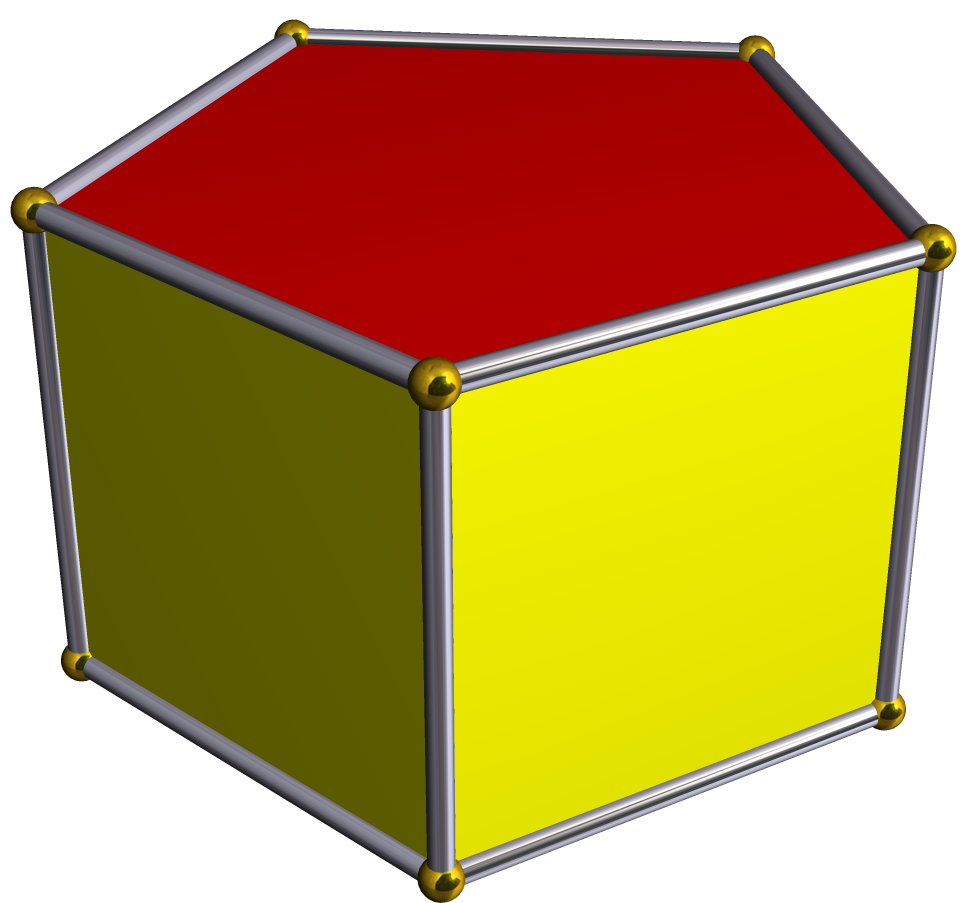


Key characteristics
- Faces: 12 (regular dodecahedron: regular pentagons) — see pentagon.
- Edges: 30 in the regular form.
- Vertices: 20, with three faces meeting at each vertex — see vertex for the concept.
- Symmetry and notation: the regular dodecahedron has Schläfli symbol {5,3} and is dual to the icosahedron.
- Topology: it satisfies Euler's formula V − E + F = 2 (20 − 30 + 12 = 2).
The regular dodecahedron is a highly symmetric solid. In geometric terms each face is identical and the arrangement appears the same from every face. Its symmetry group is one of the finite rotation groups in three dimensions, and the dual relationship with the icosahedron pairs their face and vertex structures.
History and cultural context
Classical Greek mathematicians studied regular polyhedra extensively. Plato associated the five regular solids with the classical elements and regarded the dodecahedron as linked to the cosmos. Later mathematicians and astronomers, including Kepler, explored polyhedral arrangements in attempts to explain planetary spacing and to understand spatial form. From the Renaissance onward polyhedra have been studied for their mathematical beauty and applied in artistic and architectural design.
Variants, related solids and distinctions
Not every twelve-faced solid is a regular dodecahedron. There are many dodecahedra with non‑pentagonal faces or with faces that are not congruent. Notable relatives include the rhombic dodecahedron (with twelve rhombic faces) and various Catalan and Johnson solids that have twelve faces of differing shapes. The regular dodecahedron stands out for its full transitivity on faces, edges and vertices; most dodecahedra do not share that high symmetry. See also the family of Platonic solids for context: Platonic solids.
Uses and examples
- Education and visualization: as a classroom model to teach symmetry, nets and Euler's formula.
- Recreational gaming: twelve‑sided dice (d12) are commonly used in role‑playing games.
- Natural forms and chemistry: some crystals, notably garnet, commonly show dodecahedral faces; synthetic molecules such as dodecahedrane reflect this geometry.
- Art, architecture and design: the dodecahedral form appears in sculpture, geometric art and in structural motifs for its pleasing symmetry.
Constructing a model often begins from a net of twelve pentagons or from assembling regular pentagonal faces so that three meet at each vertex. The dodecahedron continues to be a useful and attractive shape across disciplines because it combines aesthetic symmetry with simple combinatorial properties, and because it connects to broader themes in symmetry, group theory and polyhedral duality.
Related articles
Author
AlegsaOnline.com Dodecahedron: geometry, types, history and uses Leandro Alegsa
URL: https://en.alegsaonline.com/art/28155