
Octahedron
A polyhedron with eight faces. The regular octahedron has eight equilateral triangular faces, is dual to the cube, and appears in crystals, molecular structures, games, and design.
Overview
An octahedron is a three-dimensional polyhedron with eight faces. In its regular form each face is an equilateral triangle and the shape belongs to the family of Platonic solids. It can be visualized as two congruent square-based pyramids joined base-to-base. For a general definition of a polyhedron see polyhedron, and for the triangular faces common to the regular form see triangles.
Image gallery
10 Images


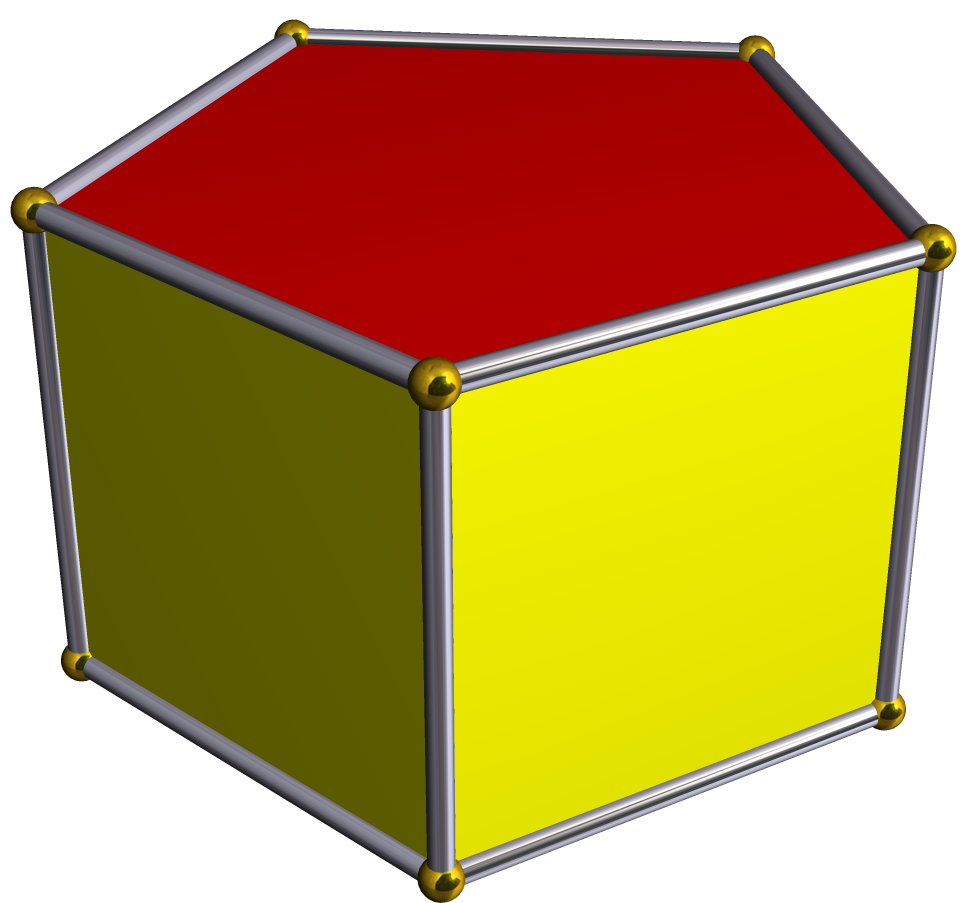



Structure and properties
The regular octahedron has eight triangular faces, twelve edges, and six vertices. Opposite faces are parallel and pairs of vertices lie along three mutually perpendicular axes through the center. As a highly symmetric solid it is the dual of the cube: each vertex of the octahedron corresponds to a face of the cube and vice versa. Variants and distorted octahedra appear when faces or angles are not all equal.
History and occurrence
Octahedral forms have been recognized since antiquity in studies of geometry and natural crystals. Classical authors associated the octahedron with one of the classical elements. In nature the octahedral shape is common in mineral crystals and in certain molecular arrangements. Notable minerals that commonly form octahedral crystals include diamond and fluorite, and more generally many crystals exhibit octahedral habits. In chemistry the term also applies to sixfold coordination geometries in compounds and complexes; see resources on chemistry for molecular examples.
Uses and examples
Because of its symmetry and aesthetic appeal the octahedron appears in architecture, sculpture, and manufacturing. In recreational gaming the common eight-sided die (d8) is an octahedron. In crystallography and materials science, recognizing octahedral habits helps identify mineral species and understand growth conditions. In coordination chemistry, octahedral geometry describes many coordination complexes with six ligands around a central atom.
Variations and related forms
- Regular octahedron: all faces equilateral triangles and full symmetry.
- Distorted octahedra: faces or edges differ but connectivity stays the same.
- Derived solids: truncation, stellation, and other operations produce related Archimedean or Catalan solids (for example, the truncated octahedron).
- Dual relationship: the octahedron is the geometric dual of the cube, linking their properties and symmetries.
Understanding the octahedron bridges pure geometry, natural science, and practical design. For further study consult introductory geometry texts or specialized material on polyhedra, crystallography, and molecular symmetry.
Related articles
Author
AlegsaOnline.com Octahedron Leandro Alegsa
URL: https://en.alegsaonline.com/art/71884
Sources
- doi.org : 10.1016/j.dam.2009.08.002
- ams.org : 2602814