
Point (geometry)
A point is the basic notion of position in geometry: an entity without size that specifies location. This article explains its properties, notation, roles in different geometries, and common applications.
A point is the simplest concept used to denote a precise location in a geometric setting. It marks where something is but does not occupy any measurable extent. In ordinary language one might say a point gives a position in space. In formal mathematical treatments the idea appears within geometry as an element that has no size—no length, area, or volume—yet it can be distinguished from other points by its coordinates or by a label.
Image gallery
4 Images


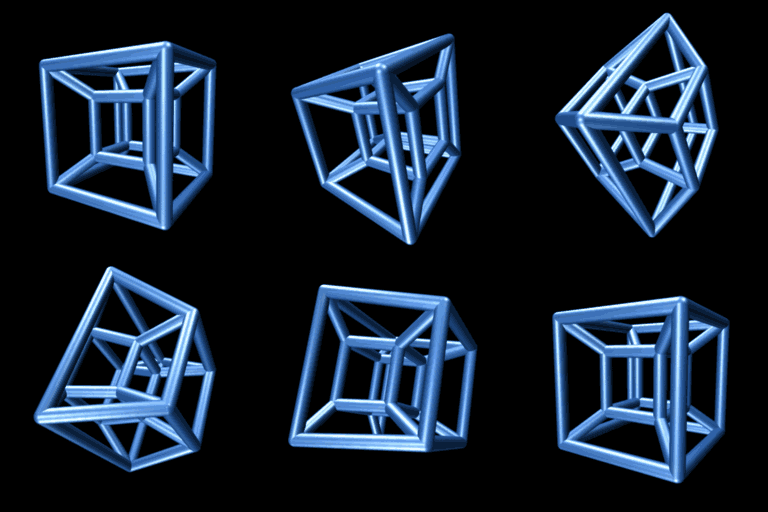
Basic characteristics and notation
Points are usually represented diagrammatically by a small dot or cross and labeled with capital letters such as A, B, C. Because points lack extent they have no volume, area, or length. Two or more points can be described by simple relations: coincident (identical), distinct, collinear (on the same line), coplanar (on the same plane), or concyclic (on the same circle). These relations are the foundation for defining lines, segments, angles and other geometric objects.
Axiomatic status and historical note
In Euclid's Elements the point is treated informally and left essentially undefined; it serves as a primitive term used in axioms and propositions. Modern axiomatic systems (Euclidean, affine, projective) likewise take points as primitive objects with rules about incidence and order. Different geometries may enrich the notion: for example, projective geometry adds "points at infinity" that represent directions, while topology considers points as elements of a set with a notion of nearness rather than size.
Coordinates and analytic viewpoint
In analytic geometry a point is identified by an ordered tuple of numbers. In the plane a point has coordinates (x, y) and in space (x, y, z), allowing algebraic computation of distances, midpoints and intersections. Coordinate systems such as Cartesian or polar are tools for giving concrete descriptions of points and for translating geometric relations into equations. Vectors often represent points relative to an origin and facilitate transformations, translations and rotations.
Uses, examples and practical importance
Points serve as the building blocks of all geometric constructions. They specify vertices of polygons, centers of circles, intersection points of curves and sample locations in numerical simulations. In computer graphics and CAD, points (often as arrays of coordinates) underpin mesh vertices, control points for splines and the placement of objects. In navigation and mapping, points locate waypoints and landmarks.
Distinctions and special cases
- Coincident points: two labels denoting the same location.
- Distinct points: different locations that determine lines and segments.
- Collinearity and concurrency: three or more points on a single line; lines passing through a common point are concurrent.
- Points at infinity: in projective settings, parallel lines meet at an ideal point, extending incidence rules.
For concise introductions and formal definitions consult elementary texts and reference treatments. General discussions of location and representation appear in resources on Euclidean and projective geometry, analytic geometry, and topology: see related overviews at introductory materials, surveys of foundations, coordinate methods at analytic geometry, and applications in computation and design at computational geometry and computer graphics.
Related articles
Author
AlegsaOnline.com Point (geometry) Leandro Alegsa
URL: https://en.alegsaonline.com/art/77623